Unfortunately, the past financial year has been disappointing for investors exposed to shares, with global shares returning -2.1% in local currency terms and Australian shares returning -6.7% as worries about the economic outlook continued to weigh.
The star performers were Australian and global fixed interest, which returned 12.4% and 11.6% respectively, with bond yields in Australia, the US, UK and Germany falling to record lows on the back of safe haven demand and as expectations for short term interest rates were revised down.
Assets like Australian real estate investment trusts (which returned +11%) and directly held non-residential property (which returned around +8.5%) also provided solid returns.
Obviously the big question is whether the new financial year will see an improvement in share market returns. Another is whether Australian shares have lost their mojo, having underperformed global shares since October 2009.
Drivers of global weakness
The drivers of the poor ride in shares over the last year are well known, with markets hit twice with global growth worries:
- The September quarter last year saw an intensification of worries about the European debt crisis combine with a blow to confidence from the downgrading of America’s credit rating and a soft patch in US economic data at a time when emerging countries were also slowing due to policy tightening to deal with inflation problems.
- Policy stimulus saw a relief rally into year end 2011 and through the March quarter this year.
But this again gave way to renewed worries about the global growth outlook as the European debt crisis returned (for a third year), on the back of worries about a Greek exit from the euro and with the focus switching to Spain, US economic data entered another soft patch and growth in the emerging world continued to slow.
Although all of the damage was actually done during the second half of last year, with share markets actually up so far this calendar year, the end result has been a difficult financial year for most share markets and commodity prices, but the sharp rally in Government bonds in perceived safe countries resulted in strong returns for bond funds.
While US shares returned +5.4% helped by very easy monetary conditions and reasonable profit growth, European shares returned -16.2%, emerging market shares lost-6.6% and global shares generally lost -2.1%.
But why have Aust shares underperformed?
After outperforming global shares through the last decade, Australian shares have underperformed since October 2009, resulting in a three year return to June of 5.6% pa compared to 10.1% pa for global shares in local currency terms. At first glance this seems inconsistent with the relatively stronger performance of the Australian economy. However, there are essentially three reasons for the underperformance:
- Relatively high interest rates in Australia have made it attractive for Australian investors to park their savings in bank term deposits as opposed to shares and acted as a drag on demand for things like retail sales and housing. This contrasts with the US which has seen interest rates stay near zero, resulting in little incentive to invest in bank deposits and encouraging consumers to spend.
- The relatively strong $A has served to depress earnings for companies exposed to trade or with offshore operations. This contrasts with companies in the US which have benefitted from a fall in the value of the $US. (Note that the rise in the $A has also cut the returns from global shares if measured in Australian dollars over the last three years, but not over the last year.)
- Finally, worries about a hard landing in China have weighed on commodity prices & perceptions of Australia.
Real GDP growth in Australia over the year to the March quarter was a strong 4.3% and, apart from being boosted by a bounce back from last years floods, reflects strong growth in parts of the economy that the share market is not highly exposed to (such as health) or mining investment, whereas the combination of high interest rates, the strong Australian dollar and worries about China and falling commodity prices have borne down on sectors of the economy to which the share market is highly exposed such as retailing, building materials, large cap industrials and mining stocks.
Outlook – global
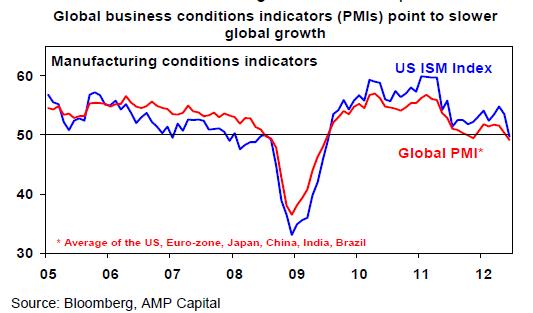
Global business conditions indicators point to a distinct slowing in global growth. See next chart. But they remain well above previous cyclical lows and while the risks have increased our assessment is the global recovery will continue but will remain constrained and fragile.
- The Euro-zone is the weakest link, but there have been some positive developments. The Greek election result has avoided a messy exit from the euro for now and the EU summit turned out better than expected with measures to allow bailout funds to be used more flexibly and a move towards a banking union. These moves should reduce the risk of Europe spiralling into a deep recession. However, Europe is still just muddling along: a fiscal union allowing common financing is a long way off, Greece remains a periodic threat and recession continues. So Europe remains a source of volatility. We see the Euro-zone contracting 1% this year.
- The pace of US economic growth appears to have stepped down to around 1.5% during the June quarter. However, there are several reasons to believe the fragile US recovery will continue: further soft US data will trigger more monetary easing from the Fed; the US housing sector appears to be gradually recovering; the shale oil phenomenon is potentially very positive for the US; and the slump in the June ISM may reflect the recent flow of bad news out of Europe. We see US growth running around 2%, notwithstanding the current soft patch.
- Having recovered from recession last year, Japanese indicators point to growth averaging around 1% pa.
- A big part of weakness lately relates to the emerging world. This has reflected the impact of policy tightening to control inflation in 2010 and 2011, reduced export demand as well as structural considerations with China shifting to a focus on quality growth and a lack of reforms dragging on India. However, with inflationary pressure fading and in the absence of debt problems, emerging countries have plenty of scope to ease policy and stimulate growth, which we expect to continue. Growth in the emerging world is expected to average 5% pa.
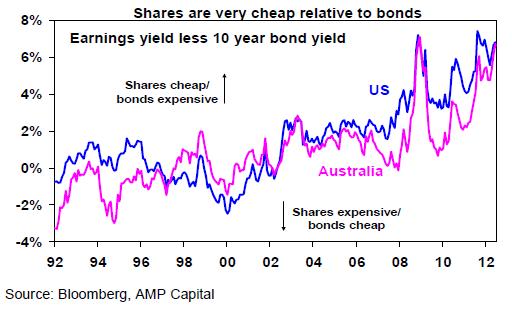
Overall this suggests something like 3% global growth. Not brilliant but enough to underpin modest profit growth over the year ahead. With shares cheap and monetary conditions easing this should see share markets move higher over the next 12 months, albeit further short term volatility is likely. The forward PE on global shares and Australian shares is now 10.8 times, which is well below historical norms and the gap between the forward earnings yield on shares and the 10 year bond yields in the US and Australia is almost as wide as it was in the GFC.
Outlook – Australia
The bad news is that more profit downgrades from Australian companies are likely in and around the August reporting season, reflecting the tough operating environment they remain in.
The good news though is that the three big drags on the relative performance of Australian shares are starting to fade. Interest rates have fallen 1.25% since last October and are likely to fall further leading to lower term deposit rates and providing a boost to spending. The $A is off its highs and the days of strong rises are behind us. And China is starting to ease, which should lead to a reduction in worries about a Chinese hard landing ahead. Combined, this should lead to a better operating environment for Australian companies into year end and through next year.
There are already tentative signs that lower interest rates are working in Australia with better data for housing approvals and retail sales. Australian shares as indicated in the previous chart remain cheap, particularly at a time when the yields on bonds are at record lows and term deposits rates are falling.
Historical context
Some historical context may be of use. The table below compares top to bottom falls in all bear markets in Australian shares since 1900. I have defined a bear market as a 20% or greater fall that is not fully reversed within a year of the low. So unless the All Ords index rises above its April 2011 high of 5065 by early September then the 22% slump from April 2011 to last September’s low constitutes a new bear market.
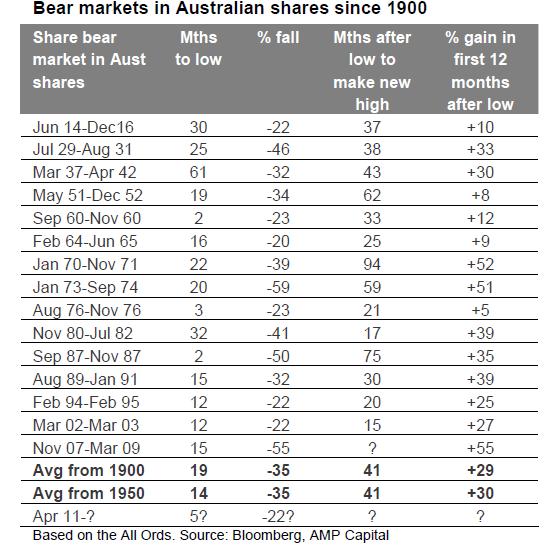
Since 1900, bear markets in Australian shares lasted an average 19 months with an average top to bottom fall of 35%. The average time taken to reach a new high once the low is in is 41 months but with deep bear markets tending to take longer. The bear market that began in April last year was relatively short at 5 months and saw a lower than average fall. This is probably because a lot of damage was already done by the bigger bear market from 2007, from which we are yet to fully recover.
In terms of the recovery from the GFC bear market, the recovery from the 1973-74 bear market is relevant. Back then it took 59 months (or nearly 5 years) to make a new high. So far we have completed 39 months, suggesting we are maybe two thirds of the way there. But these historical statistics are only a very rough guide and I suspect it will take longer than 20 months to get back to the 2007 high.
Concluding comments
After worries about the global growth outlook and added constraints on Australian shares, share markets are now very cheap compared to traditional defensive assets like bonds and should benefit over the next financial year even though the broad environment is likely to remain one of constrained growth and volatile returns. By contrast very low bond yields point to very constrained returns from bonds.
5 July 2012

 CPD: A TTR strategy for modern retirement
 CPD: Trend following in uncertain times
 CPD: Aged care advice and ethics
 CPD: AI governance – a practical framework for advisers
 CPD: Thinking outside the box – providing a loved one a paycheque for life
Market outlook after a rough financial year
Unfortunately, the past financial year has been disappointing for investors exposed to shares, with global shares returning -2.1% in local currency terms and Australian shares returning -6.7% as worries about the economic outlook continued to weigh.
The star performers were Australian and global fixed interest, which returned 12.4% and 11.6% respectively, with bond yields in Australia, the US, UK and Germany falling to record lows on the back of safe haven demand and as expectations for short term interest rates were revised down.
Assets like Australian real estate investment trusts (which returned +11%) and directly held non-residential property (which returned around +8.5%) also provided solid returns.
Obviously the big question is whether the new financial year will see an improvement in share market returns. Another is whether Australian shares have lost their mojo, having underperformed global shares since October 2009.
Drivers of global weakness
The drivers of the poor ride in shares over the last year are well known, with markets hit twice with global growth worries:
But this again gave way to renewed worries about the global growth outlook as the European debt crisis returned (for a third year), on the back of worries about a Greek exit from the euro and with the focus switching to Spain, US economic data entered another soft patch and growth in the emerging world continued to slow.
Although all of the damage was actually done during the second half of last year, with share markets actually up so far this calendar year, the end result has been a difficult financial year for most share markets and commodity prices, but the sharp rally in Government bonds in perceived safe countries resulted in strong returns for bond funds.
While US shares returned +5.4% helped by very easy monetary conditions and reasonable profit growth, European shares returned -16.2%, emerging market shares lost-6.6% and global shares generally lost -2.1%.
But why have Aust shares underperformed?
After outperforming global shares through the last decade, Australian shares have underperformed since October 2009, resulting in a three year return to June of 5.6% pa compared to 10.1% pa for global shares in local currency terms. At first glance this seems inconsistent with the relatively stronger performance of the Australian economy. However, there are essentially three reasons for the underperformance:
Real GDP growth in Australia over the year to the March quarter was a strong 4.3% and, apart from being boosted by a bounce back from last years floods, reflects strong growth in parts of the economy that the share market is not highly exposed to (such as health) or mining investment, whereas the combination of high interest rates, the strong Australian dollar and worries about China and falling commodity prices have borne down on sectors of the economy to which the share market is highly exposed such as retailing, building materials, large cap industrials and mining stocks.
Outlook – global
Global business conditions indicators point to a distinct slowing in global growth. See next chart. But they remain well above previous cyclical lows and while the risks have increased our assessment is the global recovery will continue but will remain constrained and fragile.
Overall this suggests something like 3% global growth. Not brilliant but enough to underpin modest profit growth over the year ahead. With shares cheap and monetary conditions easing this should see share markets move higher over the next 12 months, albeit further short term volatility is likely. The forward PE on global shares and Australian shares is now 10.8 times, which is well below historical norms and the gap between the forward earnings yield on shares and the 10 year bond yields in the US and Australia is almost as wide as it was in the GFC.
Outlook – Australia
The bad news is that more profit downgrades from Australian companies are likely in and around the August reporting season, reflecting the tough operating environment they remain in.
The good news though is that the three big drags on the relative performance of Australian shares are starting to fade. Interest rates have fallen 1.25% since last October and are likely to fall further leading to lower term deposit rates and providing a boost to spending. The $A is off its highs and the days of strong rises are behind us. And China is starting to ease, which should lead to a reduction in worries about a Chinese hard landing ahead. Combined, this should lead to a better operating environment for Australian companies into year end and through next year.
There are already tentative signs that lower interest rates are working in Australia with better data for housing approvals and retail sales. Australian shares as indicated in the previous chart remain cheap, particularly at a time when the yields on bonds are at record lows and term deposits rates are falling.
Historical context
Some historical context may be of use. The table below compares top to bottom falls in all bear markets in Australian shares since 1900. I have defined a bear market as a 20% or greater fall that is not fully reversed within a year of the low. So unless the All Ords index rises above its April 2011 high of 5065 by early September then the 22% slump from April 2011 to last September’s low constitutes a new bear market.
Since 1900, bear markets in Australian shares lasted an average 19 months with an average top to bottom fall of 35%. The average time taken to reach a new high once the low is in is 41 months but with deep bear markets tending to take longer. The bear market that began in April last year was relatively short at 5 months and saw a lower than average fall. This is probably because a lot of damage was already done by the bigger bear market from 2007, from which we are yet to fully recover.
In terms of the recovery from the GFC bear market, the recovery from the 1973-74 bear market is relevant. Back then it took 59 months (or nearly 5 years) to make a new high. So far we have completed 39 months, suggesting we are maybe two thirds of the way there. But these historical statistics are only a very rough guide and I suspect it will take longer than 20 months to get back to the 2007 high.
Concluding comments
After worries about the global growth outlook and added constraints on Australian shares, share markets are now very cheap compared to traditional defensive assets like bonds and should benefit over the next financial year even though the broad environment is likely to remain one of constrained growth and volatile returns. By contrast very low bond yields point to very constrained returns from bonds.
5 July 2012
Print
email
Tags:AMP Capital market commentary Oliver's Insights Shane Oliver
Latest Articles