Investors like to make money and for many years, the companies yielding the best returns may not have always been responsible corporate citizens. History is littered with shining examples of corporate profits taking precedence over ‘doing the right thing’, whether by the people, the environment or through good corporate governance.
A greater focus on ‘responsible investing’ has seen many companies becoming good corporate citizens; examples include companies that rejuvenate land they have mined or contribute to the wellbeing of communities in which they operate.
Increasing investor appetite for such companies led to the emergence of a number of funds, varying described as ‘ethical’, ‘socially responsible’ or simply ESG (which stands for environment, social and governance). Each year, Lonsec researches and rates a number of funds so categorised, to help advisers find the applicable products for their clients.
How to categorise ‘responsible’ funds
The following broad definitions are a guide:
- Ethical: Negative screening of companies in certain industries deemed to have a harmful societal impact. Avoiding investments in bad companies is the overarching investment motivation.
- Socially Responsible Investing (SRI): Generally negative screening of certain sectors in line with above but may also include a positive screening element seeking to include socially responsible companies. Rewarding good corporate citizens is a partial investment motivation.
- Sustainable investing (ESG): A belief that those companies with advanced approaches to environmental, social and governance risk management will exhibit superior performance than companies with sub optimal approaches. While it is likely that these companies will tend to rank highly on corporate ethics, unlike ethical investment, financial performance is the overarching investment consideration.
Lonsec takes fund categorisation a step further, focusing on the depth of responsible investment factors incorporated into the investment process; the output of which is a light, medium or dark green rating.
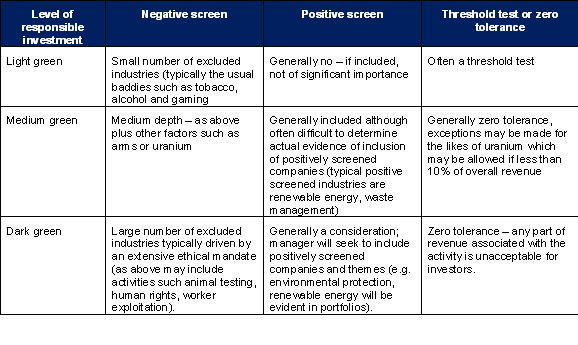
These classifications are aimed to give a general indication of Lonsec’s assessment of the level of ethical / Socially Responsible Investing (SRI) / Environmental, Social and Governance (ESG) criteria applied to, and evident in, the Manager’s investment process. The classification is not intended as an investment rating or recommendation.
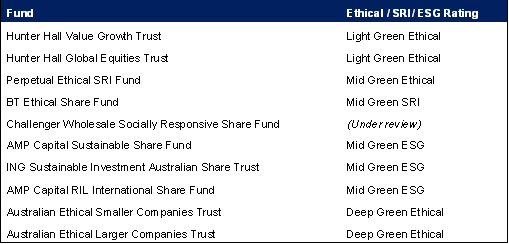
Lonsec categorises the funds in its Responsible Investment universe as follows:
Client considerations –not a one-size fits all
ESG and sustainable investment funds now tend to dominate the Responsible Investment sector replacing traditional ethical and SRI approaches. Broadly, the market seems to have less appetite for funds focused solely on avoiding corporate bad guys compared to those investing in sustainable companies.
Despite progress, the sector still presents challenges for those providing financial advice. Investors in this sector are broadly grouped together under a ‘Responsible Investment’ categorisation, though bring different investment motivations which can make it tricky for advisers to confidently select investment managers for clients. Importantly, Lonsec believes that with some research, responsible investment investors can relatively easily determine a more suitable investment option for their needs than provided by a mainstream equities fund. The following are suggested priority areas for consideration in discussion with clients interested in this sector:
How Green is my client? It is important to sample investors’ green motivations. While Responsible Investors are commonly linked by a motivation to take account of a broader range of factors than solely fundamental financial analysis in their investment decisions and a concern about the community impact of corporate activities, the investment motivations can vary greatly across the sector. Ethically motivated investors may be aggrieved to allocated capital to major miners such as BHP and RIO, while ESG investors may be comfortable with such holdings given those companies’ risk management practices, community engagement, workplace safety record and so forth.
Does investment team buy-in matter? The level of ESG engagement in portfolio management teams varies across the sector. Lonsec believes this aspect is an important credibility test for investment managers and most likely a central consideration for investors in these products. In general a portfolio manager who is motivated and engaged with the Responsible Investment agenda brings added focus to the fund and is an important factor in increasing alignment of interest with investors. While Lonsec is primarily interested in the investment credentials of the Manager, whether the investment team is displaying a degree of engagement with the responsible investment sector is a relevant consideration in Lonsec’s appraisal of these products. This may be evident through the inclusion of positively screened companies at the margins of the portfolio where supported by the underlying investment research. Factors such as elevated corporate commitment to the sector, evident in participation in industry forums, production of research papers and company engagement can also suggest increased motivation.
Manage performance expectations. Spend some time with clients to discuss performance expectations. The depth of ethical screen can significantly constrain the investment universe and may have a performance impact during periods when certain sectors outperform (e.g. materials). Similarly, the screen can make it challenging to obtain adequate diversification in portfolios. The inclusion of a significant weighting to small caps in some funds may alter the risk/return characteristics of funds (e.g. resulting in higher tracking error versus traditional large cap core Australian equity funds).