

Editors Note
The AFA, in partnership with NAB Financial Planner Banking, commissioned the “Tides of Change” research to better understand the current mindset of advisers and to understand their views around the impacts of impending FOFA reforms. This is important to both the AFA and NAB as we both work across the market and need to better understand the likely impacts on adviser businesses and how we can assist in this transition period.
1 Executive Summary
The financial advice industry is facing one of the biggest operational overhauls in history. Advisers face two choices: they can either adapt to the changing environment, or become irrelevant as the industry moves forward regardless.
However if the overhaul is to be successful, advisers must be given a voice and their praise, concerns and opinions taken on board as part of the broader consultation process.
The focus of the research on which this white paper is based ‘takes the pulse’ of financial advisers across Australia to find out which reforms they support, which they reject, and what they see as the best way forward.
This paper presents advisers’ views in the context of the various arguments in favour of and in opposition to the reforms currently on the table.
- The central proposition of the white paper is that financial advisers, while supportive of furthering education and professional standards, believe some of the Government’s key proposals will increase paperwork, drive up costs and undermine the long term nature of advice. They fear that rather than safeguard consumers, the intra-fund advice reform could put people at risk of receiving inappropriate advice that does not take account of broader financial circumstances and that the opt-in reform will put upwards pressure on the cost of advice.
The key research findings include:
The Future of Financial Advice Reforms
- Adviser support is strongest for the introduction of a statutory fiduciary duty and weakest for the proposed annual opt-in reform.
- The advice industry is divided over the prospective ban on commissions, with two in five advisers opposing the reform (42.8%) and a further 36.1% strongly supporting it.
- While the majority of respondents (56.9%) anticipate a negative impact on them, one quarter of respondents (25.2%) feel the ban will have a positive impact on their clients and almost one third (30.5%) say it will have no impact.
- Of all the reforms, respondents are most opposed to the proposed requirement for clients to opt-in annually, with three in five (59.2%) giving a rating of 0-3 out of 10. Practice principals are the most likely to not support the reform (64.5%).
- Contrary to the opt-in reform, there is strong support for the introduction of a statutory fiduciary duty for financial advisers, with three quarters (76.2%) indicating strong support.
- There is considerable opposition to the expansion of low-cost simple advice, with more than half of respondents (57.2%) not supporting the intra-fund advice reform. Practice principals are the most likely to foresee intra-fund advice having a strong negative impact on them (22.3%), while almost half (47.1%) expect a negative impact on their practice.
Adviser Profile and Education
- Three in five respondents (62.4%) are likely to undertake further study within the next two years and 61.6% are likely to undertake further study within the next five years.
- Areas of future study include: accountancy, Advanced Diploma of Financial Services (Financial Planning), risk qualifications and SMSF specialty courses.
- The most commonly held qualification is the Diploma of Financial Planning (40.6%), followed by RG146 (37.9%), the CFP designation and University undergraduate degree (both 35.2%).
- Beyond product and strategy, four in five advisers (83.3%) say providing peace of mind is the key benefit of advice – however this was only identified as a key benefit by 39.1% of consumers.
- The majority of respondents (57.2%) believe hard and soft skills are equally important. A further third (34.5%) view soft skills as more important.
- The older generations remain the core of advisers’ client bases. Boomers (45.8%) and pre-boomers (20.8%) account for the large majority of adviser business, while Generation X account for one quarter (25.3%) and Generation Y just 8.2%.
- Retirement planning is the main area on which advisers provide advice to clients (25.7%), followed by insurance and risk protection (23.1%) and superannuation (21.4%).
- More than half of respondents (57.0%) consider themselves to be a ‘generalist’ while two in five (43.0%) consider themselves a ‘specialist’.
Future of Practices
- Three quarters of practice principals (77.8%) are likely to grow their business within the next two years. Propensity to sell the business and leave the industry are both low (78.9% unlikely and 83.0% unlikely, respectively).
- Organic growth is the preferred growth route (75.7%), while finding the right client base is perceived as the biggest challenge to achieving growth.
- Three in five practice principals (61.4%) have referral partnerships in place.
Threats to the Industry
- The reforms, government intervention and competition from other providers are considered the biggest threats to the planning industry.
- Compliance and administration is considered the key issue for the majority of advisers (64.1%), followed by regulatory change endangering adviser profits (61.4%).
- Compliance costs/time is considered the most important challenge faced by advisers, followed by attracting new clients.
2 Introduction
The framework for reform of the financial advice industry has largely been built with the client in mind – and rightly so. At the heart of the Government’s Future of Financial Advice (FoFA) reforms is a desire to put the consumer first and increase the accessibility of advice among the broader population.
The reforms have been hovering over the industry like a helicopter on a shark-spotting mission, and few people could claim to have not seen them coming. In the Government’s eyes, the global financial crisis and the casualties left in its wake provided a mandate for change and an opportunity to give an industry that aspires to become a profession the impetus to make this happen.
But in the midst of all the ‘white noise’ surrounding the reforms, the voice of the adviser has been barely audible. What impact will the reforms have on them, their clients and their business? Is legislating really the answer to achieving best practice advice?
Let’s consider for a minute what the Government is proposing.
Three key reforms will apply from 1 July 2012:
- A prospective ban on conflicted remuneration structures, including commissions and any form of volume-based payment. In addition, percentage-based fees or assets under management fees can only be charged on ungeared products or investment amounts.
- The introduction of a statutory fiduciary duty for financial advisers requiring them to act in the best interests of their clients and to place the interests of their clients ahead of their own when providing personal advice to retail clients.
- The introduction of a requirement for clients to agree to the fees they pay for advice and to annually renew (by opting in) to an adviser’s continued services.
The reforms also significantly expand the provision of low-cost simple advice – or intra-fund advice – to areas including transition to retirement and the nomination of beneficiaries.
Former minister for financial services and superannuation, Chris Bowen, who announced the reforms before the formation of the new minority Government and subsequent cabinet reshuffle, said the reforms would greatly reduce the incidence of advisers recommending financial products
based on the sales incentives – rather than providing advice that is in clients’ best interests.
It’s an admirable goal, but it remains to be seen whether legislation is the answer, and the various interested parties have hugely divergent views about the impact the reforms will have.
Much of the discussion following the announcement of the reforms has centered on the remuneration debate; a debate that has plagued advisers and the advice industry for some time.
Treasury has begun consultation on the implementation of FoFA via a peak consultation group comprising industry and consumer representatives, as well as Australian Securities and Investments Commission (ASIC) officials.
But reaching a consensus view is likely to prove incredibly difficult, if not impossible.
The Association of Financial Advisers (AFA) has a strong view that consumers should be given a choice as to how they pay for advice and is opposed to a blanket ban on commissions.
The theory, backed up by consumer research commissioned by the AFA in April 2010, is that people don’t necessarily want to pay for advice in one particular way. What they do want, however, is value for money and to ensure that the cost of advice is both transparent and agreed
with them up front.
The consumer research, carried out by CoreData-brandmanagement, revealed that the most preferred method of payment was a fee determined by the service provided, however, this was still only selected by one in five people.
On the other hand, the Industry Super Network (ISN) has long argued for a ban on commissions paid to financial advisers, pointing to conflicts of interest and hidden costs that are detrimental to clients’ long term financial situation.
But while the remuneration debate has been the most emotionally charged argument of the last decade, it is the annual opt-in reform that has caused the biggest stir among the adviser community since the reforms were announced.
It’s the practical implementation, rather than the concept, that is the sticking point here, and it’s where the reform could do more harm than good if the Government is not careful.
The AFA is likewise wary of the impact the ‘opt-in’ could have on advisers and their businesses, particularly from an administrative and compliance point of view.
In fact advisers themselves, the NAB Financial Planner Banking/AFA’s adviser research shows, are fiercely opposed to the reform, fearing it will adversely impact both them and their clients.
Just like the remuneration debate, the opt-in has proved divisive among the financial services industry.
Proponents of the opt-in argue that it is the lynchpin of the Government’s reforms.
The perception of the supporting camp is that the annual review mechanism is a safeguard to ensure that the client continues to agree to fund ongoing advice fees as a deduction from their investments and is the only way in which asset-based fees can be permitted within the future
advice regime.
These are among some of the arguments set to be put to the Government throughout its consultation process.
This paper sets out to explore the views of financial advisers, who will ultimately be responsible for turning these ideas into outcomes, and assesses the perceived impact of such changes on advisers, clients and practices. This paper was a joint initiative of the AFA and NAB Financial
Planner Banking, a key industry participant and specialised unit within NAB’s Business Bank that provides banking solutions to over 1,100 financial planning business owners.
3 Methodology
The main information source used for the Tides of Change white paper was an online survey of financial adviser sentiment towards the raft of changes facing the industry.
The NAB Financial Planner Banking/AFA’s Future of Financial Advice study was carried out in August 2010 and was sent to CoreData-brandmanagement’s proprietary panel of around 16,000 Australian financial advisers; the AFA’s database of 5,000 members and over 1,100 financial planning business owners who are NAB Financial Planner Banking customers.
Some 1,343 financial advisers responded to the survey and results were analysed with segmentation based on adviser type (eg practice principals, tied advisers, independent advisers and paraplanners).
Statistically significant differences and associations were calculated using Chi square tests, TTests and ANOVA and are indicated by p<0.05.
AFA 2010 Adviser Research focus
The primary objective was to better understand:
- What impact the Future of Financial Advice reforms will have on advisers, their clients and their business
- Whether advisers have plans to grow/sell their practice or leave the industry in the short term
- What role professional associations play in the advice industry
- What role dealer groups play and what services are most valued
- Perceived threats to the planning industry
- Remuneration models used and services offered
- Key challenges facing advisers and their practices
- Education standards and propensity for further study
- Importance of hard vs. soft adviser skills
- Key benefits of advice beyond product and strategy in the eyes of the adviser
- Perceptions of the role of an adviser
- Client segments – by wealth and generation
- How the needs of Generation Y differ from other generations
In forming the white paper, publicly available information was also drawn on to help assess the arguments for and against the changes facing the planning industry.
4 Opt-in or Opt-Out?
The theory behind forcing clients to ‘opt in’ is simple: if you’re selling a service that’s valuable, then your clients will recognise this and continue to come back for more.
Just like any other service profession, requiring clients to ‘opt in’ on an annual basis ensures that advisers are only remunerated where a service is actually being provided.
The central proposition behind the reform is that advisers should not be able to piggy back off clients who are none-the-wiser – in other words, those people who are paying a trail commission for which they are no longer receiving a benefit.
The Government’s proposal requires advisers providing an ongoing service to clients to send an annual renewal notice to the client for sign off. If the client does not renew the services, the adviser cannot continue to charge the client.
Transparency and efficiency are at the heart of this, and the other FoFA reforms, however as with any reform, there will be unintended consequences.
Advisers exist for a number of reasons, one of the most pertinent being to save people from making bad choices.
Consumer research carried out by CoreData-brandmanagement earlier this year on behalf of the AFA revealed that ‘helping to make the big decisions’ is considered the number one benefit of advice beyond product and strategy – both by those who use an adviser and those who don’t.
During the global financial crisis, investors largely exhibited two behaviours: there were those that chose to exit the market, and store all their assets in cash (who we term the ‘frozen’), and there were those that saw the market freefall as an opportunity to buy quality assets at a discount (who we term the ‘ambitious’).
CoreData-brandmanagement’s research on the high net worth investor segment clearly shows that those who remained in the market, and even used the crisis as a chance to buy new assets, have benefited significantly from the recovery, while those who froze have achieved much lower
returns, and are in many ways no better off than they were 12 months ago.
There is a lesson in this which has major implications for the opt-in requirement for consumers seeking advice, the caveat being that those who responded aggressively to the downturn (the ambitious) were significantly more likely to be self-directed.
Had the opt-in requirement existed at the height of the GFC, many advisers’ clients – having experienced significant portfolio losses, as most people did – would have chosen to cut their losses and run.
They would have declined to opt in and instead run for cover, and would now be considerably worse off for the decision.
One of the most difficult tasks advisers have is to convince their clients to think long term when making investment decisions.
It is human nature to want to bring pleasure forward; to make choices that result in immediate pleasure (even if that also means future pain), rather than deferring that pleasure to a later date.
But it’s pertinent in the context of investments to make a decision and stick with it. We all know share market cycles run for seven years, and we also know that investing for short term gain involves a lot of risk – often for little gain.
Hence it could be argued that asking clients to ‘opt in’ annually flies in the face of the long term nature of advice.
Indeed, of all the FoFA reforms, adviser support is weakest for the opt-in reform as outlined in Figure 1 below.
The NAB Financial Planner Banking/AFA’s adviser research revealed considerable opposition to the proposed annual opt-in requirement, with three in five advisers (59.2%) opposing the reform (based on a support rating of 0-3 out of 10).
Practice principals are the most likely to not support the reform (64.5%), while paraplanners are the most likely to support it (31.6%) (p<0.05).

The opt-in reform is expected to have a negative impact on both advisers and their clients.
Almost three in four advisers (71.1%) expect the reform to have a negative impact on them, while three in five (59.8%) expect it to have a negative impact on their clients.
Almost two thirds of practice principals (63.5%) anticipate the reform having a negative impact on their clients – with almost one third (31.0%) anticipating a strong negative impact.
The reasons for opposing the reform are many and varied, however in almost all cases, the reform is expected to create more paperwork for both clients and advisers and is seen as not in keeping with the long term nature of advice.
Verbatim comments from advisers who oppose the opt-in reform:
“As if there’s not enough paperwork to do. This industry is turning into the legal profession where clients are charged for faxes and reading paper…let’s not go down this path.” (Practice Principal, NSW)
“More paperwork on top of mountain of compliance already subjected to.” (Tied Adviser, Vic)
“This is about the stupidest recommendation of the lot. Having to annually re-sign all clients will be a major administrative burden. Very poorly thought out.” (Independent Financial Adviser, Vic)
“Financial planning is about long term, strategic partnerships with clients. In an age where everyone expects instant gratification or results, this initiative completely misses the mark. Clients should have the right to turn off trails at any stage anyhow so I fail to see what this achieves but
creating more administrative / compliance work that adds no value & drives the price of advice up due to the time taken to deliver advice.” (Practice Principal, NSW)
“My advice is strategic, and therefore is based on a long-term view and impact, and I do not start to make any sort of income until year 2 or 3 or even later. This reform puts me in the same position as a shoe salesman, selling something with an effectively ‘1-year guarantee’!” (Independent Financial Adviser, NSW)
There’s also considerable concern that contrary to benefiting clients, the reform will in fact increase fees and charges due to the additional administrative work required to comply with the legislation.
Some advisers question the need for the reform in a no-commission world; and frankly, they have a point.
“Annual opt in will be impossible to monitor and implement without additional costs being passed on to clients. Opt in should be automatic and ongoing until terminated by client.” (Tied Adviser, Qld)
“Cost of administering this will ultimately have to be passed on to clients. Any clients who do not re-sign agreements will lose the right to proactive advice and may miss out on the benefits our service provides.” (Independent Financial Adviser, Tas)
“It will be a major logistical cost to the business which will need to be paid for by the client. Once commissions are gone, and clients can opt out, there is no need for this regime.” (Practice Principal, NSW)
4.1 A Better Solution?
While in theory the opt in is a positive development for an industry that has for many years failed to articulate the value of advice to the majority of the population in a way that resonates, there are practical implications that must be considered.
Take, for example, a client who has a margin loan, who fails, for whatever reason, to opt in when it comes time for the annual paperwork to be filled out.
Then, six months later, that client receives a margin call on their loan. Technically, since the client has not opted in, they are no longer a client, so what does the adviser do when they’re notified of the margin call?
The majority of advisers would feel morally obliged to advise their ‘ex-client’ regardless, but this would then be done at a cost to their business, since they are no longer being remunerated for their service.
The logical alternative touted by the adviser community is to mandate an ‘opt out’ system whereby clients who are unhappy with the service they are receiving can choose to no longer receive the service.
This alternative would not only reduce the paperwork for both advisers and clients but it also comes at no cost, removing the need for advisers to increase the fees charged to clients to cover the cost of the reform.
Essentially, this option already exists and is the basic right of any customer; however in the past the existence of trail commissions has prevented the ability to turn off the commissions tap – whether the client is receiving reciprocal benefits or not.
In an environment where trail commissions are banned, there would no longer be a barrier to opting out.
Verbatim comments from advisers who propose opting out:
“Clients should opt out of a service not in. Clients will have a bad day and opt out and unlink relationship with planner. When the client then needs something they will be shocked when the planner asks for a fee.” (Tied Adviser, ACT)
“It should be an Opt out. Put the responsibility on the client. If they believe they are not receiving value for money they can opt out. The cost my business to manage this may cause me to change my job because it will become financially unsustainable.” (Tied Adviser, SA)
“Opting-out ongoing service option is probably more workable than ‘opting-in’ as if clients do not require the ongoing service any longer, they can notify the adviser to opt out instead of signing an agreement all the time.” (Practice Principal, NSW)
5 Talking About Education (Not Remuneration)
The debate over the remuneration of financial advisers is as divisive within the adviser community as it is in the broader industry.
While Bernie Ripoll’s Parliamentary Joint Committee on Corporations and Financial Services stopped short of recommending an outright ban of commissions on financial advice, the intention was implied.
Upon the completion of the inquiry, Ripoll announced that the Committee had recommended that the Government “consult with the industry on the best way to cease payments from product manufacturers to financial advisers, such as commissions and volume bonuses”, stating that the
conflicts of interest created by these payments were not always managed properly and should be removed to improve trust and confidence in the industry.
The Government’s response was to propose legislation that would result in the abolition of commissions from 2012.
The ensuing debate has in many ways resembled a mudslinging contest, with vested interests and mixed media messages further embedding the existing lack of confidence in the advice industry in the eyes of consumers.
As mentioned earlier, the AFA’s consumer research carried out by CoreData-brandmanagement found consumer advice payment preferences vary broadly, with results suggesting that given the choice, each us would choose differently.
While the most preferred method was a fee determined by the service provided, this was still only selected by one in five (20.2%), followed by annual retainer or flat fee (19.4%).
However what is as yet untested in Australia is the concept of whether Australians who choose to seek advice would be willing to put their money where their mouth is.
In many ways the remuneration debate detracts from the real problem at hand – the need to enforce higher education standards for advisers, which would subsequently increase professional standards and reduce the instance of malpractice among the industry.
The higher the barriers to entry, the fewer advisers there would be who flog product for the purpose of achieving a sales incentive, rather than because it’s the most appropriate product for their client.
5.1 Divide and Conquer
When it comes to adviser sentiment, support for the prospective ban on conflicted remuneration structures, including commissions and volume-based payments, is fragmented.
Two in five respondents (42.8%) do not support the reform (based on a 0-3 support rating), while 36.1% strongly support it. The remaining one in five (21.1%) do not feel strongly either way.
In saying this, the average support rating for the reform is just 4.5 out of 10, suggesting sentiment towards the reform is more negative than positive.
The large majority of practice principals anticipate the prospective ban on commissions will have a negative impact on their business (62.2%), with one in five (22.3%) expecting the reform to have a strong negative impact.
Around one in five practice principals (19.4%) anticipate a positive impact, however only a handful of practice principals (5.1%) expect a strong positive impact on their business.
Those advisers who support the prospective ban cite the benefits to clients and increased transparency. However even those in favour of the ban on commissions paid on investment products remain steadfast in their opposition to an extension of the ban to risk commissions.
The concern is that removing commissions on insurance would further exacerbate Australia’s underinsurance problem by inhibiting the ability for people to be appropriately insured.
Life companies argue that insurance should not be treated in the same way as investments; in fact if a commission is paid on life insurance, when the insured person dies, the life benefit is paid to their estate, so investment and insurance commissions are not directly comparable.
The concern is certainly valid when considered in the context of consumer perceptions of the importance of insurance.
The AFA’s consumer research found home and contents insurance, comprehensive car insurance and medical insurance are all considered far more important than life insurance and income protection, despite these insurances being a critical part of any asset protection strategy.
Verbatim comments from advisers who support the ban on commissions:
“Although this reform will cause some pain as clients are reminded of the full cost of advice, it is ultimately a worthwhile change as it removes any possibility that advisers are motivated by commissions rather than client’s best interests.” (Practice Principal, NSW)
“I support a ban on commissions on investment products, however strongly disagree with a ban on commission on insurance products.” (Independent Financial Adviser, Vic)
“It is important to have laws that ensure there is no conflict of interest if we ever want to become a profession. No one takes us seriously otherwise.” (Independent Financial Adviser, Qld)
Those who oppose the ban on commissions are concerned that the legislation will push up the cost of advice, making affordability an even bigger issue and potentially shutting an even greater proportion of people out of the advice market.
They also claim the Government is reacting to the minority of advisers who are doing the wrong thing by their clients and are denying clients’ right to choose how they want to pay for advice.
Verbatim comments from advisers who oppose the ban on commissions:
“A lot of low value clients won’t be able to afford to pay for advice. At times these people need advice and can grow to be high value clients.” (Practice Principal, Vic)
“Clients are expressing concern that commissions via FUM relieved them of having to pay upfront for advice. Regional clients are not as wealthy and have less surplus cash flow, however they are still happy to have their financial planner be paid for the advice in an alternative form. Fee for
advice reform could effectively make access to financial planners unaffordable, which will place an already disadvantaged sector of the community at a further disadvantage.” (Practice Principal, SA)
“An overreaction. I am frustrated that the likes of Storm Financial have made it tough on all of us.” (Practice Principal, NSW)
“Governments should not interfere in commercial process. Businesses and customers should be free to choose method of remuneration.” (Practice Principal, Qld)
“How can a democratically elected Government dictate to the people how they can pay for services they chose to have?” (Practice Principal, SA)
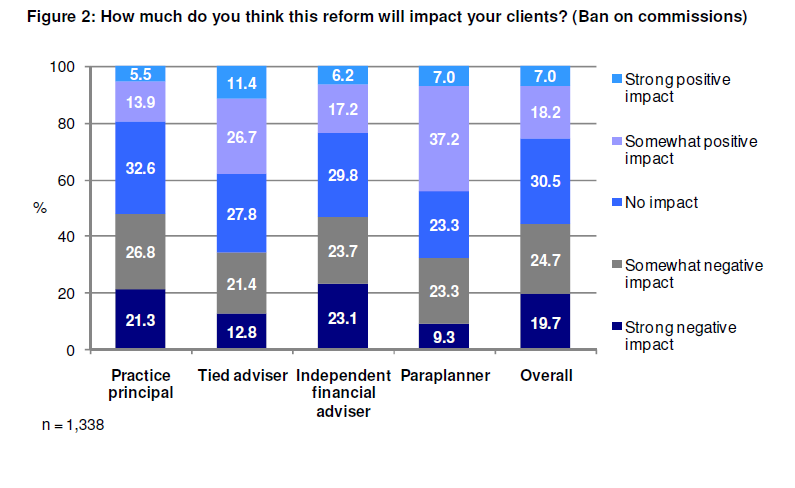
The majority of advisers (56.9%) expect the ban on commissions to have a negative impact on them, with one in five (19.3%) expecting a strong negative impact.
Paraplanners are the most likely to anticipate a positive impact (34.1%) while practice principals are the least likely (19.6%) (p<0.05).
Despite this, one quarter of advisers (25.2%) say the reform will have a positive impact on their clients, while almost one third (30.5%) say it will have no impact on clients (see Figure 2 below).
Undeniably though, adviser sentiment for the ban on commissions is negative, with more than two in five respondents (44.4%) envisaging a negative impact on their clients, and 19.7% predicting a strong negative impact.
The key to success for practices in the new environment will be embracing rather than shying away from change.
In business it is not the big that eat the small; it is the fast that eat the slow. A number of dealer groups have already pre-empted the ban by phasing out commissions among their adviser networks and moving into a fee-for-service environment.
In saying that, the reforms clearly play more into the hands of those practices that are big enough and resourced enough to cope with the administrative burden that comes with the legislative change.
Practice principals appear to have recognised the need to grow and increase their resources to survive in a commission-free environment and so rather than run from the changes, in the next two years they are very much focusing on growth.
The NAB Financial Planner Banking/AFA’s adviser research found that the short term propensity to sell or leave the industry among business owners is low, revealing a ‘can-do’ attitude on the part of most practice principals.
Figure 3 below shows there is a high appetite for business growth, with three in four practice principals (77.8%) likely to grow their business within the next two years and more than one third (37.0%) very likely to do so.

But while they might be future-proofing their businesses, sentiment remains negative, with three in five practice principals anticipating the prospective ban on commissions will have a negative impact on their business (62.2%), with one in five (22.3%) expecting the reform to have a strong negative impact.
The new fee models and opt-in clause appear to also be a strong driver behind the negative sentiment towards business valuations. Three quarters of practice principals (74.0%) anticipate these reforms to have a negative impact on the valuation of their business, and almost one third
(30.4%) expect a strong negative impact.
Multiple of recurring revenue and multiple of EBITAPR are considered the best valuation methodology for financial planning businesses, selected by almost half of practice principals respectively.
5.3 Education Drive
While the core objective of the Government’s remuneration reform is to improve outcomes for consumers, a secondary aim is to increase professionalism among the advice industry and raise education standards for financial advisers.
Advisers are the first to recognise that until they are viewed as a profession by the broader consumer market, they will struggle to expand their reach beyond the quarter of the population who seek advice and indisputably understand the value they receive from doing so.
The AFA’s consumer research found that people who have an advice relationship are better planned, happier with their investments and have greater clarity around their financial future.
However the research also found that people who do not seek advice are significantly less cognisant of the extra-financial benefits and have a much lower level of trust in advisers generally.
Previous research by CoreData-brandmanagement has shown that one of the key things a potential client looks for in an adviser is strong qualifications and experience, so higher education standards among financial advisers could go a long way to addressing the trust gap among the
unadvised.
This move is already underway, and the advisers themselves are driving it, as shown in Figure 4 below.

Three in five advisers (62.4%) say they are likely to undertake further study within the next two years, with one third (32.8%) very likely to do so. Among the areas of further study being considered are: accountancy, advanced financial planning qualifications, economics and business
degrees, risk qualifications and SMSF courses.
6 Threats or Opportunities?
In a clear signal to the Government about the level of discomfort with its intentions, the FoFA reforms and Government intervention are perceived as the biggest threats to the planning industry.
The NAB Financial Planner Banking/AFA’s adviser research reveals advisers feel the reforms threaten their future income streams and represent a heavy-handed approach on the part of Government that does not take into account the majority of financial advisers who already act in the best interest of their clients.
Interestingly, competition from industry funds, banks and other providers is also considered a key threat to advisers’ livelihood.
The proposed expansion of intra-fund advice does not sit well with a considerable chunk of the advice industry, who feel that it represents a ‘dumbing down’ of advice and raise concerns about how the ‘know your client’ rule would be implemented in this context.
More than half of advisers (57.2%) do not support the expansion of low-cost, simple advice (based on those who gave a support rating of 0-3), while a further quarter (26.7%) do not feel strongly either way (based on a support rating of 4-6).
The average support rating for the reform was just 3.2 out of 10.
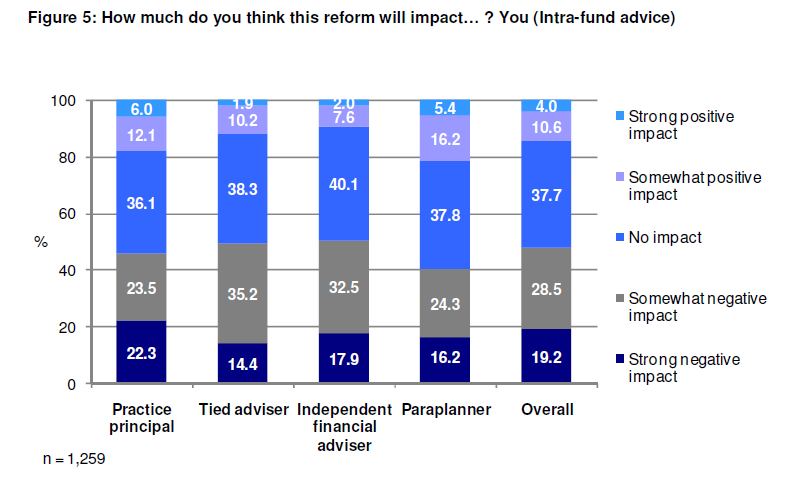
Advisers are split over the impact the intra-fund advice reform will have on them, with 47.7% anticipating a negative impact and 37.7% anticipating no impact – although clearly few are expecting a positive outcome (14.6%).
As shown in Figure 5 below, practice principals are the most likely to foresee a strong negative impact on them (22.3%).
Those advisers that oppose the reform claim the advice provided in an intra-fund environment is not holistic as it will not take into account the client’s broader financial situation.
Verbatim comments from advisers who oppose intra-fund advice:
“A simple failure of intra-fund advice is the treatment of advice in isolation from the broader client issues such as estate planning, structuring etc.” (Independent Financial Adviser, Qld)
“Clients do not have an understanding of what is comprehensive advice. They may think by obtaining advice from their super fund they have cover all bases. Advice in any form should be left up to the adviser network. Should bank tellers be given the authority to provide incidental
accountant advice? What next?” (Practice Principal, NSW)
They also argue that it goes against the ‘know your client’ rule and would ‘dumb down’ the system, due to the fact that advice could be given by people without the proper training and education.
“I think this goes completely against ‘knowing’ your client. One size fits all approaches are often fraught with danger.” (Tied Adviser, SA)
“By encouraging a ‘dumb down’ approach the end result can only be the consumer will come off second best, no matter how much ‘spin’ the advocates of this can manage to put on it.” (Independent Financial Adviser, Qld)
“I have a Bachelor of Commerce degree with a major in Economics, Accounting and Commercial Law as well as a Diploma of Financial Planning. I am totally against unqualified call centre operators of superannuation funds being able to give advice in any way shape or form to members and they do not have adequate knowledge or experience. This is totally dumbing down of advice by even dumber politicians.” (Practice Principal, Vic)
“Intra-fund advice (or Mickey-Mouse advice), completely undermines the initial reason for reform in the place. Licensed, qualified and competent financial planners should be the only people handing out advice to retail clients. No matter how small their needs are.” (Tied Adviser, SA)
6.1 Competition Breeds Innovation
The expansion of intra-fund advice and the advent of new players to the industry should not necessarily be viewed as a threat to advisers.
Competition breeds innovation; it ensures businesses continue to strive for greatness and do not become content to rest on their laurels.
The major risk that comes from the reforms, however, is that rather than increase competition, the reforms will in fact reduce competition by tipping the balance in favour of the big institutional dealer groups and forcing consolidation in the non-aligned or independent sector of the market.
This could indeed have the opposite effect to what the Government is pushing for; a reduction in the independence of advice.
One of the positive impacts of the intra-fund reform is the simplification of the delivery of advice for people with more simple needs, and the greater affordability of advice for those who could not afford to access advice through traditional advice channels.
Advisers who support the reform say that not all clients need fully-fledged advice, so the reform helps cater to this segment of the consumer market.
Verbatim comments from advisers who support intra-fund advice:
“Within reasonable bounds, this is a sensible idea. It should take pressure off professional adviser’s limited time resources in that very time consuming small technical matters can be dealt with elsewhere, without being tied up in red SOA tape.” (Independent Financial Adviser, WA
“The people who choose not to pay for full advice still need an avenue to receive basic advice I believe that this may be a suitable alternative.” (Tied Adviser, Qld)
“The comprehensive compliance forced upon advisers in the fact finding and advice provision process, by dealer groups seeking to mitigate legal risk, means the costs of advice due to the time it takes to comply are enormous. The costs of the traditional advice model are too high for less
wealthy consumers and a low cost option like intra-fund is desperately needed.” (Tied Adviser, NSW)
6.2 Putting Clients First
When it comes to the proposed introduction of a statutory fiduciary duty for financial advisers, the devil is in the detail.
On first glance, it appears that what’s being proposed is really just legally reinforcing what most advisers already do – act in the best interests of their clients.
However the legal implications of such a requirement cannot be underestimated.
The reform would be difficult to regulate and even harder to enforce; when investments go sour, will advisers be held accountable for the advice not being in the clients’ best interests?
How can the relative unpredictability of markets be decoupled from a poor recommendation, when both can quite easily result in a client ending up in an entirely different situation to what they envisaged?
In spite of these concerns, the reform has broad support among the adviser community, with three quarters of respondents (76.2%) strongly supporting the introduction of a statutory fiduciary duty for advisers.
On average, respondents gave a support rating of 7.9 out of 10 – the highest among the proposed reforms by a long stretch.

The majority of respondents envisage the reform having no impact on them (58.1%), largely because they feel they are already providing advice that’s in the best interests of their clients, despite not having a statutory obligation to do so.
Only one in 10 say the reform will have a negative impact (10.4%).
Interestingly, almost two in five respondents believe the reform will have a positive impact on their clients (37.6%), while the majority (56.2%) foresee no impact.
Paraplanners (42.5%) and tied advisers (26.7%) are the most likely to envisage a strong positive impact on their clients.
Practice principals are likewise optimistic that unlike some of the other reforms, the fiduciary duty will have little impact on their business.
In fact, almost three in five (58.1%) expect the reform to have no impact at all, while a further 30.2% expect a positive impact, and 13.9% expect a strong positive impact.
Advisers who support the statutory fiduciary duty say they are already acting in their clients’ best interests, and the statutory obligation will help to rid the industry of ‘cowboys’.
Verbatim comments from advisers who support a statutory fiduciary duty:
“I have been operating like this for 22 years so as far as me and my clients are concerned there is no difference at all. The best interest of the client always comes first.” (Practice Principal, WA)
“I am amazed we require this to be a ‘reform’ – surely on the basis of ethics alone it should be obvious and mandatory that this is the case. This reform will ensure that the few that don’t abide by this philosophy will be forced to do so.” (Practice Principal, WA)
“I think this is good. It will get rid of the shonky advisers out there that give us a bad name.” (Independent Financial Adviser, WA)
“This reform is a long time in coming. It should finally put an end to the cowboy culture that has been so predominant in years past.”(Practice Principal, NSW)
Advisers also expect the reform to improve the image and reputation of the industry.
Those who oppose the reform feel it is unnecessary to legislate, a further compliance burden and a waste of resources.
Verbatim comments from advisers who oppose a statutory fiduciary duty:
“Open to interpretation by expensive lawyers looking to make a buck out of us.” (Tied Adviser, State not mentioned)
“Responsibility already exists. Codification not necessary.” (Practice Principal, Qld)
“Unworkable reform as its subjective to opinion one advisers recommendations could be very different to another advisers opinion and qualifications. Who decides who has acted correctly?” (Practice Principal, NSW)
“We already put our clients interests first and foremost. It is the ethical thing to do and you can’t legislate to make somebody ethical.” (Independent Financial Adviser, Qld)
“Well paid lawyers will have field day with the definition. We will be sitting ducks.” (Tied Adviser,State not mentioned)
7 Conclusion
There is an appetite among financial advisers for increased professionalism, higher education standards and better outcomes for consumers – but not at the expense of advisers’ livelihoods. The key adviser concerns about the Government’s Future of Financial Advice (FoFA) reforms
centre on the potential for increasing the already heavy compliance burden and diminishing adviser profitability.
While many advisers accept and indeed support the introduction of a statutory fiduciary duty as an extension of a principle they already practise, there is strong pushback against the introduction of an annual opt-in requirement, namely due to the perceived misalignment with the long term nature of advice and the additional paperwork on the part of both advisers and clients.
The logic of ensuring clients agree to ongoing advice fees is sound, however advisers suggest a more practical alternative might be an ‘opt out’ system, whereby clients who are unhappy with the service they are receiving can choose to terminate this at any time.
They claim this would remove the need for additional administration and prevent an increase in the cost of advice being passed through to clients in order to cover the cost of implementation.
There is also considerable reservation about the expansion of intra-fund advice among the adviser community.
Advisers not only feel that super funds and other external providers are muscling in on their turf and putting their future in jeopardy, they also have reservations about the ability to deliver lowcost, simple advice within the ‘know your client’ framework.
Few argue against increasing the accessibility of advice. Rather, they say that an expansion of low-cost, simple advice could expose consumers to poor or inappropriate advice by introducing the potential for advice to be handed down by people without the proper training and education.
Advisers remain split over the prospective ban of commissions, but many appear to have accepted that the Government’s efforts to remove conflicted remuneration structures are nonnegotiable and are moving down the fee-for-service path.
The caveat, however, from a considerable number of advisers who support the ban is that commissions on risk products should be ring fenced to avoid further exacerbation of the nation’s chronic underinsurance problem.
A drive to increase education is already underway, and it’s the advisers themselves who are leading the charge.
The propensity to undertake further study is high, reflecting the recognition among advisers of the need to raise standards as part of the continued bid to be viewed by the public as a profession. Change is a necessary part of the evolution of any industry, and the industry consultation period presents an opportunity for advisers to have their say in what the future looks like.
Now is the time to build a profession that is broadly used, widely respected and recognised for the value it brings to people’s lives. This is the future the industry must strive for.
8 Appendices

Click here to read comments on the paper by financial advisers.
For a copy of the White Paper please click here.