Retail trade; Job Advertisements; Weekly Petrol Price
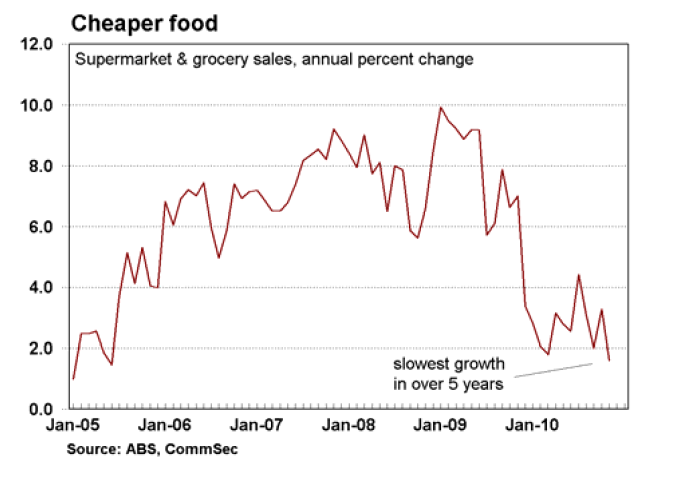
- Retail spending rose by just 0.3 per cent in November after the 0.8 per cent slide in October. However Nonfood retailing rose by 0.5 per cent. Over the past year retail spending has risen by just 1.3 per cent – marking the second weakest reading in five years (surpassed only by the 1.0 per cent annualised growth rate in the year to May 2010).
- In annual terms, sales at chain stores were up 0.6 per cent on a year ago – the weakest annual growth in records going back 16 years. Sales at smaller retailers were up 2.4 per cent on a year ago.
- The job market is losing steam. The Advantage internet job index fell by 2.3 per cent in December – marking the biggest fall in job advertisements since July 2009.
- The national average terminal gate or wholesale price of petrol eased modestly from 26-month highs over the past week and stands at 123.4 cents a litre. However the weaker Australian dollar and rise in global oil prices is likely to see pump prices track higher in coming weeks.
What does it all mean?
- The Australian economy is losing momentum. Not only are manufacturing, services and construction sectors going backwards but retail spending is barely growing. And now there are signs that the job market is stalling.
- Job advertisements have recorded the biggest monthly fall in 18 months in December, adding to the weaker result in November. The labour market has been the shining indicator however the consecutive slide in the Advantage job index suggests that job growth going forward is likely to be much more sedate.
- The domestic economy is certainly facing headwinds, with the higher Australian dollar curbing tourism and making exports less competitive. At the same time the conservative attitudes of consumers have ensured that retail activity remains weak. In fact the slide in job ads in the retail sector was a substantial 12 per cent in December.
- Retailers have certainly done it tough over the past year. Annualised growth in sales is holding at a paltry 1.3 per cent – the second worst reading in more than five years and a far cry from the decade average growth of 6 per cent. In fact retail activity levels were much more buoyant during the global financial crisis, with annualised growth rates of around 6-7 per cent. It is clear that the cumulative rate hikes have taken their toll on the household budget, and as a result discretionary spending is being pared back.


- The tightening of monetary policy and unwinding of stimulus has been the key reason for the turnaround in the fortunes of the retail sector. The domestic economy is not shooting the lights out and retail activity is virtually non-existent. As the larger department and chain stores can attest, annualised sales are growing at the weakest levels in records going back 16 years. Even the modest 0.5 per cent lift in non-food retailing in November is hardly remarkable, especially when you consider that sales plummeted by 1.9 per cent in the prior month.
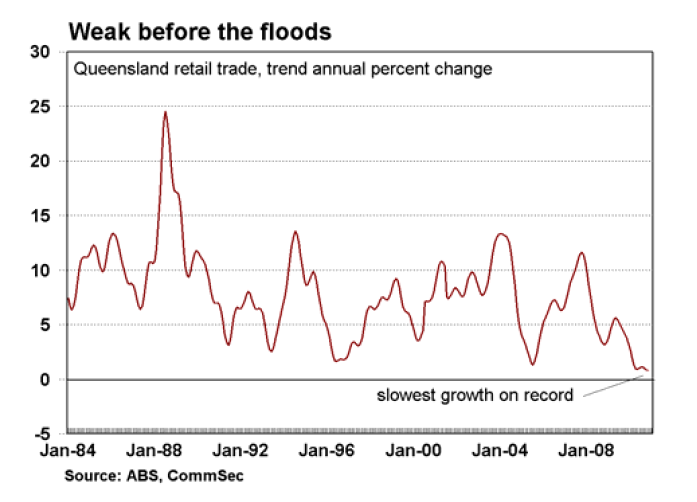
- A breakdown of the retail sales data across the states suggests that Queensland is faring far worse than other states. In smoothed terms retail sales in Queensland are growing at the slowest annual rate in records going back 28 years. However given the recent floods, there may be a pickup in activity levels as households replace damaged items such as furniture, carpets and start rebuilding.
- No doubt part of the slide in retail sales can be blamed on lower prices, rather than weaker spending, given the widespread discounting taking place across the retail sector. However weaker volumes are clearly playing their part. Prices of some goods are coming down because our dollar is strong, but plenty of retailers are cutting prices because consumers refuse to spend.
- Motorists need to prepare for higher petrol prices over the next fortnight. The wholesale price of petrol has eased modestly but the rise in the Singapore unleaded price and slide in the Australia dollar will filter through to pump prices over the coming fortnight. In fact in Australian dollar terms the Singapore unleaded price is trading at 27- month highs.
- Even retailers have been selling fuel in some states at or near cost – due to increased competition – and clearly this is an unsustainable scenario in the longer term. The bottom line is that pump prices are set to rise over the next couple of weeks.
What do the figures show?
Retail trade:
- Retail trade rose by just 0.3 per cent in November after a downwardly revised 0.8 per cent slide in October. Nonfood retailing rose by 0.5 per cent in November after the 1.9 per cent slide in the prior month. Over the past year retail trade lifted by just 1.3 per cent – marking the second weakest reading in five years (surpassed by the 1.0 per cent annualised growth rate in the year to May 2010).
- Sales by chain stores and other large retailers rose by 0.2 per cent in seasonally terms in November while sales by smaller retailers rose by 0.5 per cent. In annual terms sales at chain stores were up 0.6 per cent on a year ago – the weakest annual growth in records going back 16 years. Sales at smaller retailers were up 2.4 per cent on a year ago.
- During November, sales increased most at other recreational good retailers – including sporting, entertainment and toy retailers – (up 4.9 per cent), followed by furniture, floor coverings, and houseware goods retailing (up 1.5 per cent) and footwear and other personal accessory retailers (up 1.5 per cent). Sales fell most at newspaper and book retailing (down 1.3 per cent), followed by clothing retailers (down 0.3 per cent).
- Across the states sales lifted most in the ACT (up 1.0 per cent), followed by NSW and Tasmania (both up 0.6 per cent) and Victoria (up 0.2 per cent). Sales was weakest in the Northern Territory and South Australia (both down 0.9 per cent), followed by Western Australia (down 0.2 per cent). Sales were flat in Tasmania.


Petrol prices:
- The national average wholesale (terminal gate) price hit a 26-month low high of 124.2 cents a litre on December 31st but has eased marginally from those levels – down 0.8 cents over the week. Just over two months ago (October 1) the terminal gate price stood at an 11-month low of 111.6c/l.
- Last week, the key Singapore unleaded petrol price rose by US$2.18 (2.1 per cent) to US$105.35 a barrel. And in Australian dollar terms the Singapore gasoline price rose by $3.06 (3.0 per cent) over the week to $106.06 a barrel – a 2- month high.
Job advertisements:
- The Advantage internet job index fell by 2.3 per cent in December – “indicating an unexpected softening in the jobs market”. The authors of the report also note “An interest rate hangover brought about by seven consecutive rises and a grab for cash by the major banks late last year still appears to be having a negative impact on the job market. A weakening job market nationally, coupled with significant job losses in Queensland, is like to set a negative tone for early 2011”. In December gains were recorded in only engineering (1.7 per cent) and human resources (1.2 per cent). While significant losses were recorded by retail (-12.0 per cent), followed by tourism and hospitality (-10.8 per cent). All states were down except for Western Australia which recorded growth of 1.2 per cent in December.
What is the importance of the economic data?
- The Bureau of Statistics’ Retail trade publication contains the most current readings on the performance of consumer spending. The ABS surveys 500 ‘larger businesses’ and 2,750 ‘smaller businesses’. Retail trade covers spending at a broad range of retail outlets but excludes both petrol and motor vehicle sales. A weak retail trade result may point to a slowing economy as well weighing on the share prices of listed retail stocks. But retail trade estimates can’t be assessed in isolation – it is important to look at the influences determining future trends in consumer spending, such as income, employment and confidence levels.
- The monthly Job Advertisements release is a leading employment indicator. Employers only seek additional staff if business activity is strong, and more importantly, if they expect that conditions will remain favourable in coming months. It takes around 5-6 months for the new staff to be added to the payrolls. But a fall in job advertisements would have a more immediate impact on monthly employment estimates.
- Weekly figures on petrol prices are compiled by ORIMA Research on behalf of the Australian Institute of Petroleum. National average retail prices are calculated as the weighted average of each State/Territory’s
metropolitan and non-metropolitan retail petrol prices, with the weights based on the number of registered petrol vehicles in each of these regions.
What are the implications for interest rates and investors?
- The sluggish activity levels in the retail sector will need to turnaround pretty quickly to justify a further rate hike in the first half of 2011. Rather it is more likely that retailers will need to continue discounting in coming months especially given the economy was already struggling before the Reserve Bank delivered the November rate hike.
- Consumers will only start to spend again when they become more confident – an extended period of interest rate stability will help.
- The job market is still in good shape, but with the economy losing momentum, employment gains are likely to be much more subdued. Already the tourism, retail and hospitality sectors are curbing future
employment with jobs ads sliding in December– adding a further drag on consumer spending and economic growth.
Produced by Commonwealth Research based on information available at the time of publishing. We believe that the information in this report is correct and any opinions, conclusions or recommendations are reasonably held or made as at the time of its compilation, but no warranty is made as to accuracy, reliability or completeness. To the extent permitted by law, neither Commonwealth Bank of Australia ABN 48 123 123 124 nor any of its subsidiaries accept liability to any person for loss or damage arising from the use of this report.
The report has been prepared without taking account of the objectives, financial situation or needs of any particular individual. For this reason, any individual should, before acting on the information in this report, consider the appropriateness of the information, having regard to the individual’s objectives, financial situation and needs and, if necessary, seek appropriate professional advice. In the case of certain securities Commonwealth Bank of Australia is or may be the only market maker.
This report is approved and distributed in Australia by Commonwealth Securities Limited ABN 60 067 254 399 a wholly owned but not guaranteed subsidiary of Commonwealth Bank of Australia. This report is approved and distributed in the UK by Commonwealth Bank of Australia incorporated in Australia with limited liability. Registered in England No. BR250 and regulated in the UK by the Financial Services Authority (FSA). This report does not purport to be a complete statement or summary. For the purpose of the FSA rules, this report and related services are not intended for private customers and are not available to them.
Commonwealth Bank of Australia and its subsidiaries have effected or may effect transactions for their own account in any investments or related investments referred to in this report.