Weekly Petrol; Latest economic data
- According to the Australian Institute of Petroleum, the national average Australian price of unleaded petrol rose by 1.2 cents per litre to 136.3 cents a litre in the week to February 27 – a fresh 28 month high.
- Motorists are likely to see a further increase in petrol prices. While the Singapore unleaded price rose by more than US$8 a barrel, it has only partially filtered through to the terminal gate (wholesale) price – which gained 3 cents a litre in the past week. CommSec expects pump prices to rise by a further 4-5 cents a litre in the next fortnight.
- The TD Securities-Melbourne Institute monthly inflation gauge rose by just 0.2 per cent in February. Excluding volatile items, prices were up just 0.1 per cent – the seventh straight month of negligible growth.
- Private sector credit rose by 0.3 per cent in January to stand 3.4 per cent higher than a year ago.
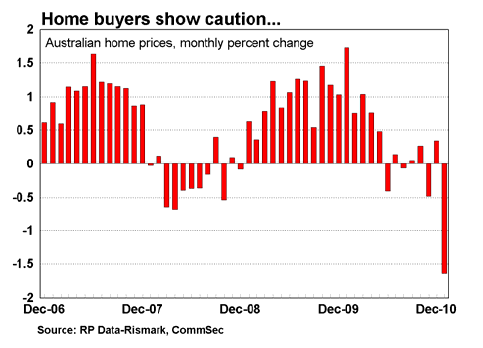
- Capital city home prices fell by 1.6 per cent in seasonally adjusted terms in January after rising by 0.3 per cent in December according to the RP Data-Rismark Hedonic Australian Home Value Index – the largest property database in Australia. Outside capital cities, prices fell by 1.2 per cent in January.
- Company profits fell by 2.8 per cent in the December quarter. Profits rose in just four of the 15 industry sectors. However sales rose in ten of the 15 industry sectors in the December quarter with aggregate sales up by 0.9 per cent. Inventories (stocks) held by businesses rose by 0.7 per cent in the December quarter in inflation-adjusted terms.
What does it all mean?
- All the data released today points to a soft economy that does not need any further interest rate hikes in the near term. Inflation remains well under control, consumers and businesses are still refusing to borrow, house prices are recording modest falls and the sustained rise in petrol prices will add further pressure to household budgets – further slowing down spending.
- After largely going sideways for the last month pump prices have resumed their upward trajectory. Petrol prices are now holding at fresh 28-month highs and unfortunately for motorists it is unlikely to get any better over the next couple of weeks.
- The political instability in the Middle East and North Africa has resulted in the Singapore unleaded price surging by over US$8 a barrel in the past week. And given that the Australian dollar was largely unchanged, the entire increase in the global oil price will need to filter through to domestic pump prices.
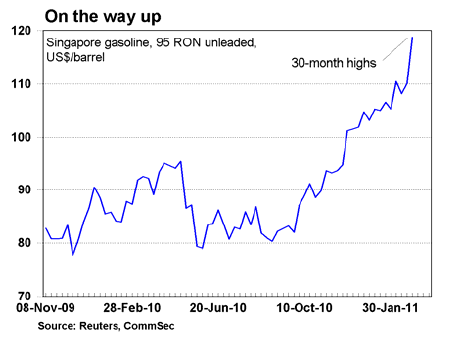
- Already the terminal gate price (wholesale) has started to react rising by a sizeable three cents a litre in the past week. But a further increase in the wholesale prices will take place over the rest of this week and given the lag effect motorists should see the impact on petrol signboards around Australia early next week. CommSec expects prices to increase by 4-5 cents a litre in the next fortnight, taking the national average price to above $1.40 a litre. At the high point of the discounting cycle petrol will be trading at well above a $1.50 a litre.
- The latest TD inflation gauge suggests that inflation remains well and truly under control at present. In February prices rose by 0.2 per cent. Interestingly the rise in fruit and vegetable prices may be the first indication of the impact from the floods. But strip out volatile elements like fruit and vegetable prices, and petrol and inflation is largely non-existent in Australia. Over the past seven months inflation has been negligible and the annualised core result is holding at a more sedate level of 2.3 per cent. Even the three month annualised rate of inflation is amazingly just 0.3 per cent.

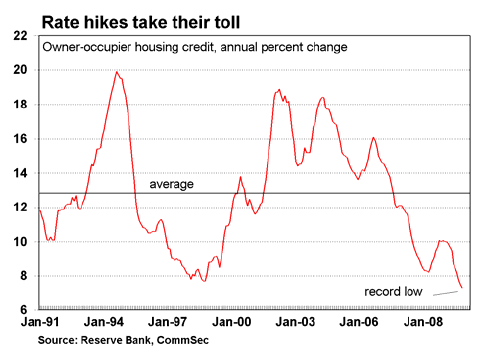
- The latest lending data adds further weight to the view that interest rates should remain on hold in the near term. Overall lending ticked higher but the sub components suggest that activity levels are still shaky. Business credit fell for the seventh straight month, while consumer borrowings were unchanged after sliding in the prior month, and housing credit ticked modestly higher. Even within housing credit, lending to home owners continued to slide, with the annual growth rate at the weakest levels since records began 20 years ago.
- Australian home prices have completed a soft landing. In March 2010, prices were seemingly going gangbusters with annual growth standing at 14.1 per cent. But home prices are now tracking at just a 1.2 per cent annual rate – the slowest growth rate in 23 months and well below the long-term average pace of 8.0 per cent.
- The rate hikes delivered over 2010 have taken the heat out of the housing market, while the wet weather conditions has also added another degree of weakness to the result. Property prices across Australia fell by 1.6 per cent in January however it is important to highlight that sales volumes were less than 50 per cent of a typical months flows.
- It is likely that housing conditions will remain soft in the near term, however the long term fundamentals certainly look more attractive. The Reserve Bank is likely to remain on the interest rate sidelines in the near term, while healthy jobs growth, rising population and sliding rental vacancy rates will support housing activity in the medium term.
What do the figures show?
Petrol prices:
- According to the Australian Institute of Petroleum, the national average Australian price of unleaded petrol rose by 1.2 cents a litre to 136.3 cents a litre in the week to February 27. The metropolitan price rose by 1.0 c/l to 136.1 c/l, while the regional average price rose by 1.3 c/l to 136.6 c/l.
- Average petrol prices across states over the past week were: Sydney (up 2.1 cents to 136.6 c/l), Melbourne (up 0.9 cents to 135.2 c/l), Brisbane (up 0.1 cents to 137.7 c/l), Adelaide (up 1.1 cents to 134.7 c/l), Perth (up 0.2 cents to 135.6 c/l), Darwin (up 1.3 cents to 139.0 c/l), Canberra (down 1.7 cents to 133.7 c/l) and Hobart (up 0.3 cents to 141.0 c/l).
- Today, the national average wholesale (terminal gate) stands at a 28-month high of 130.0 cents a litre, up 3 cents a litre over the past week. The wholesale price has been hovering around 126-127 cents a litre since late January 2011.
- Last week, the key Singapore unleaded petrol price rose by US$8.67 (7.9 per cent) to US$118.77 a barrel – a 30 month high. And in Australian dollar terms the Singapore gasoline price rose by $8.47 (7.8 per cent) over the week to $117.20 a barrel.

Inflation gauge:
- The monthly inflation gauge rose by 0.2 per cent in February after lifting by 0.4 per cent in January. The annual rate of inflation rose from 3.4 per cent to 3.6 per cent.
- Excluding volatile items like petrol and fruit & vegetables, the inflation gauge rose by 0.1 per cent after remaining unchanged for the two prior months. The annual rate of core inflation remained steady at 2.3 per cent. The threemonth annualised rate of inflation rose eased from 0.4 per
cent to 0.3 per cent. - TD Securities noted that “Contributing most to the overall change in February were price rises for fruit and vegetables, meat and seafood, and automotive fuel. These were offset by a sharp seasonal fall in holiday travel and accommodation, and a fall in rents. The price of fruit and vegetables rose by 5.1 per cent in February, following the 12.1 per cent rise in January. Excluding a grocery chain milk price discount war, the Inflation Gauge rose by 0.3 per cent.”

Private sector credit
- Private sector credit (lending) rose by 0.3 per cent in January after rising by 0.2 per cent in December. Credit growth is up 3.3 per cent on a year ago.
- Housing credit grew by 0.6 per cent with lending to owner-occupiers rising by 0.5 per cent and investor housing up 0.6 per cent. Housing credit is up 7.3 per cent on a year ago – the weakest annual growth in 18 months. Owner occupier housing credit is up 7.0 per cent on a year ago – slowest pace in records going back 20 years. Investor housing lending was up 7.9 per cent on a year ago.
- Personal credit remained flat in January after sliding by 0.4 per cent in December. Personal credit was up 0.8 per cent over the year – still well below the rate of inflation. Business credit fell for the seventh straight month in January, easing by 0.2 per cent. Business credit is down 2.4 per cent on a year ago and has been consistently contracting for the past 19 months.
House price prices
- The RP Data-Rismark Hedonic Australian Home Value Index fell by 1.6 per cent in seasonally adjusted terms in Janaury after a 0.3 per cent rise in the previous month.
- House prices fell by 1.0 per cent in the month while apartments fell by 2.2 per cent.
- Capital city home (dwelling) prices are up 1.2 per cent on a year ago, the slowest growth rate in 23 months. House prices are up 0.9 per cent and apartment prices are up by 2.1 per cent.
- Prices rose in just one of the seven capital cities in January with Darwin prices up 3.3 per cent. Across the other cities prices fell most in Melbourne (down 2.3 per cent), followed by Sydney and Brisbane (down 1.8 per cent), Canberra (down 1.6 per cent), Perth (down 1.5 per cent), Adelaide (down 0.7 per cent). In Hobart, prices rose by 2.1 per cent in December (January data not yet available).
- Home prices are higher than a year ago across all capital cities except Perth (down 4.1 per cent), Brisbane (down 3.5 per cent), and Canberra (down 0.6 per cent). Prices are up most in Darwin (up 4.7 per cent), followed by Melbourne (up 3.8 per cent), Sydney (up 2.6 per cent), and Adelaide (up 2.2 per cent).
- January home prices aren’t available yet for Hobart. In the year to December, home prices in Hobart were up by 2.2 per cent.

Business indicators
- Company gross operating profits fell by 2.8 per cent in the December quarter. Profits now stand 14.7 per cent higher than a year ago.
- Profits rose in four of the 15 industry sectors, led by Financial and insurance service (up 201.6 per cent), Administrative and support services (up 26.9 per cent), and Accommodation & food services (up 8.5 per cent), Mining profits fell by 8.5 per cent following the 1.6 per cent fall in profits in the September quarter.
- Excluding the financial and insurance sector, profits fell by a much larger 4.6 per cent in the quarter.
- Profits fell 10.6 per cent in construction.
- Sales rose in ten of the 15 industry groupings in real (inflation-adjusted) terms in the December quarter. Of the major sectors, sales rose 1.4 per cent in accommodation and food services. Sales fell by 4.1 per cent in Rental, hiring & real estate services, and by 1.4 per cent in Mining.
- In real terms, aggregate sales rose by 0.9 per cent in the December quarter.
- In nominal terms sales fell most in December quarter in both Queensland (down 2.5 per cent). Sales rose most in both Victoria and South Australia (up 1.6 per cent) followed by Western Australia (1.4 per cent).
- Inventories fell in three of the six sectors, with overall stocks up by 0.5 per cent. Mining stocks fell by 3.5 per cent with retail trade up 0.7 per cent. Utilities fell 6.0 per cent.
What is the importance of the economic data?
- Weekly figures on petrol prices are compiled by ORIMA Research on behalf of the Australian Institute of Petroleum. National average retail prices are calculated as the weighted average of each State/Territory’s metropolitan and non-metropolitan retail petrol prices, with the weights based on the number of registered petrol vehicles in each of these regions.
- The TD Securities/Melbourne Institute Monthly Inflation Gauge is designed to “provide a timely and accurate monthly measure of inflation in Australia”. The Bureau of Statistics only releases the Consumer Price Index on a quarterly basis.
- Private sector credit figures are released by the Reserve Bank on the last working day of the month. Credit is separated into three categories – housing, other personal and business. Private sector credit is effectively the amount of loans outstanding in the economy. If growth in lending is strong then it suggests that credit from financial institutions is freely available, underlying demand for assets such as cars and houses is firm and that the price of credit (interest rates) is attractive.
- The RP Data-Rismark Hedonic Australian Home Value Index is based on Australia’s biggest property database covering more than 340,000 sales during 2010. Unlike the ABS Index, which excludes terraces, semidetached homes and apartments, the RP Data-Rismark Hedonic Index includes all properties.
- The monthly RP Data-Rismark Hedonic Index compares month-to-month index results. Quarterly results are measured comparing end months rather than averaging each month in the quarter. For example, the first quarter of 2009 index results would compare the end of March index with the end of December index.
What are the implications for interest rates and investors?
- It is clear that rising petrol prices will boost the inflation rate in coming months. However there is not a lot that the Reserve Bank can do about changes at the petrol bowser or the floods in Queensland – a key driver of changes in fruit and vegetable prices. If underlying inflationary pressures remain contained, then the Reserve Bank can stay on the sidelines until well into 2011.
- Businesses are still cutting debt at a faster rate than new loans are being taken out. Overall this is a good reason to remain cautious on the outlook for the economy.
- Home prices are off the Reserve Bank’s worry list – at least for now. A softening in home prices combined with the prospect of interest rates remaining unchanged until mid year is clearly positive for budding home buyers.

Produced by Commonwealth Research based on information available at the time of publishing. We believe that the information in this report is correct and any opinions, conclusions or recommendations are reasonably held or made as at the time of its compilation, but no warranty is made as to accuracy, reliability or completeness. To the extent permitted by law, neither Commonwealth Bank of Australia ABN 48 123 123 124 nor any of its subsidiaries accept liability to any person for loss or damage arising from the use of this report.
The report has been prepared without taking account of the objectives, financial situation or needs of any particular individual. For this reason, any individual should, before acting on the information in this report, consider the appropriateness of the information, having regard to the individual’s objectives, financial situation and needs and, if necessary, seek appropriate professional advice. In the case of certain securities Commonwealth Bank of Australia is or may be the only market maker.
This report is approved and distributed in Australia by Commonwealth Securities Limited ABN 60 067 254 399 a wholly owned but not guaranteed subsidiary of Commonwealth Bank of Australia. This report is approved and distributed in the UK by Commonwealth Bank of Australia incorporated in Australia with limited liability. Registered in England No. BR250 and regulated in the UK by the Financial Services Authority (FSA). This report does not purport to be a complete statement or summary. For the purpose of the FSA rules, this report and related services are not intended for private customers and are not available to them.
Commonwealth Bank of Australia and its subsidiaries have effected or may effect transactions for their own account in any investments or related investments referred to in this report.