CBA Business Spending index
- The Commonwealth Bank Business Sales Indicator (BSI) eased yet again in trend terms in January, but it certainly wasn’t all bad news. In fact only a small minority of business sectors are now posting weaker sales. In January only three of the 20 industry sectors recording weaker sales in the month, down from four sectors in December and nine sectors in November.
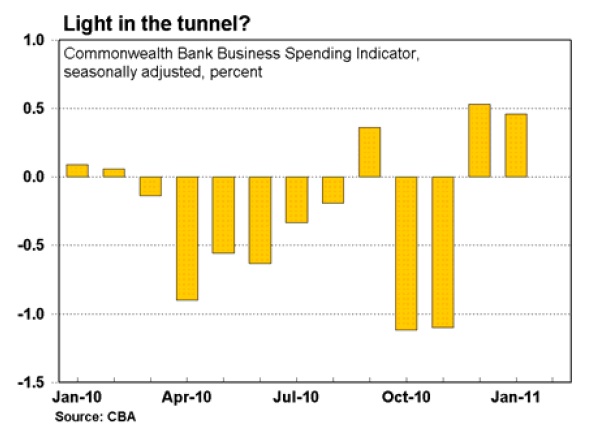
- In seasonally adjusted terms the BSI rose for the second straight month, lifting 0.5 per cent.
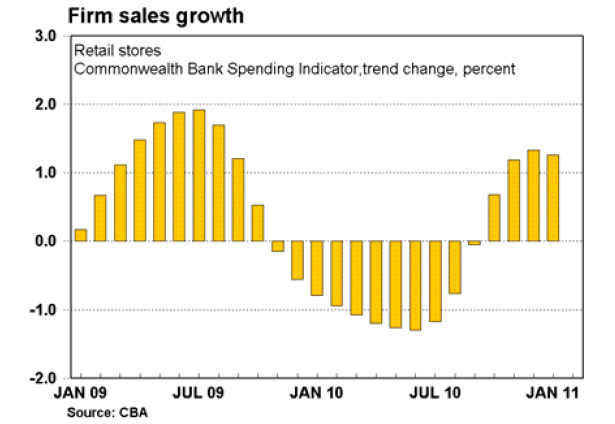
- Across the sectors, Retail stores recorded the largest gain with a 1.3 per cent increase in trend terms – marking the biggest monthly increase in 17 months.
- The Commonwealth BSI is obtained by tracking the value of credit and debit card transactions processed through Commonwealth Bank merchant facilities. The BSI covers spending broadly across the economy rather than just retail sales, including spending on automobiles, personal services and airlines.
What does it all mean?
- The Commonwealth Bank Business Sales Indicator (BSI) fell by 0.2 per cent in trend terms in January after similar declines in November and December. At face value that suggests continued tough times for retailers, but further examination reveals a more promising picture.
- In fact the majority of industry sectors continue to record spending growth. In January only three of the 20 industry sectors recording weaker sales in the month, down from four sectors in December and nine sectors in November.
- While ordinarily the trend measure is preferred for data analysis as it is less volatile and shows broader trends, seasonally adjusted estimates can highlight key turning points in the data. And another source of encouragement is that we have seen overall growth in sales in seasonally adjusted terms.
- In seasonally adjusted terms the BSI rose for the second straight month, lifting 0.5 per cent. And the biggest industry category – retail stores recorded the largest gain across sectors –marking the biggest increase in 17 months.
- The latest figures do appear to show that we are on the road to recovery, however with high fuel prices and the prospect of a rise in both interest rates and the price of food, consumers will remain fairly guarded.
- The Commonwealth BSI is obtained by tracking the value of credit and debit card transactions processed through Commonwealth Bank merchant facilities. And in line with the practice of the Bureau of Statistics with its retail trade data, seasonally adjusted and trend estimates of the BSI are obtained by applying statistical software. This allows analysis of the broader underlying trends that may be hidden in the raw data.
What do the figures show?
- The Commonwealth Bank Business Sales Indicator (BSI) fell by 0.2 per cent in trend terms in January after similar declines in November and December. This was the 13th straight monthly decline for the trend measure of economy-wide spending.
- In January the BSI rose by 0.5 per cent in seasonally adjusted terms after a similar gain in December. There have only been three positive readings in the past 11 months so the recent gains are encouraging for retailers.
- Another source of encouragement is the fact that the majority of industry sectors recorded spending growth in trend terms. In trend terms, the value of spending transactions fell in only three of the 20 industries in January, down from eight sectors in November.
- The biggest industry category – Retail stores – recorded the largest gain across sectors. The 1.3 per cent increase in trend sales in January was the fourth straight gain and biggest increase in 17 months. Next strongest was Contracted services (up 1.2 per cent) followed by Repair services and Service providers (both up 1.1 per cent).
- The Contracted services category includes a range of building trades like electrical services, carpenters and landscape services. Service providers include financial and insurance services.
- The Amusement & entertainment sector recorded growth of 0.5 per cent in January, the best reading in 15 months. The sector includes motion picture theatres, bowling alleys, golf courses and video stores.
- Other sectors to record encouraging gains were Automobile/vehicle rentals (up 0.5 per cent – the best gain in 19 months), Clothing stores (up 0.2 per cent – the best gain in 20 months) and Mail order/telephone order providers (up 0.6 per cent – best gain in 25 months).
- The weakest sectors in January in trend terms were Miscellaneous stores (down 1.2 per cent), Hotels and motels (down 0.4 per cent) Government services (down 0.1 per cent).
- In annual terms, eight of the 20 industry sectors contracted in January. The weakest sectors were Automobile & vehicles and Mail Order and Telephone Order Providers (both down 12.5 per cent) followed by Miscellaneous stores (down 11.9 per cent) and Retail stores (down 3.3 per cent).
- At the other end of the scale, Professional services & membership organisations recorded annual trend growth of 7.7 per cent followed by Contracted services (up 6.2 per cent) and Personal service providers (up 5.3 per cent). Personal service providers include laundries, hairdressers, shoe repair and tax agents.
- Only two of the eight states and territories recorded lower trend sales in January, down from four states in December. Sales were down by 0.1 per cent in both Queensland and Victoria. There was no noticeable impact of either the floods or Cyclone Yasi in the BSI state results. Spending rose most in NSW (up 0.6 per cent), followed by Tasmania (up 0.5 per cent) and Western Australia (up 0.3 per cent)
- In annual terms, the only two states/territories to record growth in January was NSW (up 1.1 per cent) followed by Western Australia (up 0.9 per cent). At the other end of the scale, the spending gauge was weakest in Victoria (down 9.1 per cent) followed by South Australia (down 8.6 per cent) and Queensland (down 5.9 per cent).
What is the importance of the economic data?
- The Commonwealth Bank Business Sales Indicator is obtained by tracking the value of credit and debit card transactions processed through Commonwealth Bank merchant facilities throughout Australia. Credit and debit card transactions can be volatile on a month-to-month basis, affected by seasonal and irregular factors. To better gauge the direction and changes of spending across the economy, the Business Sales Indicator is tracked in trend terms.
- The monthly Business Sales Indicator has been devised to provide a more timely assessment of spending trends in the economy. The main monthly indicator of spending in the economy is the Australian Bureau of Statistics’ (ABS) Retail Trade release. However these statistics cover just spending at retail establishments, and exclude spending at a raft of other businesses.
Produced by Commonwealth Research based on information available at the time of publishing. We believe that the information in this report is correct and any opinions, conclusions or recommendations are reasonably held or made as at the time of its compilation, but no warranty is made as to accuracy, reliability or completeness. To the extent permitted by law, neither Commonwealth Bank of Australia ABN 48 123 123 124 nor any of its subsidiaries accept liability to any person for loss or damage arising from the use of this report.
The report has been prepared without taking account of the objectives, financial situation or needs of any particular individual. For this reason, any individual should, before acting on the information in this report, consider the appropriateness of the information, having regard to the individual’s objectives, financial situation and needs and, if necessary, seek appropriate professional advice. In the case of certain securities Commonwealth Bank of Australia is or may be the only market maker.
This report is approved and distributed in Australia by Commonwealth Securities Limited ABN 60 067 254 399 a wholly owned but not guaranteed subsidiary of Commonwealth Bank of Australia. This report is approved and distributed in the UK by Commonwealth Bank of Australia incorporated in Australia with limited liability. Registered in England No. BR250 and regulated in the UK by the Financial Services Authority (FSA). This report does not purport to be a complete statement or summary. For the purpose of the FSA rules, this report and related services are not intended for private customers and are not available to them.
Commonwealth Bank of Australia and its subsidiaries have effected or may effect transactions for their own account in any investments or related investments referred to in this report.