Credit card lending; Weekly Petrol Price
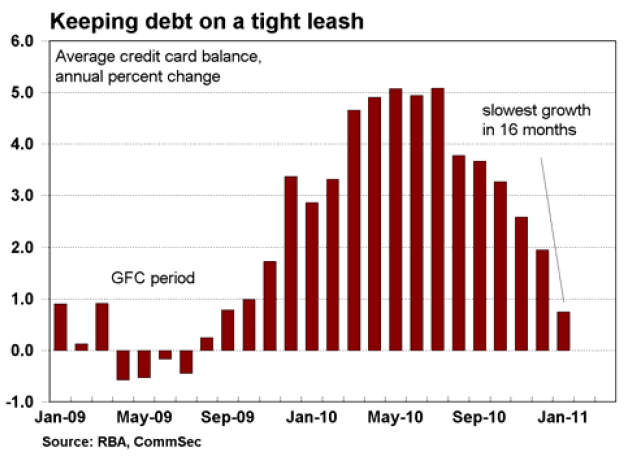
- Credit card balances are growing at the slowest annual pace in 16 months. The average credit card balance in January was up just 0.8 per cent on a year ago. The average balance fell by $100.90 to $3,214.00.
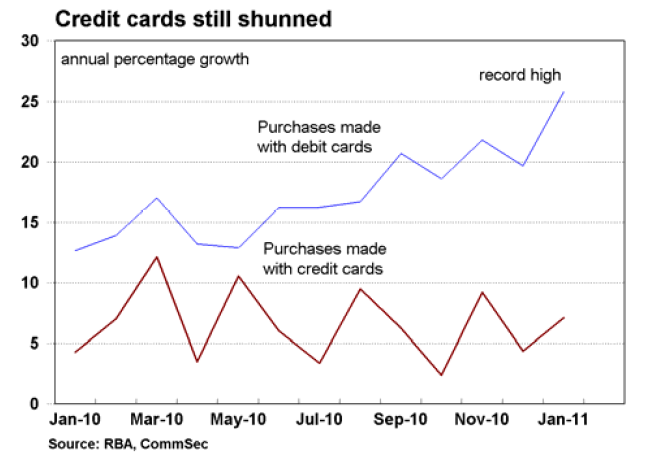
- Consumers are preferring to use their own money to purchase goods. Purchases made on debit cards rose by 25.8 per cent on a year ago – the fastest growth on record.
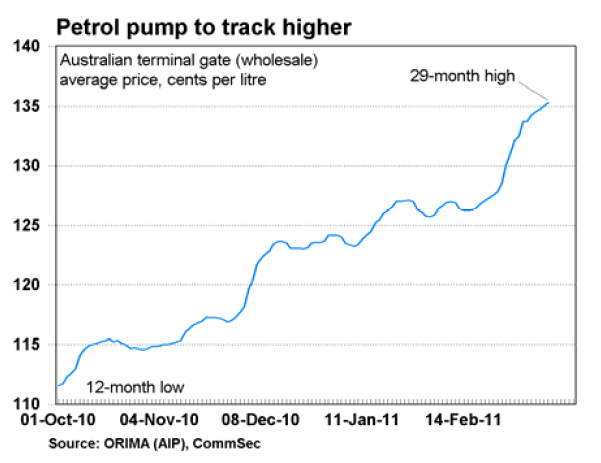
- Petrol prices are likely to track higher in coming weeks. The national average wholesale (terminal gate) stands at a near 29-month high of 134.8 cents a litre today, up a further 2.2 cents a litre over the past week.
What does it all mean?
- Consumers continue to remain ultra conservative. The average credit card balance is barely growing at present with consumers much preferring to live within their own means. The average balance is up just 0.8 per cent on a year ago, the slowest annual pace in 16 months. And once inflation is taken into account, the average credit card balance is actually going backwards.
- Aussie consumers are increasingly using their own money (debit cards) to make purchases rather than put them on credit. Purchases made on using debit cards are up almost 26 per cent on a year ago – the fastest pace recorded.
- The news for retailers isn’t good. The price of petrol is going up, acting like a de facto rate hike. At the same time, consumers continue to shun discretionary spending, added to which the recent losses on equity markets will be a further dampener on spending – both in terms of confidence and actual income levels.
- It is a public holiday in Canberra today and the usual data on retail petrol prices will be released tomorrow. However the sustained increase in the terminal gate (wholesale) price suggests that pump prices will continue to rise in the coming fortnight. In fact since bottoming out just over a month ago the terminal gate price has surged by almost 9 cents a litre.
- CommSec expects pump prices to increase by a further 3 cents a litre in the next fortnight, taking the national average price to around $1.45 a litre. Already signboards around Australia are showing prices above $1.50 a litremeaning that motorists are more likely to actively lookout for the discount days to purchase fuel.
What do the figures show?
Credit & debit card activity:
- Figures released from the Reserve Bank show that the average credit card balance, fell by $100.90 to $3,214.0 in January. The average credit card balance is only up 0.8 per cent on a year earlier – the slowest annual growth in 16 months.
- Of credit cards attracting interest charges, the average outstanding balance rose by $18.40 to $2,408.50. The average balance accruing interest is up 3.1 per cent on a year ago (slowest growth in 11 months).
- The number of credit card cash advances fell by 3.1 per cent in January. Credit card advances are now down 1.6 per cent on a year ago. Cash advances have been largely falling in annual terms for four years.
- The average credit card limit grew at a 1.7 per cent annual pace, below the rate of inflation and the slowest growth rate in records going back 16 years.
- The number of purchases made on credit cards grew by 8.7 per cent in January compared with a year ago.
- Total debit card transactions rose by 25.8 per cent on a year ago – marking the highest reading on record.
Petrol prices:
- Today, the national average wholesale (terminal gate) stands at a near 29-month high of 134.8 cents a litre, up 2.2 cents a litre over the past week.
- Last week, the key Singapore unleaded petrol price fell by US$2.78 (2.3 per cent) to US$120.82 a barrel. And in Australian dollar terms the Singapore gasoline price fell by $1.42 (1.2 per cent) over the week to $120.46 a barrel.
What is the importance of the economic data?
- The Reserve Bank releases data on credit and debit card transactions each month. The credit card figures are useful in highlighting consumer borrowing and spending trends.
- Weekly figures on petrol prices are compiled by ORIMA Research on behalf of the Australian Institute of Petroleum. National average retail prices are calculated as the weighted average of each State/Territory’s metropolitan and non-metropolitan retail petrol prices, with the weights based on the number of registered petrol vehicles in each of these regions.
What are the implications for interest rates and investors?
- The lift in the price of petrol is further bad news for motorists, taking precious spending dollars out of consumer pockets. Retailers already have to contend with the effects of the weather on seasonal spending, consumer conservatism and higher utility prices.

Produced by Commonwealth Research based on information available at the time of publishing. We believe that the information in this report is correct and any opinions, conclusions or recommendations are reasonably held or made as at the time of its compilation, but no warranty is made as to accuracy, reliability or completeness. To the extent permitted by law, neither Commonwealth Bank of Australia ABN 48 123 123 124 nor any of its subsidiaries accept liability to any person for loss or damage arising from the use of this report.
The report has been prepared without taking account of the objectives, financial situation or needs of any particular individual. For this reason, any individual should, before acting on the information in this report, consider the appropriateness of the information, having regard to the individual’s objectives, financial situation and needs and, if necessary, seek appropriate professional advice. In the case of certain securities Commonwealth Bank of Australia is or may be the only market maker.
This report is approved and distributed in Australia by Commonwealth Securities Limited ABN 60 067 254 399 a wholly owned but not guaranteed subsidiary of Commonwealth Bank of Australia. This report is approved and distributed in the UK by Commonwealth Bank of Australia incorporated in Australia with limited liability. Registered in England No. BR250 and regulated in the UK by the Financial Services Authority (FSA). This report does not purport to be a complete statement or summary. For the purpose of the FSA rules, this report and related services are not intended for private customers and are not available to them.
Commonwealth Bank of Australia and its subsidiaries have effected or may affect transactions for their own account in any investments or related investments referred to in this report.