Housing finance; Weekly Petrol Price; New Car Sales
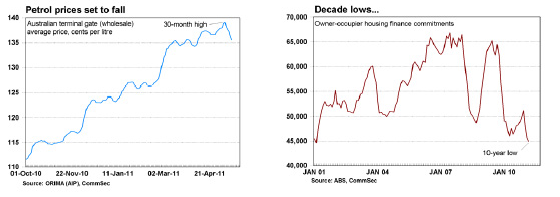
- The number of new owner-occupier housing loans fell by 1.5 per cent to 44,968 new commitments –marking the lowest result since March 2001. The number of loans is 5.0 per cent lower than a year ago
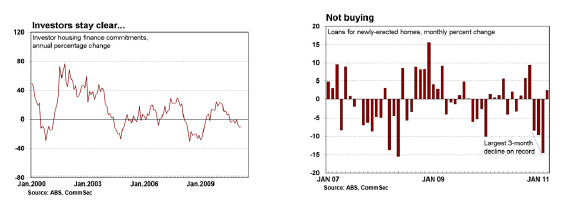
- Loans for the purchase of newly erected dwelling rose by 2.4 per cent in March after sliding by more than 32 per cent in the prior three months.
- According to the Australian Institute of Petroleum, the national average Australian price of unleaded petrol fell by 0.2 cents per litre to 145.7 cents a litre in the week to May 15. The terminal gate (wholesale) price fell by 3.5 cents a litre in the past week and as such CommSec believes petrol prices could fall around 4 cents a litre over the next week.
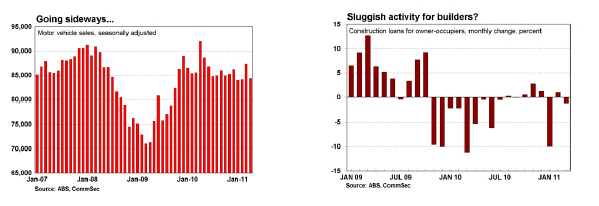
- New car sales fell by 3.5 per cent in seasonally adjusted terms in April, after rising by 3.9 per cent in the prior month.
- The latest ABS analytical living cost indexes has highlighted that Australian households are experiencing higher living costs than shown by the inflation data. Employee households have seen living costs rise by4.9 per cent over the past year. Similarly aged pensioners noted a 4.1 per cent rise in costs while other households living of government benefits recorded a 5.1 per cent annual increase in living costs. Over the same period the CPI rose by 3.3 per cent.
What does it all mean?
- The latest petrol price data has confirmed what we discussed last week in our publication – petrol prices are set to ease substantially and the cheaper fuel prices are likely to be felt as early as this weekend. The terminal gate price has fallen by 3.5 cents a litre in the past week and as such motorist are in for some massive savings at the pump in just over a fortnights time. CommSec expects pump prices to fall by around 4 cents a litre in the next week.
- The housing sector has well and truly come of the boil. Home prices have been falling, albeit modestly, while the number of new loans have fallen to the lowest level in a decade. Clearly buying interest has dried up with potential home buyers holding off on purchases in all areas. Loans for the construction of new dwellings – a key forward looking indicator for housing activity – fell by 10 per cent in the past three months and are now holding at the lowest levels in 27 months.

x
- Even the 2.4 per cent rise in loans to purchase newly established dwellings comes after a period of extended weakness. In fact over the prior three months loans fell by over 32 per cent.
- The natural disasters earlier in the year have no doubt had a negative effect on the housing sector, but rather than being the primary reason for the sharp downturn in housing activity it is more a peripheral issue that has compounded an already weak housing sector.
- Owner-occupied loans remain weak but the area that is most disappointing is the weakness in investor finance. Granted, investor finance recorded a modest rise in March, but even in annual terms investor finance is down over 10 per cent on a year ago. The slump in investment loans is yet another sign that potential investors believe that property prices are in for a period of consolidation, and as such can afford to take their time on investment decisions – especially given the likelihood of further rate hikes over the coming year.
- The Australian Bureau of Statistics has released the latest analytical data covering the rise in living expenses across Australia households. Interestingly living costs have risen more significantly across an array of households than suggested by the rise in the CPI. The sharp rise in living costs effectively adds another explanation as to why households have been reluctant to spend, coupled with a sluggish housing sector it is unlikely that the Reserve Bank is likely to raise interest rates in the next couple of months.
x
What do the figures show?
Housing Finance:
- The number of new owner-occupier housing loans fell by 1.5 per cent to 44,968 new commitments – marking the lowest result since March 2001. The number of loans is 5.0 per cent lower than a year ago.• Loans for the construction of homes fell by 1.1 per cent in March to 4,526 – holding at 27-month lows. Loans for the purchase of established dwellings (ex refinancing) fell by 1.1 per cent, while loans for the purchase of newly erected dwellings rose by 2.4 per cent. The rise in newly erected home purchases follows a 14.4 per cent fall in February, a 9.6 per cent fall in January and an 8.5 per cent slide in December. Refinancing commitments were lower by 3.0 per cent.
- The value of new housing commitments (owner occupier and investment) fell by 0.1 per cent in March. Owner occupier loans slumped by 1.1 per cent while investment loans rose by 2.1 per cent.
- Banks accounted for 91.5 per cent of all loans taken out in March up from 90.1 per cent in February.
- The proportion of first home buyers in the market rose from 6½ year lows of 14.9 per cent of all lending to 16 percent in March. Fixed rate loans accounted for 6.8 per cent of all loans in March, down from 7.3 per cent of loans. And the average home loan across Australia stood at $285,500, up 0.7 per cent on a year ago.
Petrol prices:
- According to the Australian Institute of Petroleum, the national average Australian price of unleaded petrol fell by 0.2 cents a litre to 145.7 cents a litre in the week to May 15. The metropolitan price fell by a similar 0.2 c/l to 145.5c/l, while the regional average price fell by 0.2 c/l to 146.1 c/l.
- Average petrol prices across states over the past week were: Sydney (down 1.1 cents to 144.8 c/l), Melbourne (down 0.3 cents to 144.4 c/l), Brisbane (down 1.1 cents to 147.4 c/l), Adelaide (up 4.9 cents to 148.1 c/l), Perth(up 0.2 cents to 145.2 c/l), Darwin (down 2.3 cents to 149.7 c/l), Canberra (down 1.4 cents to 143.4 c/l) and Hobart (down 0.2 cents to 150.7 c/l).
- The national average wholesale (terminal gate) fell by 3.5 cents over the past week to 135.5 cents a litre today.
- Last week, the key Singapore unleaded petrol price rose by US$1.41 (1.2 per cent) to US$123.43 a barrel. In Australian dollar terms the Singapore gasoline price rose by $1.62 (1.4 per cent) over the week to $115.86 a barrel.

New car sales:
- New car sales fell by 3.5 per cent in seasonally adjusted terms in April, after rising by 3.9 per cent in the prior month.
- Passenger car sales were flat in the month, while sports utility vehicles fell by 9.6 per cent and “other” vehicles (trucks, utes etc) fell by 5.5 per cent.
- Overall car sales are down 8.4 per cent on a year ago. Passenger vehicle sales are down by 11.3 per cent, SUVs are up 7.3 per cent and “other vehicles” are down by 0.7 per cent.
- In rolling annual terms, 236,670 SUVs were sold in the 12 months to March – easing from record highs.
x
What is the importance of the economic data?
- Housing Finance data is produced monthly by the Bureau of Statistics and shows commitments by lenders, such as banks, to provide finance for housing purposes. The lending figures relate to those looking to buy or build homes to live in as well as those seeking to buy or build homes for investment purposes. Generally people get their finance organised first, so the figures are regarded as a leading indicator on the housing market.
- Weekly figures on petrol prices are compiled by ORIMA Research on behalf of the Australian Institute of Petroleum. National average retail prices are calculated as the weighted average of each State/Territory’s metropolitan and non-metropolitan retail petrol prices, with the weights based on the number of registered petrol vehicles in each of these regions.
- The Australian Bureau of Statistics (ABS) provides monthly estimates of car sales in seasonally adjusted and trend terms after receiving the actual sales data from the car industry. The figures highlight the strength of consumer spending as well as conditions facing auto & components companies.
x
What are the implications for interest rates and investors?
- The rate hikes over the past year are having a profound impact on consumer spending patterns. The housing sector is cooling while businesses continue to highlight weak trading conditions. Given the subdued near term economic conditions it is unlikely that the Reserve Bank will be raising interest rates anytime soon.
- The long term fundamentals for the economy remain sound. The job market remains tight, wage growth is healthy and housing affordability is tracking sideways. The rebuilding phase after the floods will support housing activity,and in turn drive up economic growth, in the second half of the year. CommSec doesn’t expect the next rate hike to take place until at least August but there is also the risk that rate increase may be delayed until much later in the year.

Produced by Commonwealth Research based on information available at the time of publishing. We believe that the information in this report is correct andany opinions, conclusions or recommendations are reasonably held or made as at the time of its compilation, but no warranty is made as to accuracy, reliability orcompleteness. To the extent permitted by law, neither Commonwealth Bank of Australia ABN 48 123 123 124 nor any of its subsidiaries accept liability to any person for loss or damage arising from the use of this report.The report has been prepared without taking account of the objectives, financial situation or needs of any particular individual. For this reason, any individual should,before acting on the information in this report, consider the appropriateness of the information, having regard to the individual’s objectives, financial situation and needs and, if necessary, seek appropriate professional advice. In the case of certain securities Commonwealth Bank of Australia is or may be the only market maker.This report is approved and distributed in Australia by Commonwealth Securities Limited ABN 60 067 254 399 a wholly owned but not guaranteed subsidiary of Commonwealth Bank of Australia. This report is approved and distributed in the UK by Commonwealth Bank of Australia incorporated in Australia with limited liability. Registered in England No. BR250 and regulated in the UK by the Financial Services Authority (FSA). This report does not purport to be a complete statement orsummary. For the purpose of the FSA rules, this report and related services are not intended for private customers and are not available to them. Commonwealth Bank of Australia and its subsidiaries have effected or may effect transactions for their own account in any investments or related investments referred toin this report.