Housing finance
- The number of new owner-occupier housing loans rose by 4.8 per cent in April after falling by 1.1 per cent in March. The number of loans is 3.1 per cent higher than a year ago
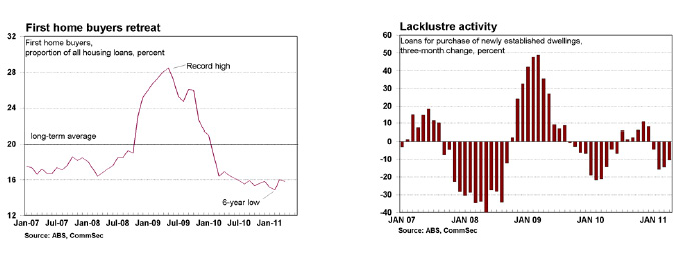
- Loans for the purchase of newly erected dwelling rose by 9.0 per cent in April after sliding by more than 28 per cent in the prior four months.
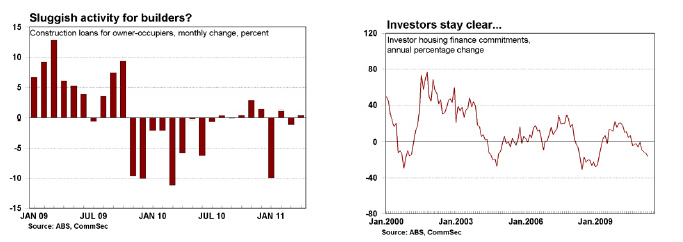
- Loans for the construction of homes rose by 0.4 per cent in April however were still down 11.8 per cent on a year ago.
- The value of investment loans fell by 1.6 per cent in April to $6.04 billion – a two year low. Investment loans are now down 15.9 per cent on a year ago.
What does it all mean?
- The latest improvement in the housing finance figures is certainly a welcome sight. Over the past few months the housing sector has certainly come off the boil and the modest gain in April is encouraging. However few more months of healthy gains will be required to claim a revival in the fortunes of the housing sector.
- Rather than focusing on just one month’s data the broader picture highlights that conditions in the housing sector are soft. Buyers have been holding off on purchases in all areas. Loans for the construction of new dwellings – a key forward looking indicator for activity housing activity – is still down by almost 12 per cent on a year ago. While loans to purchase newly established dwellings is still down a cumulative 20 per cent in the past five months, and that is despite the nine per cent jump in April. Clearly the recent weakness in house prices is unlikely to turn around anytime soon.
- The natural disasters earlier in the year have no doubt had a negative effect on the housing sector, but rather than being the primary reason for the sharp downturn in housing activity it is more a peripheral issue that has compounded an already weak housing sector. Of more importance it is the impact of last year’s rapid fire interest rate hikes that is still being felt across the economy.
- Owner-occupied loans remain weak but the area that is most disappointing is the weakness in investor finance. In fact investor finance has now fallen for four straight months and is now almost 16 per cent lower than a year ago. The slump in investment loans is yet another sign that potential investors believe that property prices are in for a period of consolidation, and as such can afford to take their time on investment decisions – especially given the likelihood of further rate hikes over the coming year.
x

What do the figures show?
Housing Finance
- The number of new owner-occupier housing loans rose by 4.8 per cent to 47,342 new commitments in April –marking the first rise in four months. The number of loans is now up 3.1 per cent higher than a year ago.
- Loans for the construction of homes rose by 0.4 per cent in April to 4,553 – still well below the decade average of4,916. Loans for the purchase of established dwellings (ex refinancing) rose by 5.8 per cent, while loans for the purchase of newly erected dwelling rose by 9.0 per cent. However newly erected home purchases are still down 7.2 per cent on year ago. Refinancing commitments were higher by 3.7 per cent.
- The value of new housing commitments (owner occupier and investment) rose by 3.7 per cent in April. Owner occupier loans surged by 6.3 per cent while investment loans fell by 1.6 per cent.
- Banks accounted for 91.4 per cent of all loans taken out in April down from 91.5 per cent in March.
- The proportion of first home buyers in the market fell from 16 per cent to 15.8 per cent in April – well below the decade average of 18.2 per cent. Fixed rate loans accounted for just 5.6 per cent of all loans in April, down from 6.8 per cent of loans. And the average home loan across Australia stood at $289,600, up 0.5 per cent on a year ago.
What is the importance of the economic data?
- Housing Finance data is produced monthly by the Bureau of Statistics and shows commitments by lenders, such as banks, to provide finance for housing purposes. The lending figures relate to those looking to buy or build homes to live in as well as those seeking to buy or build homes for investment purposes. Generally people get their finance organised first, so the figures are regarded as a leading indicator on the housing market.
What are the implications for interest rates and investors?
- The rate hikes over the past year are having a profound impact on consumer spending patterns. The housing sector is cooling while businesses continue to highlight weak trading conditions. Given the subdued near term economic conditions it is unlikely that the Reserve Bank will be raising interest rates anytime soon.
- The long term fundamentals for the economy remain sound. The job market remains tight, wage growth is healthy and housing affordability is tracking sideways. The rebuilding phase after the floods will support housing activity,and in turn drive up economic growth, in the second half of the year. CommSec doesn’t expect the next rate hike to take place until at least August but there is also the risk that rate increase may be delayed until much later in the year.

Produced by Commonwealth Research based on information available at the time of publishing. We believe that the information in this report is correct andany opinions, conclusions or recommendations are reasonably held or made as at the time of its compilation, but no warranty is made as to accuracy, reliability orcompleteness. To the extent permitted by law, neither Commonwealth Bank of Australia ABN 48 123 123 124 nor any of its subsidiaries accept liability to any person forloss or damage arising from the use of this report.The report has been prepared without taking account of the objectives, financial situation or needs of any particular individual. For this reason, any individual should,before acting on the information in this report, consider the appropriateness of the information, having regard to the individual’s objectives, financial situation and needsand, if necessary, seek appropriate professional advice. In the case of certain securities Commonwealth Bank of Australia is or may be the only market maker.This report is approved and distributed in Australia by Commonwealth Securities Limited ABN 60 067 254 399 a wholly owned but not guaranteed subsidiary ofCommonwealth Bank of Australia. This report is approved and distributed in the UK by Commonwealth Bank of Australia incorporated in Australia with limited liability.Registered in England No. BR250 and regulated in the UK by the Financial Services Authority (FSA). This report does not purport to be a complete statement orsummary. For the purpose of the FSA rules, this report and related services are not intended for private customers and are not available to them.Commonwealth Bank of Australia and its subsidiaries have effected or may effect transactions for their own account in any investments or related investments referred toin this report.