How do we know when a market is in recovery mode? Fil Andronaco, Senior Asset Consultant with van Eyk Research explains.
Unlike a market crash, which is quite evident, recoveries are more subtle in their nature and less easily identifiable. In these circumstances it can be tempting to latch onto one statistic to justify our belief one way or the other. But reality is almost always more complicated than that.
Take the US housing market for example. There is an increasingly popular view that the market, which is regarded as an essential driver of economic growth, is in recovery. The statistics people most often cite is the growth in home sales. It is true that sales have recovered substantially.
Chart 1 highlights some key statistics related to the US housing market (latest available data).
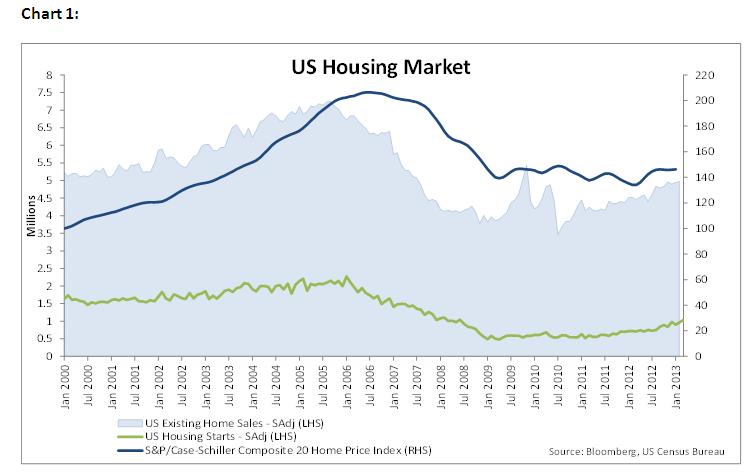

These credits expired in November 2009 and were subsequently extended to April 2010. Existing home sales then bottomed to 3.39 million dwellings in July 2010. But since that time, sales of existing homes have gradually recovered to their current level of around 4.98 million dwellings as at February 2013. This is near the level of existing home sales prior to the housing boom of 2002–2007.
However, while housing sales have improved over the last three years, prices are yet to show any substantial improvement. The dark blue line in Chart 1 represents US house prices. Since January 2009 there has been little meaningful recovery in housing prices and they continue to remain well below their pre-GFC peak.
House prices are a key part of housing’s importance to the broader economy. Without prices rises, the consumer does not benefit from the “wealth effect” which makes homeowners feel richer and encourages them to spend and borrow more. The bad news is that there is unlikely to be any sustainable recovery in housing prices until there is a fall in the number of home foreclosures and distressed sales, which put downward pressure on prices.
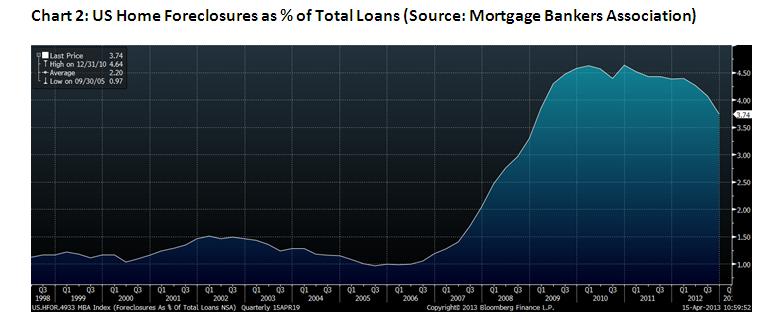
The good news is that we are beginning to see some improvement in these measures. For example, Chart 2 shows that foreclosure rates have been trending down from their 2009 and 2010 peaks, albeit they have some way to go before they return to more normal levels.

At their peak, US housing starts reached an annualised figure of 2.27 million dwellings in January 2006 but by April 2009 they had bottomed to just 478,000 starts. A more “normalised” level of housing starts is in the range of 1-1.5 million.
While the improvement in the green line appears minimal, housing starts have been trending above 900,000, annualised, in December 2012 and January 2013 and broke through 1 million in March 2013. This is a positive sign and getting close to a more normalised volume of construction.
So while there is evidence of a recovery in US housing, it is unlikely to be reflected meaningfully in prices until distressed inventory clears through the system, nonetheless things appear to be trending in the right direction.
Furthermore, while an improvement in the housing market is a key component of US economic recovery, housing by itself can’t cement the recovery, there also needs to be a sustained improvement in employment and growth in household incomes.