State & territory economic performance report
-

Sate of the states, July 2013
How are Australia’s states and territories performing? Each quarter CommSec attempts to find out by analysing eight key indicators: economic growth; retail spending; equipment investment; unemployment, construction work done; population growth; housing finance and dwelling commencements.
- Just as the Reserve Bank uses decade averages to determine the level of “normal” interest rates; we have done the same with the economic indicators. For each state and territory, latest readings for the key indicators were compared with decade averages – that is, against the “normal” performance.
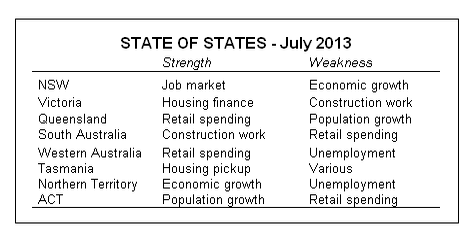
- Western Australia remains the top-performing economy in the nation with little slippage in the ranking over the past three months. However the big change has been the lift in the ranking of the ACT to second while the Northern Territory economy has slipped to third strongest. There has been little change in the ranking of other states with South Australia and Tasmania under-performing other economies at present.
- Western Australia comes out top on three of the eight criteria – housing finance, retail spending and equipment investment. Western Australia is still second on three of the eight indicators, third on dwelling starts and fifth on unemployment.
- The switching in the rankings of the Northern Territory and the ACT is largely due to weakening in the performance of the job market in the Northern Territory and improvement in the job market in the ACT. NSW is the fourth strongest economy from Victoria and Queensland. Then there is a gap to South Australia and then another gap to Tasmania.

Western Australia still on top; then the ACT and Northern Territory
- Western Australia remains Australia’s best performing economy, while ACT is now second strongest from the Northern Territory.
- Western Australia leads the way on retail trade, equipment investment and housing finance. It is second strongest on economic growth, construction work done and population growth; and finished third on dwelling starts and fifth on unemployment.
- The ACT economy is now the second strongest economy with the main strengths being housing finance, equipment investment and population growth. The ACT is now third strongest on unemployment, up from eighth in the past report.
- The Northern Territory finished first on three indicators: economic growth; dwelling starts and construction work done and was second strongest on retail trade. But the job market has weakened over the past three months and it now ranks seventh on this indicator rather than first.
- There is still little separating NSW, Victoria and Queensland in terms of relative economic performance. NSW is strongest on unemployment, and third strongest on population growth. Victoria is second strongest on housing finance and unemployment. And Queensland has high rankings on economic growth, equipment investment, construction work done and retail spending. But it lags on population growth and dwelling starts.
- There is then a gap in the rankings to South Australia. While the state is middle ranking on unemployment and construction work, it lags on economic growth, retail spending and equipment investment.
- Tasmania remains locked at the bottom of the Australian economic performance table. Tasmania lags all other economies on all of the eight indicators. The economy is still growing – economic growth and retail spending are growing faster than ‘normal’ or decade-average levels. But stagnant population growth is reducing activity in home building and home purchase, as well as commercial and engineering construction and business investment.

How was performance judged?
- Each of the states and territory economies were assessed on eight key indicators: economic growth; retail spending; equipment investment; unemployment, construction work done; population growth; housing finance and dwelling commencements.
- The aim was to find how each economy was performing compared with “normal”. And just like the Reserve Bank does with interest rates, we used decade-averages to judge the “normal” state of affairs. For each economy, the latest level of the indicator – such as retail spending or economic growth – was compared with the decade average.
- While we also looked at the current pace of growth to look at economic momentum, it may yield perverse results to judge performance. For instance retail spending may be up sharply on a year ago but from depressed levels. Overall spending may still be well below “normal”. And clearly some states such as Queensland and Western Australia consistently have faster economic growth rates due to historically faster population growth. So the best way to assess economic performance is to look at each indicator in relation to what would be considered ‘normal’ for that state or territory.
- For instance, the trend jobless rate in the ACT of 3.7 per cent is lower than all economies. But compared with its ‘normal’ or decade-average rate of 3.4 per cent, the jobless rate is actually higher in percentage terms than NSW and Victoria, thus restraining activity in the retail sector. Trend measures of the economic indicators were used to assess performance rather than more volatile seasonally adjusted or original estimates.
Economic growth
- Ideally gross state product (GSP) would be used to assess broad economic growth. But the data isn’t available quarterly. Rather state final demand (household and business spending) is added to exports less imports to act as a proxy for GSP. Exclusion of the trade sector would provide an incorrect assessment of growth for economies such as Western Australia and Queensland.
- The Northern Territory continues to lead the rankings on economic activity. Activity in the ‘top end’ is almost 40 per cent above its ‘normal’ or decade-average level of output.
- Next strongest is Western Australia, with output around 33 per cent higher than the decade average level of output. Then follows Queensland (up 18.3 per cent) from the ACT (up 17.3 per cent).
- At the other end of the scale, economic activity in Tasmania in the March quarter was just 3.0 per cent above its decade average while South Australian activity was up almost 10 per cent on its “normal” or average output over the past decade.
- There would be little change in the rankings if “final demand” was used instead. But NSW would move ahead of Victoria in fifth spot.
- The Northern Territory also maintains the fastest annual economic growth rate in the nation, up by 13.5 per cent on a year ago, ahead of Western Australia with 7.9 per cent and NSW (3.0 per cent).
- The weakest trend economic growth rate was recorded in Tasmania (-2.6 per cent) followed by South Australia (-2.1 per cent) and Victoria (-0.1 per cent).
Retail trade
- The measure used was real (inflation-adjusted) retail trade in trend terms with March quarter data the latest available. If monthly retail trade was assessed instead (May data available), there would be no change in the rankings. This provides added confidence about the overall results on consumer spending.
- Western Australia retains top spot on the retail rankings with spending in the March quarter 25.2 per cent above decade average levels. Solid population growth, a lift in home purchases and firm wage growth underpin the relative strength in consumer spending.
- Northern Territory was next strongest, again courtesy of low unemployment, with spending just under 19 per cent above decade-average levels.
- Queensland was next strongest, with spending 15 per cent above decade averages, followed by Victoria (up 11.5 per cent).
- Tasmania has the weakest result on retail spending, up just 2.7 per cent on the decade average (but up from 1.4 per cent in the December quarter), and below South Australia with growth of 6.6 per cent.
- In terms of the monthly retail trade series, Western Australian spending is 4.3 per cent higher than a year ago, just in front of Queensland with 4.2 per cent growth, the ACT with 3.4 per cent growth and NSW, up 3.2 per cent. At the other end of the scale, Tasmanian spending is 1.9 per cent down on a year ago and South Australian spending is lower by 1.0 per cent.
Equipment investment
- Western Australia continues to be well above other states and territories when it comes to equipment investment. Spending in the March quarter was almost 75 per cent above “normal” – or decade-average levels but down from 103.2 per cent in the December quarter. Next placed were the ACT (up 36.6 per cent) and Queensland (up 33.4 per cent) followed by NSW (up 15.7 per cent), Victoria (up 5.2 per cent) and Northern Territory (up 4.5 per cent).
- By contrast, new equipment spending in South Australia was in line with its decade-average while Tasmania had business investment 1.3 per cent below its longer-term average in the March quarter.
- On a shorter-run analysis, equipment investment in the March quarter was lower than a year ago in five of the state and territory economies. Currently equipment investment is down on a year ago in Tasmania (down 33.6 per cent), Northern Territory (down 26.9 per cent), South Australia (down 15.5 per cent), NSW (down 6.2 per cent) and Victoria (down 0.1 per cent). By contrast new equipment investment in the ACT is up 50.4 per cent on a tear earlier followed by Queensland (up 10.4 per cent) and Western Australia (up 0.1 per cent).
Unemployment
- NSW and the ACT arguably have the strongest job markets in the nation. While its trend unemployment rate of 5.5 per cent is not the lowest in the nation, the NSW jobless rate is just 5.1 per cent above the “normal” or decade average level.
- In the ACT, trend unemployment has fallen from 4.5 per cent to 3.7 per cent over the past four months but this is 9.3 per cent above its decade average rate of 3.4 per cent.
- In Victoria the 5.7 per cent jobless rate is 9.2 per cent above its decade average.At the other end of the scale Tasmania’s 8.1 per cent jobless rate is the highest in the nation and up 36 per cent on the decade average. The Northern Territory job market is next weakest – a significant turnaround over the last report. In the past six months the jobless rate has lifted from 4.0 per cent to 5.3 per cent and it is now 23 per cent above its decade average level of 4.3 per cent.
Construction work
- The measure used for analysis was the total amount of residential, commercial and engineering work actually completed in trend terms in the March quarter.
- In all states/territories except Tasmania construction work is higher than decade averages. And there remains a large gap between the strongest states (the resource states) and weakest states (Tasmania).
- In Tasmania, overall new construction work completed is 3.5 per cent below its decade average. By contrast construction work done in Northern Territory was almost 80 per cent above its decade average followed by Western Australia (up 66 per cent) and Queensland (up almost 53 per cent).
- Next weakest to Tasmania is Victoria where construction work is 15.8 per cent above decade averages, followed by NSW (up 19.4 per cent on the decade average).
- In terms of annual growth rates, Northern Territory construction work done in the March quarter was up 55.7 per cent on a year ago, followed by Queensland (up 7.7 per cent) and NSW (up 6.4 per cent). Four of the states and territories had weaker construction work than a year ago.
Population growth
- To assess population performance we looked at the current annual growth rate and compared it with each economy’s decade-average growth pace. And the good news is that population growth is above ‘normal’ in six states or territories while growth has also picked up in five jurisdictions over the past quarter.
- Western Australia is the clear leader in population growth. Not only is the annual growth rate of 3.47 per cent the strongest in the nation, it is also almost 46 per cent above the decade average. But the actual leader in the rankings is the ACT. Annual population growth of 2.31 per cent is the highest in 21 years and is almost 57 per cent above “normal’.
- In NSW current annual population growth of 1.25 per cent is 18 per cent above the decade average.
- At the other end of the leader-board is Tasmania where the annual population growth of 0.08 per cent is the weakest in over 11 years and a massive 90 per cent below the decade average rate of 0.77 per cent.
Housing finance
- The measure used was the trend number of housing finance commitments and this was compared with the decade-average for each respective state and territory.
- Housing finance is not just a lead indicator for real estate activity and housing construction but also is a useful indicator of activity in the financial sector. It would be useful to compare figures on commercial, personal and lease finance, but unfortunately trend data is not available for states and territories.
- In all but three states and territories, trend housing finance commitments are below decade averages – an improvement on the previous report when all economies had activity below decade averages. And encouragingly commitments in May were above year-ago levels in all but the Northern Territory.
- In the strongest state of Western Australia, the number of housing finance commitments was 10 per cent above the decade-average level and commitments in May were 16.5 per cent higher than a year ago.
- Victoria was in second spot for housing finance, with the number of commitments 2.3 per cent above the long-term average. And importantly the market has momentum with home lending 5.7 per cent higher than a year ago in trend terms to a 42-month high.
- The ACT remains in third spot on housing finance, up 1.4 per cent on the decade average followed by NSW (down 4.4 per cent).
- Tasmania is the weakest economy for housing finance with trend commitments 27.7 per cent lower than its decade average, but encouragingly commitments were up 4.9 on a year ago. Next weakest was the Northern Territory with trend commitments down 23.8 per cent on the decade average.
Dwelling starts
- The measure used was the trend number of dwelling commencements (starts) with the comparison made with the decade-average level of starts. Starts are driven in part by population growth and housing finance and can affect retail trade, unemployment and overall economic growth. However any over-building or under-building in previous years can affect the current level of starts.
- The outlook for housing construction has improved, underpinned by state government grants for new construction and low interest rates. Dwelling starts are above decade averages in five of the states and territories and again starts in five states and territories are above levels of a year ago.
- The Northern Territory is in the strongest position for new housing construction, with starts almost 54 per cent above decade averages. In addition in the March quarter the number of dwellings started was 27 per cent higher than a year earlier, although down from the 61.6 per cent annual growth in the December quarter.
- In second spot was NSW, with starts over 16 per cent above decade averages. And there is plenty of momentum with starts in the quarter up 33.4 per cent on a year ago – the best growth in three years. In Western Australia, dwelling starts in the March quarter were up 11.2 per cent on the ‘normal’ or “decade average” level with starts in Victoria up almost 6 per cent and ACT starts still 2.3 per cent above decade averages.
- At the other end of the scale, Tasmanian dwelling starts were 38.6 per cent below decade averages, while starts in the March quarter were 25 per cent down on a year earlier. Next weakest was Queensland (down 20.5 per cent), followed by South Australia (down 12.5 per cent). However encouragingly Queensland starts were higher than a year ago, albeit modestly, up just 2.3 per cent. And South Australian starts in the March quarter were up 14.4 per cent over the year.
Other indicators
- Real wages were positive in all economies in the March quarter except for the Northern Territory. Strongest growth occurred Tasmania at 2.2 percentage points, followed by Western Australia (1.3 percentage points) and the ACT (1.2 percentage points).
- Even using “underlying” inflation than “headline” inflation, real wages are growing on average by around 1.0 percentage points.
- Home prices are now higher than a year ago in all but Hobart (down 1.8 per cent). Strongest growth in home prices was in Darwin (up 6.1 per cent) followed by Perth (up 6.0 per cent) and Sydney (up 5.6 per cent).
Implications and outlook
- The good news is that economic performance didn’t become more polarised in the past three months. While Western Australia is still the best performing economy, it has seen some slippage in indicators such as unemployment. The Northern Territory also lost ground but the ACT lifted in the performance rankings courtesy of strong population growth, driving housing activity and leading to a stronger job market.
- There has been little change in the performance rankings of the three largest states: NSW, Victoria and Queensland.
- Tasmania remains at the bottom of the relative economic performance rankings. The economy is growing in a number of key areas such as demand for home loans but there isn’t enough momentum to catch the other state and territory economies. Encouragingly real wage growth is strong and this could serve to lift retail spending and consumer spending, boosting prospects for the business sector.
- In South Australia, government infrastructure spending is providing valuable support for the economy. Encouragingly new home loans are up 9.5 per cent on a year earlier to the highest levels in 40 months.
- All economies should lift once the uncertainty of the Federal Election is finally out of the way later in 2013.
- While new investment in mining and engineering construction is easing, the housing sector is providing a source of new growth, especially in regions where population growth is strongest.