
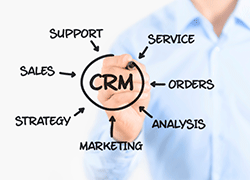
Getting your CRM right is essential for your business.
One of the thorny issues for financial advisers is finding the right Client Relationship Management (CRM) system.
What makes it even more difficult for many is they struggle to define what is “right”. As with most things in business, one should begin the decision making journey with a clear view of what you are trying to achieve. Begin with the end in mind.
I believe that Peter Drucker summed up the importance of the client database best when he said: “Knowledge has become the key economic resource and the dominant, if not the only, source of competitive advantage.”
We (and our clients) are drowning in information….but knowledge is a very different thing. Information is cheap, knowledge is valuable. The systematic collection and organisation of the knowledge of our clients is where the real capital value lies within an advice business.
Some of the issues I have run into in considering CRM systems have been:
- Who owns what? My client data is the intellectual property of my business….arguably it is the most important IP the business has….so what do the CRM vendor agreements say about ownership and portability of data? This is so important in my view that it is a show stopper. I would not consider any CRM system that does not reflect ownership of the data correctly, or which does not explicitly safeguard the access to or use of the data.
- A related issue, but one which is a significant concern with increasing compliance and statutory responsibility being placed upon advisers, is Privacy. A core promise made by many CRM vendors is that the platform can take product supplier downloads of policy information directly…an argument for efficiency on the surface. But if you are opening up your database to allow another party to pour data into it, are you also allowing another party to simultaneously uplift data from it? What safeguards are in place to prevent the possibility of your practice inadvertently breaching privacy laws?
- Adaptability. Each business is different, and there is a need today for “mass personalization“. Your practice needs to be systematic in its application of personalized advice and service. The adviser practice has to be able to adapt a CRM system to reflect its area of specialization so personalization of data recording, and the ability to introduce the adviser’s (or practice’s) own marketing and advice documentation or report writing facilities is an essential.
- It has to work in with your chosen email platform, not the CRM vendors preferred email platforms. Your primary form of recorded communication with clients for the foreseeable future will be email, so it is one of the key business marketing tools. Do not compromise your key marketing tools because they do not fit with a CRM vendors preferences.
- Tailored workflow management at individual client level is required. Each engagement has the potential to be slightly different, and although the same essential process needs to be employed in delivering best practice advice that is compliant, you need to be able to personalise the desired workflow at individual client level taking into account the clients instructions and your scope of service.
- Integrate business workflow with company financial reporting. Fees, commissions, regular review fees….ideally these will be captured within an individual client record, but will also be used in the overall company financial management and reporting. You want to minimise data capture…or rather, minimise the repeating of data capture. Capture it well, once, and have the data flow through to all the places you need it.
- Be able to integrate your key digital marketing channels, such as social media posts. Capturing and recording any interactions via social media would be an ideal, but at the very least your marketing database needs to be able to feed information to your marketing distribution channels.
- Be able to backup independently of the software supplier, preferably to a separate cloud based backup facility.
- Provide meaningful sales & marketing data. Client profiles, demographics, sources of business, profitable and unprofitable clients, key business metrics with product suppliers, ROI on specific campaigns or marketing initiatives….this is all very useful business intelligence. You can only manage what you measure.
- Can the CRM work with voice recognition programs to record data (e.g Dragon Dictate?), or to create reports or manage workflow?
- Accessible and useable via mobile. Not just tablets, but via phone as well. Advisers need to capture and record every interaction with clients and there is a need to capture SMS conversations, and a need to be able to record client notes while on the move and immediately after client contact.
One would expect any decent CRM system to provide basic features such as the ability to categorize and segment client bases, be able to personalize customer data fields to suit the individual adviser business, and to be able to record critical policy or product information in a meaningful (and searchable) format, so I have largely ignored such issues here.
One thing which may seem inconsequential but will matter enormously to your use of a CRM is the ability to change terminology on product or policy information. To be blunt, the product terminology used in the USA is not the same as the terminology used in NZ or Australia. In fact, the terminology in Australia and NZ is not the same…which downgrades the effectiveness of a CRM if it is providing reports to clients with jargon that nobody understands.
In a similar vein, my own unfortunate experience has been that when allowing multiple product suppliers to download data into my CRM each of them created mayhem by continually replicating records or over-writing other data. The expectation was that we would be configured to meet their system requirements…but of course once we had begun personalizing data fields we didn’t match their systems. So each download would create new client records in our CRM when there was a mismatch, resulting in a single client having multiple corrupted records… .and if you add in data downloads from half a dozen other suppliers it becomes totally chaotic. We simply switched off policy data downloads from suppliers in pretty quick time….partly because of the mess, and partly because of the privacy concerns.
I am by no means an expert on CRM solutions….or even an expert on technology issues. I am an avid user of technology and software for business efficiency however and I do know what has frustrated me and rendered some whizz-bang products to being something rather ho-hum as far as my business is concerned. These have been the big ones for me, and the ones that I would be asking a lot of questions about when considering any changes to a CRM system in the future.
How an advice business collects, stores and uses it’s customer information is where it has the greatest opportunity is to leverage knowledge.
Take a lesson from the banks, as that is what they have done better than anyone. They have mastered the collection and use of customer knowledge.