Over the past year or two, investors globally have become more wary about bonds, envisaging the end of the 30-year rally in bond yields. Yields on bonds remain relatively low, below what some term their ‘normal’ levels. This is being artificially driven by central banks’ bond buying and historically low cash rates across the globe.
Investors looking at their medium-term and long-term investments are currently asking themselves: what is in store for bonds when rates normalise? As central banks’ bold experiment in monetary policy comes to an end and they begin to normalise cash rates, many investors fear possible negative returns on bonds, such as we had in 1994, which is notorious as the year of the great bond rout. Either we will see an orderly bond selloff (with a slow, steady rise in yields) as the central banks successfully manage to exit quantitative easing (QE) without causing market panic, or we may experience a disorderly one if central banks lose control of the process. Another possibility is that there is a selloff caused by inflationary fears. Whichever scenario one subscribes to, the outlook for bonds does look risky.
Obviously with any asset class, investors must ask the question: does the cost of holding bonds outweigh the benefits of holding bonds? In our view, the answer is no. Bonds remain an important component of a portfolio: even in a rising cash rate environment, diversifying a portfolio so that it includes fixed income alongside other assets can help balance returns, diversify risk and reduce overall volatility. The approach should not be to avoid or sell out of bonds, but to look at the types of bonds in a portfolio and to adopt a flexible, active approach that helps cushion the bond portfolio against rising rates.
Bonds are the only truly defensive asset
Over the past few decades, Australian investors have largely ignored fixed income investments, preferring cash or term deposits as the defensive assets in their portfolios. Although they believed they were investing in asset classes which were getting higher returns, actual returns were higher for true fixed income funds since cash and term deposit holdings missed out on the capital returns enjoyed by bonds.
In addition, these investors missed out on the major benefit of holding high quality bonds – the negative correlation they provide to equities. Although bonds don’t generally deliver the high returns that equities do, holding them in addition
to equities should decrease the risk in a portfolio. In market environments when equities are performing poorly, the bond holding can help to offset losses on the equity portion. So it’s possible to construct an efficient portfolio that maximises potential returns while helping to minimise risk. This cannot be done with other defensive asset classes, such as cash or term deposits, because their correlation to equities is zero and can even verge on positive in the long term since falls in equity markets can lead to cash rate cuts by central banks.
Bonds tend to perform relatively better in market downturns and when, due to very low inflation or deflation, prices are falling. Although bonds may perform well during times of low inflation or deflation, such an environment is bad for most other asset classes, particularly equities. Central banks around the world have strived for low inflation, but the risk from any cyclical fall in inflation can lead to a deflationary scare in financial markets, such as we saw in 2001 and 2009.
The reason why we have seen such a bold QE experiment by central banks is that they have learnt how to deal with inflation and have the tools to do so. However, most have not had to deal with deflation and don’t necessarily have the tools to handle such a scenario. Japan in the 1990s and the US in the 1930s are examples of the risk of deflation and the difficulty it takes to get out of such a situation once in it. With low world inflation and the weakening of conventional monetary and fiscal policies, deflation is still a potential risk for investors to consider, just as inflation was in the 1970s and 1980s. Maintaining an allocation to bonds would help to offset this risk given their superior performance in such an environment. Cash and term deposits would not offset the risk of deflation because the RBA would cut the cash rate to very low levels in order to try to jump-start the economy in that scenario.
Assessing risk for bond portfolios
The short-term risk of higher rates is compounded by the current relatively low yields and the fact that duration has increased for bonds and the typical benchmarks. The lower a bond’s duration, the lower its price volatility and the less sensitive it will be to interest rate changes. The duration of the UBS Composite Bond Index 0+YR (the benchmark for most Australian bond funds) is currently around four years compared with three years prior to the GFC1. The major reason for this is that government issuance since the GFC has tended to be longer in nature. For example, Australia issued a 20-year government bond in November, the longest maturity bond to be issued since the 1960s.
Apart from duration, it’s important to consider what will happen to bond yields when assessing what a rise in rates will do to bonds. The most important consideration is when and how orderly, or disorderly, the bond selloff is. If rates were to rise and bond yields rose in an orderly and steady manner, they wouldn’t suffer large losses. However, in a disorderly selloff or market panic, it’s possible that we could see negative returns, as in 1994. The big risk to bonds isn’t so much rising rates, it’s rapidly rising rates. A fact that might surprise some investors is that in the past 20 years, Australian bonds have only experienced negative returns twice, in 1994 and 1999. Although 1994 saw a very disorderly selloff in the bond market, it only delivered a negative return of 4.66%, with -1.22% for 1999 . The most common returns over the whole 20-year period have been between +5% and +15%.
In addition, unlike capital losses experienced on equities, capital losses on bonds are recovered over subsequent periods until maturity. This is called the ‘pull-to-par’ effect: As a bond approaches maturity, its market value gets closer and closer to its face value based on an assumption by the market that the bond will be repaid in full and on time. Even if rates do rise and prices fall, as long as the issuer remains solvent, investors will receive repayment of their full capital investment at the bond’s maturity. So, if you hold a bond until it matures, you won’t lose your principal. The potential for capital loss thus only comes when selling a bond before it matures or if the issuer defaults.
New natural rate of interest is around 4%
Quantitative easing from global central banks has depressed real rates and term premiums. The chart below shows how we believe the new natural interest rate (NRI) has changed from being around 5-5.5% from the start of the century until the GFC, to around 4-4.5% since then. In our view, the reasons for the drop are pressure on the government to rein in spending and that since the Reserve Bank of Australia (RBA) started cutting the official cash rate, Australia’s banks have retained around 100 bps of those cuts and not passed them on.
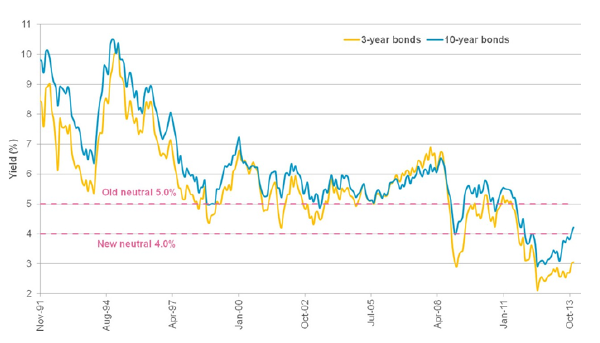

Source: Bloomberg
If rates were to normalise, we should expect the cash rate to head toward this new NRI, so potentially the extent of the rise over time would be around 150-200 basis points (bps). Obviously, the NRI can change temporarily, but this means the extent of the selloff shouldn’t equate to 1994.
In our view, the concept of duration should be rethought, particularly as it applies to individual bonds. As a measurement of risk in a portfolio, duration is still highly relevant since it measures the portfolio’s sensitivity to interest rates. However, that does not mean that long duration bonds are necessarily more risky – as the chart above shows, 10-year bonds are currently within the 4-4.5% band of this new NRI. If long-term rates don’t move or don’t move by too much, then longer duration bonds shouldn’t be particularly affected. If we saw the cash rate rise to 4.0%, then it would be the yield on the shorter maturity bonds which would react the most and despite their shorter durations, they would suffer worse losses than higher duration bonds. Longer duration bonds are more vulnerable to central banks decreasing their purchases or decreased foreign investment in Australian bonds as the supply increases. However, a normalisation of cash rates would not hurt all maturities of bonds equally.
Because a bond portfolio comprises a variety of bonds with different interest rate levels and maturities, it should have a steady stream of maturities which can be invested at the higher yields if cash rates/yields are rising. By owning bonds of different maturities, fund managers ensure that they are not tying up money for too long. If and when interest rates go up, maturing assets offer the opportunity to reinvest that capital into more recently issued, higher yielding bonds. As such, the effect of any return erosion is constantly being reduced and so any capital losses on bonds should be recovered over time. It’s important to remember that not all bonds are the same: a diverse portfolio containing different bond types and maturities helps to minimise any potential losses.
Conclusion: Bonds remain a good long-term investment
Bonds remain a viable asset class despite the risk of higher rates in the short term. Apart from bonds’ defensive qualities and negative correlation to equities, the longer term threat of deflation and the impotence of central banks to deal with it also warrants an allocation to bonds. The question is which bonds to invest in and at what level. Good value can still be found in various areas of the bond market, such as semi-government, bank and some corporate bonds, as well as by using duration and yield curve strategies. Opportunities remain to add value through bonds via active management using a variety of different strategies in combination to produce a diversified, well performing portfolio.
By Roger Bridges
————-