The media and markets’ love of neologisms can obscure the investment reality
New global themes and trends, usually relayed and reinforced by the 24-hour news cycle, have a funny way of overpowering fundamental analysis of markets and economies. My favourite example in 2013 was failed electronics retailer Tweeter, which saw its share price soar by over 1000% when investors caught up in the hysteria over the Twitter IPO mistook its stock code—TWTRQ—for Twitter’s (TWTR). Investors bought 14 million Tweeter shares in a single day.
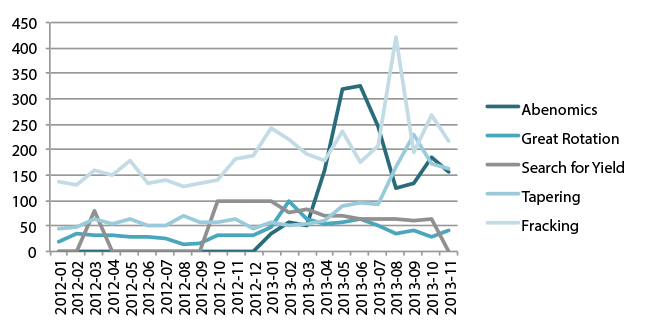
Granted, this is an extreme example, but in some ways we are all guilty of focusing too much on the investment theme du jour. While these themes can have enormous power to move markets, they often obscure the fundamental story that investors should be focusing on. Below are what I consider to be the most overused and abused phrases and concepts of 2013 (with their prevalence in Google search results) and what we should have focused on instead (it may not be too late!).
Chart 1: Google search results (Source: Google)

“Whatever it takes”
Just three words uttered by European Central Bank President Mario Draghi in July 2012 but which heavily influenced market sentiment well into 2013. Implied by this phrase was an assurance that the Eurozone would not let one of its members fall down. The backstop proved solid as the Cyprus crisis that erupted in March 2013 didn’t cause nearly as much disruption to world markets as its PIIGS predecessors did in 2010, 2011, and 2012. However, Mr Draghi was conveniently long on promises and short on details. Saving the Euro could realistically only be done if the Eurozone transforms itself from a monetary union to a fiscal one. Getting all 17 members to agree to this (especially Germany) is tricky at best, and while an agreement on fiscal union was signed, it has yet to be carried out. Instead of focusing on Draghi’s promise, investors should monitor the implementation of actual reforms (or lack thereof).
“The great rotation”
Refers to the supposedly “secular” change in asset allocation that will see investors abandoning their low yielding fixed interest securities in favour of equities. As is often the case though, most of the rotation had already occurred by the time the media took hold of the story, since sovereign bonds have been overvalued relative to equities for the last two to three years. The Australian version of the “great rotation” that is seeing investors leaving their term deposits in favour of local equities is perhaps a notable exception, as the process is still very much in progress. Overall, there is nothing secular about the change and nothing “great” about the rotation. The yield of the US 10-year Treasury bond has gone up in 2013 and will most likely continue to do so in 2014, as the Federal Reserve slowly withdraws quantitative easing. As bonds become more attractive again, investors will inevitably switch back.
“Search for yield”
A sub-theme of the great rotation, it pertains to investors for whom yield (rather than capital growth) is a primary investment objective, such as retirees. For them, abandoning fixed income investments is only half the equation and an appropriate income stream must be found elsewhere. The solution they opted for en-masse were shares with high dividend yields. This phenomenon has been powerful enough that it created a market distortion nick-named…
“Expensive-defensives”
Defensive, high yielding stocks are traditionally perceived to be more defensive than high growth stocks, and usually priced more conservatively. That is, they tend to lag in market rallies. However, these stocks have undoubtedly led the S&P/ASX 200 Index in 2012 and 2103, earning them the “expensive” label. Indeed, according to most measures of valuation, the likes of Telstra and the four major Australian banks appear expensive at current levels, which means they are likely to lose more than the overall market in a future downturn. So while certainly expensive, they have probably lost their defensiveness. This could be the exception to our rule, because despite extensive use of this term in the media, investors don’t seem to have altered their behaviour. Quite the contrary, some companies have picked up on the trade and are issuing debt in order to pay for dividends, knowing it will increase their share price. The concept of dividend growth sustainability doesn’t seem to have penetrated investors’ consciousness just yet.
“Fracking and shale gas”
Infrastructure investments have been the other main beneficiaries of the “search for yield”. The sales and marketing departments of investment banks have come up with the perfect cover story to sell them: technological advancement leading to productivity gains. Everything started with a supposedly innovative drilling technique called hydraulic fracturing (shortened to “fracking”) that allows gas and petroleum to be extracted from previously hard to reach bedrocks. But fracking was actually first tested in 1947 and the (very real) shale gas boom in the US owes its success to many other factors as well, including high oil prices and pre-existing pipeline networks. While fracking will, in all likelihood, continue to expand, it is fair to assume that the remaining upside in all related investment opportunities is limited. That should include the Australian “gas boom”. Furthermore, no one has yet been able to explain why, despite the abundant new supply of natural gas, the price of oil has remained near historical highs. The answer to this question is probably the key to successful future investments in energy. Supply and demand anyone?
“Abenomics”
The term used to describe the economic policies of Japanese Prime Minister Shinzo Abe, whose PR team also deserves special mention for having come up with the “three arrows” concept: fiscal stimulus (also known as government borrowing more to spend more), monetary stimulus (quantitative easing) and structural reforms. The Japanese Nikkei 225 Index has risen 46.5% YTD on the back of the first two arrows being implemented and the promise that the third one is imminent. With Japan’s debt-to-GDP ratio at 230%, the first arrow can only be pursued with the help of the second, that is, if the central bank buys every bond issued by the government. The central bank is expanding its balance sheet to previously unthinkable levels and Mr Abe appears to have convinced international investors that this can be done ad-infinitum. The sceptics among us believe that at a certain (as yet unquantifiable) point, the sheer size of the central bank’s balance sheet as a percentage of GDP could cause investors to lose confidence and devalue the yen by much more than Abe is targeting, plunging the country in a more severe recession. Only structural reforms can help save Japan, and they are not yet being implemented.
“Septaper”
The tapering of the US Fed’s quantitative easing measures was set to happen in September, but didn’t. From April on, members of its policy setting body the Federal Open Market Committee started to put out “feelers”, implying that the Fed may reduce the amount of Treasuries it was buying every month (currently still at $US85 billion). The markets took those indications very seriously and long-term bond yields started to rise as a consequence. While the Fed seemed satisfied enough with the slow pace of economic recovery to begin to taper, it deemed the recovery too fragile yet to sustain higher yields and delayed the decision. One cannot blame the financial press for focusing so much attention on an event that is indeed a turning point in the post-GFC recovery, one that we’ve been awaiting for five years. It is, however, regrettable that the adverse side effects and unintended consequences of quantitative easing have gone largely unnoticed. For one, the liquidity provided by the Fed has led to new records in corporate debt issuance, which companies have used to issue higher dividends and buy back more shares, inflating their share prices. Another notable side effect has been the lack of availability of US Treasuries (because the Fed holds so many), which are needed as collateral for many lending transactions. As a result, borrowing has been somewhat restricted, even though QE was originally designed to boost borrowing.
——————
By Jonathan Tolub, senior asset consultant, van Eyk Research