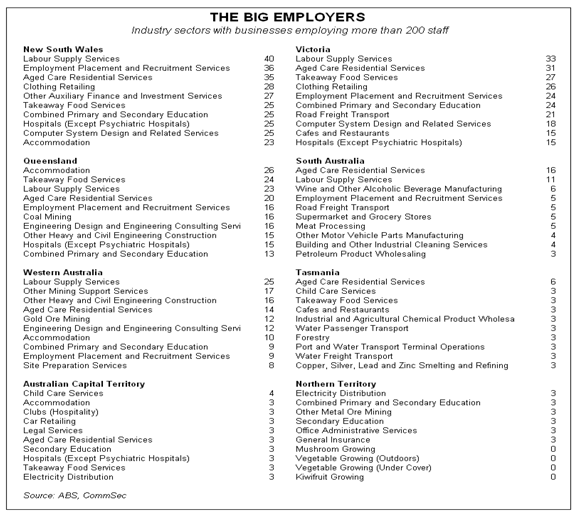
What do the figures show and what does it all mean?
When you think of big employers, you tend to think of major banks, retailers or mining companies. But if you are looking at the industries which have a big concentration of firms employing more than 200 people, you may be surprised at the results. “Big Business” includes schools, hospitals, takeaway food businesses and hotels.
Across Australia, there is a raft of firms in both the Aged Care Services and Labour Supply Services industries that have more than 200 staff.
But some of the results across Australia are less surprising. For instance in Western Australia, there is a high number of firms in Mining, Mining Support and Heavy Engineering that employ more than 200 people. In South Australia, there are six Wine Manufacturing firms employing more than 200 staff. And in Queensland there are big employers across Coal Mining, Engineering and Heavy & Civil Engineering Construction.
Large Takeaway Food Services firms are also well represented in NSW, Victoria and Queensland.
The data released yesterday by the Bureau of Statistics also enable researchers to determine the number of businesses across small suburbs and regions, classified by employment. And other tables enable researchers to determine the number of businesses by fine industry level (or industry class). For instance, the data shows there were 166 Deer Farming operations as at June 2013 (with most in Victoria). Or there were 2,762 Health and Fitness Centres in operation across Australia at the same date.
Other data shows the number of businesses classified by turnover which is important in highlighting the concentration of bigger businesses across industries.
The data has myriad uses for businesses, local governments and financial institutions. Especially for the latter – data showing survival rates of businesses is important in highlighting the risk of dealing with certain industries.
Budding business operators and investors can also highlight opportunities by examining entry/exit rates, survival rates and the number of businesses already operating in regions or towns.