Population; Employment by Industry
- Industry employment: Employment rose by 14,400 over the three months to May – the smallest quarterly increase in three quarters but after strong gains in the previous six months.
- Shift in rankings: The Professional, Scientific and Technical Services sector is now the fourth biggest employer in Australia, moving past Manufacturing for the first time.
- Employment rose in 9 of the 19 industry sectors. The largest job gains was in Professional, Scientific and Technical Services (up 47,000), followed by Rental, Hiring and Real Estate Services (up 29,000).
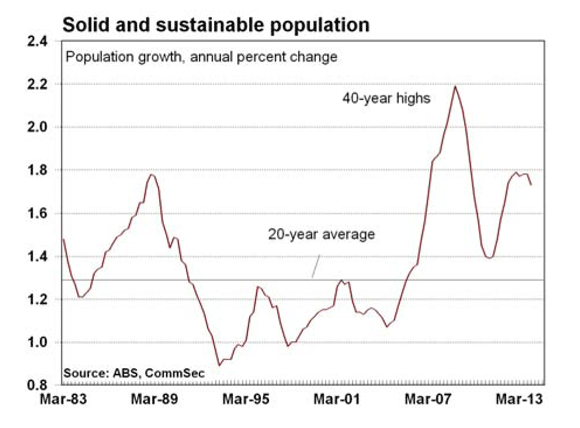
- Population: Australia’s population 1.73 per cent over the year to December 2013, down from 1.78 per cent in the year to September. Australia’s population stood at 23,319,385 people at the end of December 2013.
- NSW Population lifts: The NSW population grew by 1.5 per cent in the year to December, the fastest in four years and underpinning the lift in the economy over the past year. Tasmania’s population is growing at the fastest rate in two years.
What does it all mean?
- Job growth was modest in the three months to May, but given the negative media attention on the Budget, this was understandable. But it is clear that the housing sector is now driving job gains with professional services like architects, surveyors, conveyancing staff, real estate agents and accountants in strong demand.
- This is yet another example of the “passing of the baton”. Mining construction is no longer driving job gains across the economy, but rather the construction or purchase of houses and apartments. The fact that the housing market is labour intensive augurs well for job creation, spending and overall economic momentum.
- The Accommodation and Food Services sector also recorded solid job gains in the past three months, reflecting increased travel demand and the warm autumn weather – causing more people to go outdoors to cafes & restaurants.
- Australia continues to maintain one of the fastest population growth rates in the world as part of the PPP strategy to address the financial challenges associated with the ageing of the population. And the attempts to boost population, participation in the workforce and productivity growth have been remarkably successful.


What does the data show?
Demographic Statistics
- Australia’s population grew by 1.73 per cent over the year to December 2013, down from 1.78 per cent in the year to September and the slowest growth in almost two years. Australia’s population stood at 23,319,385 people at the end of December 2013.
- In the year to December 2013, 308,000 babies were born; shy of the record 311,400 babies born in the year to June 2013. The number of deaths stood at 147,700 over the year to December, down 0.1 per cent over the year. Overseas migration totalled 235,800 over the year to December, the slowest growth in 18 months and below the record high of 315,700 in the year to December 2008.
- Across the states and territories, fastest annual population growth occurred in Western Australia (2.88 per cent – the fifth quarter of slower annual growth), followed by Victoria (1.90 per cent), Queensland (1.73 per cent), Northern Territory (1.69 per cent), ACT (1.63 per cent), NSW (1.50 per cent), South Australia (0.91 per cent) and Tasmania (0.30 per cent).
- Population was below the decade average in Queensland, South Australia, Northern Territory and Tasmania. Annual population growth in NSW was the fastest in four years.
Industry employment:
- Economy-wide employment rose by 14,400 in the three months to May 2014 – the slowest growth in nine months but after an outsized 58,800 lift in jobs in the three months to February.
- Employment rose in just 9 of the 19 industry sectors. Employment rose most in Professional, Scientific and Technical Services (up 47,000) followed by Rental, Hiring and Real Estate Services (up 29,000) and Accommodation and Food Services (up 26,200).
- Jobs fell the most in Health Care and Social Assistance (down by 35,200) followed by Manufacturing (down by 28,200) and Arts & Recreation Services (down by 26,400)
- Healthcare remains the biggest employer with 1.39 million employees (12.1 per cent of the total) followed by Retail Trade (10.7 per cent) and Construction (8.8 per cent).
- Professional, Scientific and Technical Services, including lawyers, accountants, engineers, surveyors, vets and advertising staff, is now the fourth biggest employer with 937,600 jobs or 8.1 per cent of the total. The Professional, Scientific and Technical Services sector has passed Manufacturing for the first time.
- Demographic Statistics are issued by the Bureau of Statistics each quarter. The figures include estimates of births, deaths, in-bound and out-bound migration movements and estimates of population change by State.
- The Australian Bureau of Statistics (ABS) provides detailed labour market figures one week after releasing ‘top level’ statistics of employment & unemployment levels across states and territories. The detailed data is useful in identifying broader underlying trends and instructive about the health of the economy.
- The high-profile announcements of job cuts in recent months are only part of the story. Across a raft of small and medium-sized businesses, especially in “white collar” professions, jobs are being created. And more jobs are being created than those lost. Around 97 per cent of businesses employ less than 20 people – an important point that tends to get lost in the economic messages filtering across the economy.
- States and territories with fastest population growth rates are still out-performing when it comes to assessing economic criteria. The good news is that population growth has lifted in Tasmania to the fastest rate in two years and serving to boost momentum in the economy.
- The slowdown in population growth in late 2013 has corresponded to weaker retail spending growth during early 2014. But, more positively, consumer confidence has lifted in recent weeks while housing activity remains robust, pointing to higher spending and job growth ahead.


What is the importance of the report?
- Demographic Statistics are issued by the Bureau of Statistics each quarter. The figures include estimates of births, deaths, in-bound and out-bound migration movements and estimates of population change by State.
- The Australian Bureau of Statistics (ABS) provides detailed labour market figures one week after releasing ‘top
level’ statistics of employment & unemployment levels across states and territories. The detailed data is useful in
identifying broader underlying trends and instructive about the health of the economy.
What are the implications for interest rates and investors?
- The high-profile announcements of job cuts in recent months are only part of the story. Across a raft of small and medium-sized businesses, especially in “white collar” professions, jobs are being created. And more jobs are being created than those lost. Around 97 per cent of businesses employ less than 20 people – an important point that tends to get lost in the economic messages filtering across the economy.
- States and territories with fastest population growth rates are still out-performing when it comes to assessing economic criteria. The good news is that population growth has lifted in Tasmania to the fastest rate in two years and serving to boost momentum in the economy.
- The slowdown in population growth in late 2013 has corresponded to weaker retail spending growth during early 2014. But, more positively, consumer confidence has lifted in recent weeks while housing activity remains robust, pointing to higher spending and job growth ahead.
