Economic forecasters, sharemarket commentators and crystal ball gazers are busily predicting the directions that sharemarkets will take in 2015. Typically, views are divergent – some see markets reaching record highs, while others take a more pessimistic view.
Whatever the direction, all seem to agree on one point – there is likely to be volatility along the way.
What is volatility?
Often confused with risk, volatility is the statistical measure of the dispersion (or spread) of returns for a given security or market index. It refers to the amount of uncertainty about the size of changes in a security or indices’ value.
A higher volatility means that a security’s value can potentially be spread out over a larger range of values; therefore the price of the security can change dramatically over a short time period in either direction. A lower volatility means that a security’s value does not fluctuate significantly, but may change in value at a steady pace over a period of time.
Measuring volatility
In 1993, the Chicago Board Options Exchange (CBOE) created the Volatility Index – or VIX – to reflect investors’ consensus view of future 30-day expected stock market volatility of the S&P500 Index. A high VIX reading indicates that investors see significant risk that the market will move sharply, either up or down.
Periods of financial stress are often accompanied by steep declines in the sharemarket. As a result, option prices – and the VIX Index – tend to rise. The greater the fear, the higher the VIX level, which is why the VIX has become colloquially referred to as the “fear index”.
VIX futures were launched on the CBOE Futures Exchange in 2004 and VIX options began trading on the CBOE in 2006. While you cannot invest directly in the VIX, a highly liquid derivatives market has made volatility an investable asset class.
In 2013 the Australian Stock Exchange (ASX) launched the A-VIX, a volatility index based on the S&P/ASX200 Index (ASX200). Currently, futures contracts are the only derivative instruments available and to date, volumes – and therefore liquidity – have been low.
Why invest in volatility?
Negative correlation to US equities…
Volatility is an asset class that is causally negatively correlated to equities, as represented by the S&P500 Index; it is inversely related to equity index prices, especially when there are large moves. This causal relationship, illustrated by figure one, enables an investor to generate negative correlation that is persistent and reliable.
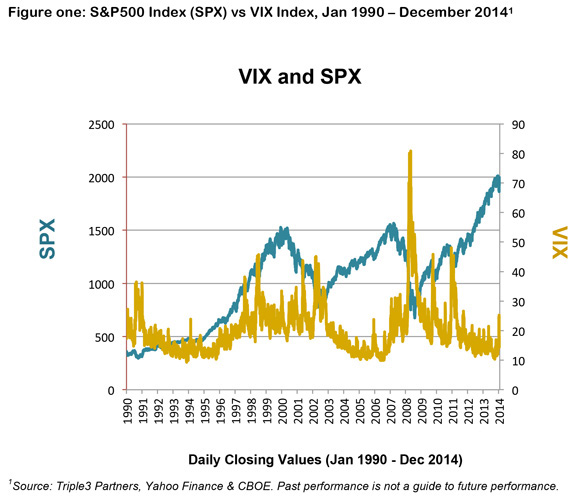

Typically, the more equities fall, the faster volatility (i.e. the VIX) rises. It has what’s called a ‘convex’ payoff profile – the more the S&P500 Index falls, the harder and faster the VIX tends to rise. In other words, when equity investors are ‘running for the door’, those investors with an exposure to volatility can reap the benefits.
….and Australian equities
Most Australian investors have a high exposure to equities. Blue chip Australian companies for growth and franked dividends, small cap companies for exciting growth opportunities and in a diversified portfolio, exposure to global equities – large cap, small cap and emerging markets may all be represented.
Investors have sought to diversify their equity risk by investing in a range of ‘so called’ alternative assets, including commodities and hedge funds. Post the Global Financial Crisis (GFC), it became apparent that those asset classes were not reliably effective as diversifiers, which resulted in many ‘balanced’ portfolios experiencing prolonged negative returns. This was an especially poor outcome for those investors close to, or at, retirement.
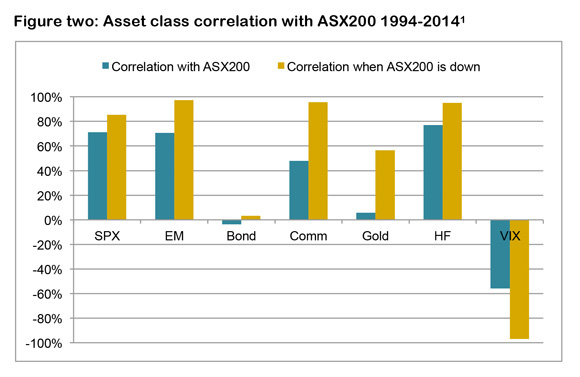
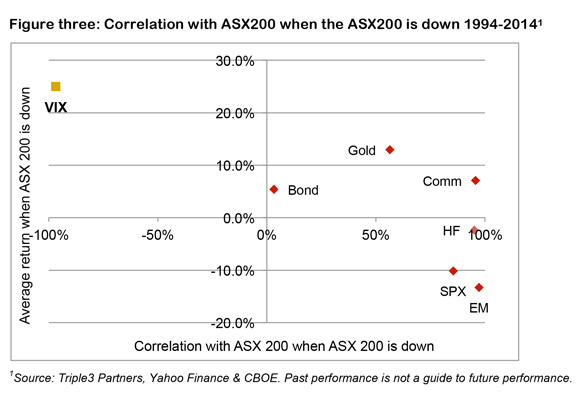
Unlike most other asset classes, volatility – as represented by the VIX – generally exhibits a strong negative correlation to Australian equities, particularly in down markets. Figures two and three illustrate the correlation between the S&P/ASX200 (ASX200) and a range of other asset classes, including US equities, commodities and hedge funds.


Key
XJO |
ASX 200 Index |
Comm |
IMF Commodities Index |
SPX |
S&P 500 Index |
Gold |
Spot Gold |
EM |
MSCI Emerging Markets Index |
HF |
Credit Suisse Hedge Fund Index |
Bond |
Barclays US Aggregate Bond Index |
VIX |
CBOE VIX Index |
The charts clearly illustrate the strong inverse relationship between the VIX and other asset classes, particularly when the ASX200 is down. In fact, as shown in figure two, the VIX is the only asset class to be strongly negatively correlated with equities.
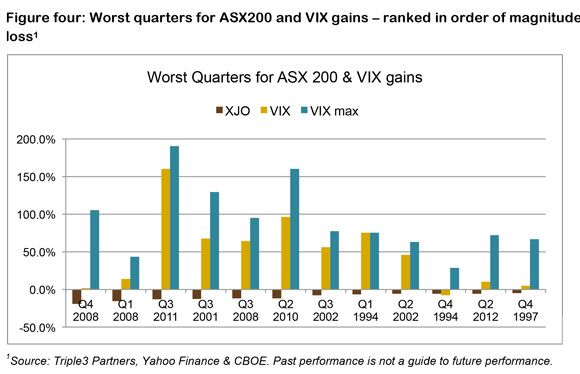
Figure four looks at the worst quarters for the ASX200 from 1994-2012 and plots what happened to the VIX index during that period. Typically, the larger the decline experienced by the ASX200, the greater the rise in the VIX. The gold VIX bar represents the growth in the VIX from beginning to end of that same quarter, while the blue VIX max represents the maximum level reached in the VIX over the course of that quarter.

Although often portrayed negatively, volatility can actually provide a hedge to equity exposure. Adding a small allocation of volatility to a balanced portfolio can have a positive impact on the total return of the portfolio.
Liquidity
When financial markets are under stress, a number of investments may become ‘locked up’, making it difficult for investors to access their capital. A key benefit of volatility is liquidity – the more the S&P500 drops, the faster volatility rises and the greater the liquidity of VIX futures and options contracts.
VIX options now rank as one of the most liquid options markets in the world, sometimes trading more than one million contracts per day.
Volatility and investment risk
As the only way to invest in volatility is via derivatives, it is important to understand the associated risks, which are different to the risks associated with investing directly in more traditional investments such as shares and bonds, or alternative investments like commodity or hedge funds.
The key risks particular to derivatives are:
- The value of the derivative not moving in line with the underlying asset
- Clearer and counterparty risk
- Potential illiquidity if a particular derivative is difficult to sell or buy, if the transaction is
particularly large, or the market is illiquid.
Volatility…a natural hedge
Rather than fearing volatility, it should be put to work in portfolios. Investible volatility instruments have the benefits of liquidity and a negative correlation to equities; volatility is a natural hedge to investors’ global and domestic equity exposure.
As volatility also has low correlation to other asset classes, it can be used to enhance returns and manage risk, and can potentially provide an additional source of alpha to a portfolio.
———–