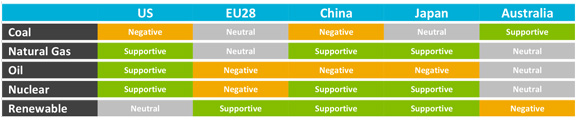
Each month Australian Ethical Investments assesses energy policy. For each type of energy source, policy is assessed to be either being supportive, neutral, or negative, with assessments updated following new developments.

Australia, go solar and save money… really!
Despite the ongoing policy uncertainty introduced by the government’s review of the Renewable Energy Target (RET), solar rooftop growth continues unabated. Updates from network operators show that households are taking up rooftop solar, even though financial assistance is falling. Previously overly generous Feed-in-Tariffs (FiT) that were as high as $0.60 per kilowatt hour in some states have fallen to less than $0.08. We continue to point out that the unsubsidised economics of solar work for households because of our high electricity prices. If you have not done so already, get a quote from a solar installer today!
Renewables strike back in the US
The rollout of solar power is creating odd bedfellows with the ultra-conservative Tea Party joining with environmentalists and libertarians to allow solar leasing in Florida. Florida has one of the best solar resources in the country, but legislation prevents homeowners from buying energy from anyone other than a utility. This has prevented companies from entering the market with solar lease packages that help to defray the substantial upfront cost of the solar system and provide long-term price certainty. In a similar vein, SolarCity has sued an Arizona utility for implementing a punitive pricing policy that it claims discriminates against solar households and amounts to anti-competitive behaviour. Bloomberg quoted a representative from the Arizona utility as saying solar households were saving “about a $100 a month” which was impacting their cost recovery business model. Regardless of the outcome of the lawsuit, we find it instructive that the utility put such a definitive value on solar that only bolsters our view that the economic benefit to households instaling solar is real and robust.
UK CfD auction shows renewables are cheaper than natural gas-fired power stations
The successful completion of the UK’s first Contract-for-Difference (CfD) auction produced some surprising results. Most notable in our mind was that bidding for some onshore wind and solar photovoltaic projects was at levels cheaper than a new build natural gas-fired power station. This development should further drive public support for renewable energy because the “high cost” argument against renewable energy is simply no longer true. We also note that always progressive Germany is now considering financial support for renewable energy heating. Heating is generally a household’s largest source of energy consumption, and Germany wants to encourage the take-up of solar-powered heating, pellet heating and geothermal systems.
Intent is not leading to action in China
The release of the documentary film ‘Under the Dome’ has sparked critical dialog amongst the 200 million people who have already seen it. Widely reported stories of the poor air quality in China had already led to sweeping policy announcements by the government. This resulted in tentative evidence that the country was serious about reducing coal usage, the main culprit behind China’s poor air. However, the documentary reveals how enforcement of these new laws has been lax and the shocking extent of the pollution across the nation. While the air quality remains poor, we believe that the existence of such a film is a strong signal that attitudes are changing for the better in China.
Energy efficiency flexes its muscle in Japan
Bloomberg reports that in the four years following the Fukushima disaster; Japan has purchased 73 million LED light bulbs, or approximately one-third of all bulbs sold there. A previous study conducted by the Institute of Energy Economics, Japan in July 2011 indicated that if Japan switched all its lighting to LEDs, it could cut power consumption by 9%. We estimate that power consumption has fallen approximately 8% since the Fukushima disaster, and this is the result of only a partial contribution from LED lighting. Japan is demonstrating that energy policy cannot ignore efficiency and conservation mandates because they represent a significant opportunity to change the energy equation with very little investment.
India targets 175 gigawatts of renewables and ‘net zero’ tipped for Paris
India has formally announced that it will target 175 gigawatts of renewable energy by 2022. This will be composed of 100 gigawatts of solar photovoltaics, 60 gigawatts of wind, 10 gigawatts of biomass and five gigawatts of hydro. Widely seen as an ambitious target, it implies a near four-fold increase in the current rate of renewable construction. Nevertheless, when faced with energy poverty for 300 million people, a big solution is needed for such a big problem.
Given that the world appears poised to exceed its carbon budget in the next decade, the ‘Net Zero’ concept is being discussed for inclusion in the Paris climate talks in December. The idea is emissions would need to fall to zero between 2040 and 2070 and keep falling below zero after that. This means a slower rate of emission reduction in the short term can be offset by negative emission technologies in the future. There is skepticism around this strategy given the limited success carbon capture and storage has achieved to date.
The month’s developments in detail
Australia
- Energex reports that Queensland households install solar by the thousand’s despite negligible government incentives.
- New South Wales and Victoria health officials object to Federal wind farm conclusion – claim political
- SA Power Networks reports that 23% of homes in South Australia have installed rooftop solar.
- AGL becomes first big retailer to offer a solar PPA plan.
- Labour rejects Liberals offer to reduce Renewable Energy Target to 31,000 gigawatt hours.
North America
- Colorado anti-fracking movement has failed in the state legislature, courts, and ballot boxes.
- The Senate failed to override President Obama’s veto of the legislation approving the Keystone XL pipeline.
- A Goldman Sachs report calculates that even assuming natural gas at US$0.25 per million British Thermal Units (essentially free gas) to produce electricity in California, New Jersey, Massachusetts, Colorado, and New York, the economics to households in each state still favours rooftop solar.
- US Environmental Protection Agency (EPA) considering pushing back implementation of new carbon rules for utilities from 2020 to 2030.
- There is growing anticipation that the Inland Revenue Service (IRS) will expand the scope of real estate investment trust (REIT) legislation to favour solar.
- Canada creates a $250 million disaster fund to deal with consequences of a crude derailment. Funding is coming from shippers who use trains to transport crude oil.
- In Florida, the Tea Party and environmentalists are jointly lobbying to allow solar leasing in the state.
- US proposes first rules for drilling in Arctic Region.
- Mexico will not cut US$3.5 billion earmarked for wind investments despite national budget cuts due to the falling oil price.
- SolarCity sues Arizona utility for anti-competitive behaviour. New fees negate benefit of instaling
Europe
- UK shale gas ambitions have not materialised. Scotland and Wales have passed bans on fracking, and there is no active shale drilling currently in the country.
- The leading UK political parties made a joint commitment to confront the challenges of climate change regardless of who wins the elections in May.
- Italy’s constitutional court rules ‘Robin Hood Tax’ is unconstitutional. May help solar operators.
- EU Commission has sued Germany claiming it needs the Commission’s approval for the subsidies Germany provides to the renewable energy sector.
- Poland, finally, passes renewable energy law.
- EU Commission reveals ‘Energy Union’ plan that calls for more natural gas storage, renewables, and coordinated renewable energy subsidy policy.
- UK announces results of first ever Contract-for-Difference (CfD) auction. The Department of Energy & Climate Change (DECC) estimates the auction reduced the cost of renewable energy by £110 million per year than it would have without the competitive bidding process. Both solar and onshore wind bid prices that were lower than a new build natural gas-fired power station.
- Italy has connected its grid to France, Austria, and Slovenia, becoming part of the Multi-Regional Coupling (MRC). Links to Switzerland and Greece to follow. The MRC allows the creation of a day-ahead wholesale energy market further integrating the European energy complex making it more efficient.
- Germany to launch first auction of land for solar power. Winning bid will be guaranteed its proposed rate for 20 years.
- French Senate passes watered down nuclear phase-out plan, but the language remains supportive for renewable energy.
- German government said to be considering subsidies for renewable energy heating.
- Negotiations around the specific mechanics of the EU carbon fix proposal are expected to wrap up by mid-2015.
- German renewables represent8% of total power in 2014 versus 25.4% in 2013.
China
- Some form of greenhouse gas scheme will cover 48% of global Gross Domestic Product (GDP) once China starts its carbon trading market in 2016 says the International Carbon Action Partnership (ICAP).
- China restarts its nuclear build out with the approval of two reactors, the first since the Fukushima disaster.
- The film Under the Dome, a documentary about China’s air pollution, is viewed by at least 200 million people in its first week. It reveals the extent of air pollution in the country and how regulation has yet to result in real action.
- Government expected to enact first laws to curb soil pollution.
Japan
- Domestic solar shipments rose 10% to 2,239 megawatts in the fourth quarter of 2014 against the same period last year.
- The Ministry of Economy, Trade and Industry (METI) has proposed a 16% cut to solar tariffs to ¥27 from ¥32 currently.
- Electricity consumption continues to fall in Japan despite an improving economic backdrop as impact of conservation and efficiency efforts continue to flow through.
- Japan’s Cabinet releases legislation to separate electricity distribution from generation assets. Parliament will now debate the new legislation.
Global
- Adani Enterprise to build 10 gigawatts solar park in Rajasthan, India.
- Ships designed to carry natural gas are idled as prices collapse. Asian LNG is selling for US$6.90 per million British Thermal Units versus mid-teens in previous two years.
- ‘Net Zero’ option being discussed for Paris climate according.
- Brazil developers register 19 gigawatts of projects for the July energy auctions. Wind is competing directly with natural gas on an unsubsidised
- India’s Ministry of Power is tasked with the job to develop 15 gigawatts of grid-connected
- India doubles the tax on coal to fund renewables and electric vehicles.
- India’s Finance Minister during the budget speech says India is targeting 175 gigawatts of renewables by 2022.
Nathan Lim, International Equities Portfolio Manager, Australian Ethical Investments.