Asian equity markets have been tough since mid-2015, prompted by fears over China’s slowing growth. In September, global investors withdrew more than USD 50 billion, the biggest redemption ever recorded in Asia ex-Japan. Valuations have also hit record lows. A trailing price-earnings ratio of 9 and an average price-to-book of 1.1x were last seen in three times of crisis: during the Global Financial Crisis (GFC), the Asian Financial Crisis (AFC) and the Severe Acute Respiratory Syndrome (SARS) Crisis. On each of these occasions, markets bounced back strongly in the following 12 months. We believe now is the time to have a fresh look at Asian equities.
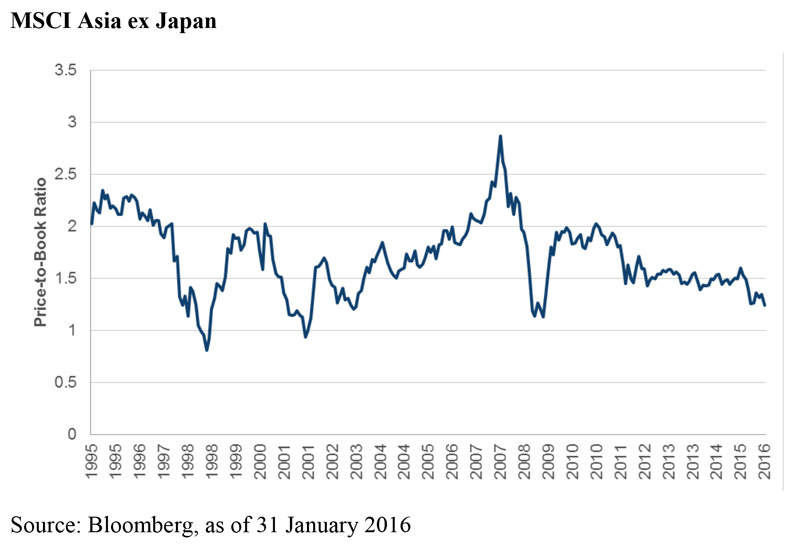

The Asian sell-off has been too severe, discounting a scenario akin to the GFC or the AFC. We believe the current challenges are manageable, particularly with the availability of both fiscal and monetary tools.
In our view, the current valuations of Asian stocks are the cheapest seen in years. Asian economies are in better shape than they were in 1997 and their currencies are more flexible. Nor is the world facing the consequences of a US housing bubble burst as in 2007. Asia should also be a net beneficiary of the long-term structural bear market in commodities and oil, helping it to outperform its global peers. China and India should lead the way.
India is a reform and structural growth story, with falling oil prices slashing input costs and reining in the current account deficit. Indian stocks look comparatively expensive, but investors should not overlook India’s high returns on equity and corporate ability to navigate macro volatility.
China too could bounce back after mishandling its currency devaluation and stock market intervention. We doubt this is the start of a large-scale devaluation to boost exports. Reforms remain high on the agenda as China goes through a transition. No question that this is a challenging period for China, but China stocks listed in Hong Kong are pricing in a dire outcome, which we doubt will eventuate.
Compared to India, China looks attractive on a price-to-book of just 1.2x. Valuations are lower than in 2008 and in previous troughs. Rising returns on equity make the case more compelling.
Likewise, ASEAN (Association of Southeast Asian Nations) offers selective opportunities after bearing the brunt of the sell-off last year. Investor fears that the region could not cope with further outflows overlook the tremendous change since the Asian Financial Crisis.
Fears about high debt in weak current accounts in ASEAN are unwarranted, in our view. There are fewer domestic excesses and less misallocation of capital than before the Asian crisis a decade ago. Reserves are strong, currencies more flexible and markets liberalised.
The declines have discounted most of the lingering concerns, leaving Singapore looking attractive on a historical basis. Indonesia is the odd-one-out, sitting some 15% above its 2008 lows. Even so, we believe that opportunities can still be found, particularly in light of the positive structural drivers in ASEAN.
Historical lessons are instructive; they give us a notional minimum for Asia’s corporate value during various crises. The recent market malaise recognises China’s slowing growth, but Asia’s strong long-term prospects overall.
By Peter Sartori, Head of Asian Equity, Nikko Asset Management
———