Investment markets and key developments over the past week
The past week saw further gains in Japanese and Chinese shares but US, European and Australian shares along with the $US had a bit of a consolidation, after the post US election rally led to overbought positions. However, energy shares and the oil price got a huge boost after OPEC agreed on a production cut. While the oil price rose, metal prices slipped and the iron ore price had a volatile ride with the latter weighing a bit on the $A.
After a “yes they will, no they won’t” soap opera OPEC agreed on an oil production cut of 1.2 million barrels a day. While stronger than talked about in September this was made necessary by a ramp up in production since then. The cut adds to confidence that we have seen the low in oil prices and that deflationary forces are in retreat. So good news for energy producers and central banks. But there is a danger in getting too excited. Around $50/barrel is where the median shale oil producer is economic and so shale production will start to ramp up again (the US rig count is already well up from its lows) and it’s questionable whether OPEC discipline will really hold…so I am sceptical that the oil price will go too high. Maybe $55 or $60 tops. Inflation is already picking up as the 2014 to early 2016 oil price plunge drops out, but so far the flow on to core inflation has proven to be muted. Don’t forget that the oil price is still less than half 2013-14 levels. For Australian petrol prices the OPEC cut might add 5 cents a litre at the bowser but that will be lost in normal day to day price volatility.
China appears to be seeing another one of its periodic policy tightening phases with increasing measures to cool the hot property market, a crackdown on capital outflows to ease downwards pressure on the Renminbi, tighter monetary conditions and measures around shadow banking and commodity markets. The Chinese share market may be a beneficiary though to the extent capital outflows are limited and need to find a home domestically and it’s not seen as too hot.
Major global economic events and implication
US data remained strong with September quarter GDP growth revised up to 3.2%, consumer confidence rising sharply in November (maybe as election noise was lifted), the ISM manufacturing conditions index rising further in November, home prices continuing to rise, construction spending up and jobs indicators remaining strong. The Fed remains on track for a December rate hike. Meanwhile President elect Donald Trump’s picks for various cabinet positions including Treasury secretary are adding a bit to confidence in his administration such that the dial is still pointing to Trump the pragmatist as opposed to Trump the populist.
In the Eurozone economic sentiment moved higher in November and bank lending accelerated a touch pointing to slightly stronger economic growth. Unemployment even fell to its lowest since 2009. Meanwhile CPI inflation rose as the impact of the plunge in oil prices continues to fall out but core inflation remains stuck at a low 0.8% year on year.
Japanese data was better than expected with continuing jobs market strength, stronger than expected household spending, a continuing upswing in industrial production and gains in housing starts and construction orders.
Chinese business conditions PMIs were on balance better than expected in November and remain consistent with stable to maybe even stronger GDP growth.
Indian September quarter GDP growth accelerated to 7.3% yoy (from 7.1%) boosted by consumer and public spending. Growth may slow in the current quarter because of “demonetization” (the replacement of old large denomination currency notes with new notes but only after deposit in bank accounts)…but the impact on the November manufacturing conditions PMI, which saw a fall from 54.4 to 52.3, suggests only a moderate impact.
Australian economic events and implications
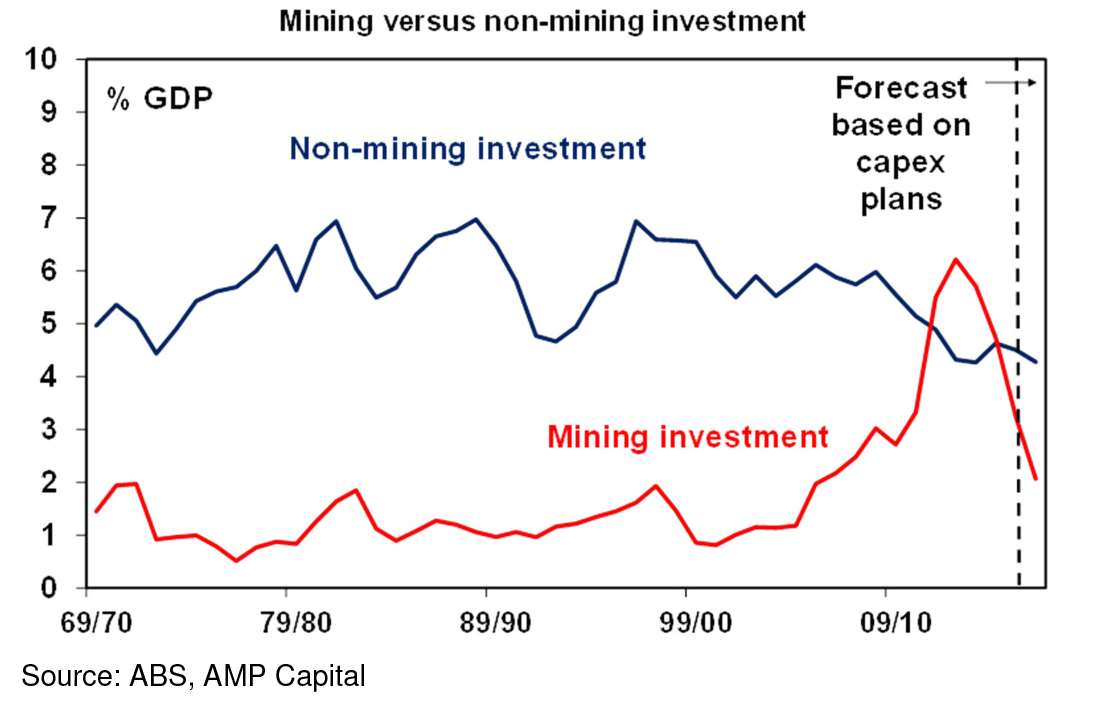
Weak business investment data both for the September quarter and intentions for the current financial year along with another sharp fall in building approvals added to a sense of near term economic gloom regarding Australian economic growth. As we noted a week ago, there is a significant risk that September quarter GDP growth will be negative – thanks to weak retail sales volumes, a fall in dwelling investment, a continuing fall in business investment and weak net exports. While a continuing decline in mining investment is no surprise the failure to see stronger non-mining investment is disappointing. However, there is no reason to get too gloomy. Weak and possibly negative September quarter GDP growth looks like payback for stronger than expected GDP growth over the year to the June quarter of 3.3%. And looking forward the ramp up in resource export volumes has further to go, there is still a huge pipeline of housing activity yet to be completed so home building is likely to rebound in the short term, strengthening approvals for non-dwelling construction are a positive sign, the drag from mining investment is fading as it reduces in importance and its likely to be close to a bottom in the next 12-18 months (see chart), recent retail sales data have improved with three months in a row of solid growth up to October suggesting a consumer bounce back in the December quarter, another rebound in the manufacturing conditions PMI for November suggests that the September quarter growth soft patch may be over and the rebound in commodity prices tells us that the income recession in Australia is over.

However, recent soft data highlights that its way too early to be talking about a 2017 RBA rate hike as the OECD and some others have been doing. In fact given the downside risks to near term growth and inflation along with the $A remaining too high we remain of the view that the RBA will cut the cash rate again during the first half of 2017.
Just finally, home price momentum remained solid in November according to CoreLogic – except in Melbourne where unit prices lost 3.2%. The apartment supply surge is starting to impact in that city and it will likely spread to others next year with unit prices in areas of large supply increases in Sydney and Melbourne likely to fall 15-20% over the next few years.
What to watch over the next week?
Reaction to the Italian Senate referendum being held on December 4 will no doubt impact investment markets early in the week ahead. While confirmation of a “No” vote (as the polls are suggesting) will add to uncertainty about the Italian government and its banks and maybe further fuel fears about a “break-up” of the Eurozone, a lot will have to occur before Italy leaves the Eurozone if at all. An early Italian election is unlikely to occur and even if there is the Five Star Movement is unlikely to win unless it softens its anti-Euro stance. Meanwhile, if the “Yes” vote wins Italy’s economic woes will remain. So the referendum is unlikely to settle anything either way. More broadly, the Eurozone is likely to continue to hang together and bouts of market turmoil driven by break-up fears should continue to be seen as buying opportunities.
After the Italian vote, all eyes in Europe will shift to the ECB meeting on Thursday which is expected to announce a six month extension of its quantitative easing program beyond its current expiry of March 2017 and some changes to enable it to buy a wider universe of bonds. Continuing moderate growth and sub-par inflation along with issues around Italy and Italian banks are likely to be the main drivers with the back-up in bond yields giving the ECB a bit of leeway. It may also try and inject a bit of flexibility into its QE program to allow it to speed up and slow individual country bond buying as justified.
In the US, expect the non-manufacturing conditions ISM index (Monday) to remain strong, the trade balance (Tuesday) to deteriorate and labour market indicators for hiring and vacancies (Wednesday) to remain solid.
Chinese October trade data (Thursday) is expected to show continued softness in exports and imports and a further rise in both consumer and producer price inflation (Friday).
In Australia, the RBA is expected to leave rates on hold on Tuesday. While recent data points to soft September quarter GDP growth to be released on Wednesday this is unlikely to be enough to move the RBA to cut rates given recent upbeat commentary on the economy from both Governor Lowe and Assistant Governor Kent. However, as noted above we remain of the view that the RBA will cut rates again in the first half of next year reflecting downside risk to both growth and inflation.
On the data front in Australia, expect September quarter GDP growth (Wednesday) of just 0.2% qoq or 2.5% yoy driven by weak business investment, retail sales, housing investment and trade with a high risk of a fall in GDP. September quarter data for production, profits and inventories (Monday) and net exports and public demand (Tuesday) will help fine tune September quarter GDP forecasts. Expect the surge in coal prices to have led to a further collapse in the trade deficit (Thursday) and housing finance (Friday) to fall.
Outlook for markets
Shares remain overbought and are vulnerable to the outcome of the Italian Senate referendum, the upcoming ECB and Fed meetings and to any further near term rise in bond yields. However, we anticipate shares to be higher by year end as seasonal strength kicks in – the “Santa rally” normally gets underway from around mid-December – and see share markets trending higher over the next 12 months helped by okay valuations, continuing easy global monetary conditions, a shift towards fiscal stimulus in the US, moderate economic growth and the shift from falling to rising profits for both the US and Australia.
Sovereign bonds are now very oversold and due for a short term pullback in yield. But still low bond yields point to a poor medium term return potential from them. The abatement of deflationary pressures as commodity prices head up, the gradual using up of spare capacity and a shift in policy focus from monetary to fiscal stimulus indicates that the long term decline in yields since the early 1980s is probably over. Expect the trend in bond yields to be up.
Commercial property and infrastructure are likely to continue benefitting from the ongoing search for yield by investors though as these two asset classes never fully adjusted to the full decline in bond yields.
Dwelling price gains are expected to slow, as the heat comes out of Sydney and Melbourne thanks to poor affordability, tougher lending standards and as apartment supply ramps up which is expected to drive 15-20% price falls for units in oversupplied areas into 2018.
Cash and bank deposits offer poor returns.
A shift in the interest rate differential in favour of the US as the Fed remains on its path to hike rates should see the long term trend in the $A remain down.
By Shane Oliver, AMP Capital