
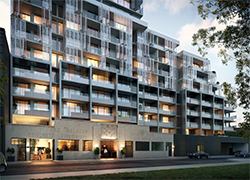
Supply Co, located in the inner eastern Melbourne suburb of Richmond.
Following a 12-month marketing campaign, Forza Capital has commenced construction of the $83 million, 129 residential apartment complex known as Supply Co, located in the inner eastern Melbourne suburb of Richmond.
Funding for the development was raised via debt and equity; the latter raised through the Forza 9-15 David Street Fund, a single asset unlisted property fund that was quickly fully subscribed.
The Fund holds the prime 2,325m2 residential development site in Richmond, located directly adjacent to the Victoria Gardens Shopping Centre and a stone’s throw to the Yarra River and the Bridge Road and Victoria Street shopping precincts.
The Fund obtained a planning permit to construct an 11-level complex of 130 apartments and a cafe on the site, which provided a strong valuation uplift for investors in the first 12 months. In November 2014, investors in the Fund resolved to develop the site and a second capital raising occurred in March 2015 to deliver the apartments and a café.
Mr Ashely Wain, director of Forza Capital, commented: “We had keen interest from SMSF investors looking for direct residential property exposure without the logistics of buying a property directly within the SMSF structure.”
“Although multiple headwinds have built up in the residential development sector, one market segment that has held firm, and potentially even improved, is the owner occupier sector. By targeting these buyers, who have often been priced out of the inner-city housing market, we’ve had strong sales and should deliver solid returns to investors.”
Almost across the board, the lending appetite of debt financiers to the apartment sector has been turned on its head in the past 12 months; Loan to Value Ratios have tightened, presale requirements have increased, the number of foreign sales have been capped, and importantly, the cost of debt has increased.
Added to the change in sentiment from lenders, the number of local residential investors has decreased. Those still in the market have become significantly more discerning about location, price and the quality of apartments they seek to buy.
“CBA has been extremely supportive of the Supply Co project. This emphasises the importance of strong banking relationships in tough development environments,” said Mr Wain.
Forza Capital settled the Supply Co site in 2014, paying $5.85 million or $45,000 per apartment.
“Many developers having been paying too much for inner city development sites, and then have to apply an extremely high sale rate to make projects feasible,” Mr Wain said.
“Astute investment has enabled us to deliver a high-quality product at a reasonable price (average sale rate of under $9,000m2), with firepower to accommodate initiatives such as bathroom upgrades into our project feasibility.”
To date, Forza Capital has sold 106 of 129 apartments at Supply Co, representing approximately 85% of the overall stock.
“We reached the bank’s presale target under our loan agreement once we attained 80% in sales. These high presale hurdles make the commencement of projects extremely challenging,” Mr Wain said.
The new design guidelines, which impact the number and configuration of apartments that can be accommodated on a development site, will affect the feasibility of future projects. Depending on the dimensions and street frontages of a site, a parcel of land that previously accommodated 100 units may now only house 60 – 70 units.
“We support the introduction of new design standards for residential apartments, although we believe land values need to adjust to reflect the new development yields that can be achieved,” said Mr Wain.
“The combination of higher funding costs, reduction in the number of dwellings that a site can accommodate, the changing profile of the buyer and their demand for a high-quality product at a competitive price, all while construction prices continue to increase, all point to the need for land values to adjust downwards to reflect the new development landscape.”