Key Points
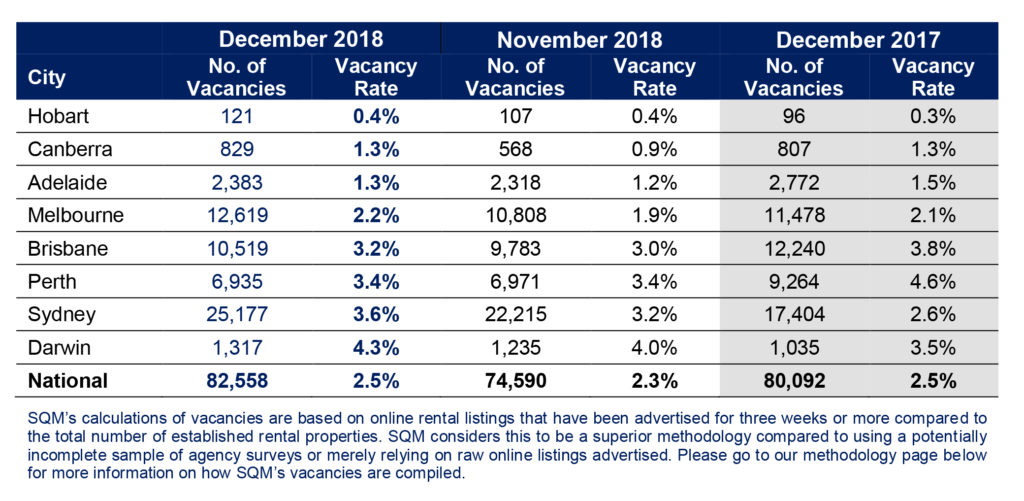
- Nationally, the vacancy rate rose to 2.5% in December from 2.3% in November.
- Darwin has the highest vacancy rate at 4.3%, followed by Sydney which rose to 3.6%.
- Hobart continues to record the lowest vacancy rate of 0.4% with no change from November.
- Melbourne’s vacancy rate rose to 2.2% in December from 1.9% in November.
- Perth’s rental market continues to improve with the vacancy rate remaining steady at 3.4%, from November and well down from 4.6% a year ago when it had the highest vacancy rate.
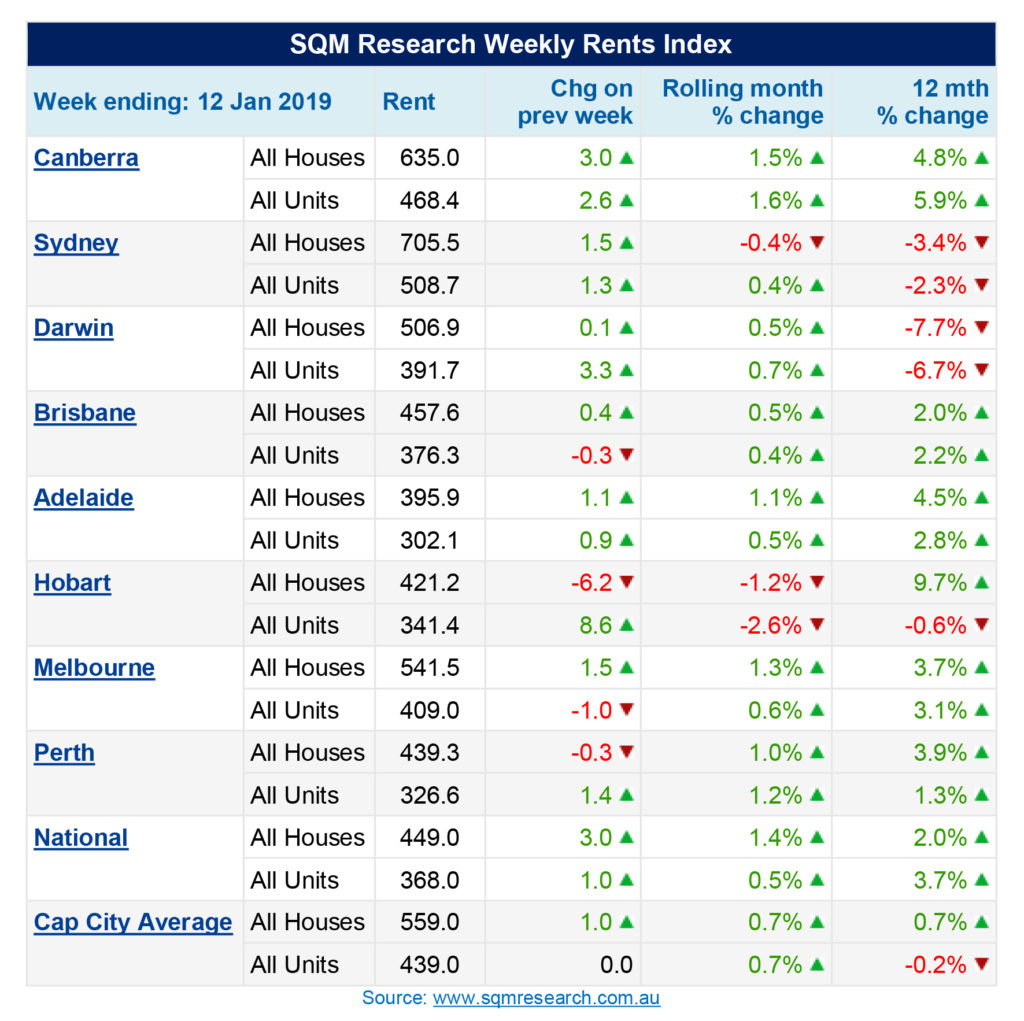
- Capital city asking rents for Houses rose 0.7% over the month to 12 January 2019 to $559 per week.
- Capital city asking rents for Units also rose by 0.7% to $439 a week.
Data released by SQM Research yesterday has revealed the national residential vacancy rate rose to 2.5% in December 2018, up from 2.3% in November 2018, with the total number of vacancies Australia-wide increasing to 82,558 – an additional 7,968 properties are now available for rent since November 2018.
Most capital cities experienced an increase in their vacancy rates in December with both Perth and Hobart remaining steady at 3.4% and 0.4% respectively – Hobart is still the lowest of all capital cities.
Darwin currently has the highest vacancy rate of all capital cities at 4.3%, up 0.3% on November’s vacancy of 4.0%. Vacancies in Sydney and Canberra increased the most since November, both a 0.4% increase. However, Sydney’s vacancy rate is currently the second highest of all capital cities at 3.6% with 25,177 properties available for rent while Canberra’s vacancy rate is a low 1.3% with 829 properties available for rent.
Perth’s rental market continues to improve with the vacancy rate remaining steady at 3.4% since November and well down from 4.6% a year ago when it was the highest of all capital cities.
Brisbane’s vacancy rate edged higher to 3.2% from 3.0% in November, but is down from 3.8% a year ago. Melbourne’s vacancy rate also rose slightly to 2.2% from 1.9% in November and only marginally up from 2.1% a year ago. Adelaide’s rose slightly to 1.3% from 1.2% but slightly down from 1.5% in December 2017.

Managing Director of SQM Research, Louis Christopher said, “the rise in vacancies continue into December due to seasonality, with Hobart continuing to face ongoing tight rental conditions however rents in Hobart have decreased over the month for both houses and units.”
“If current vacancy rate levels continue to rise into January and February, Darwin, Sydney, Brisbane and Perth will be a tenant’s market in 2019,” Mr Christopher said.
Asking rents
Despite the rise in vacancies, capital city asking rents for houses rose 0.7% over the month to 12 January 2019 to $559 a week. Unit asking rents also rose 0.7% to $439 a week. Over the year, asking rents for houses rose 0.7% while unit asking rents slipped 0.2%.
Hobart is the only city to record a decrease in both house and unit asking rents over the month to 12 January, at 1.2% decline for houses and 2.6% decline for units. 12 months ago, Hobart’s house asking rent increased by a large 9.7%.
Sydney also recorded a marginal decrease in house asking rents of 0.4% over the month. Unit asking rents in Sydney however, increased 0.4%.
Canberra recorded the highest increase in both house and unit asking rents at 1.5% for houses and 1.6% for units.
Asking rents in Melbourne for houses rose 1.3% over the month to $541.5 a week while asking rents for units rose 0.6% to $409.
Despite the upward pressure on vacancy rates, the asking rent for a three-bedroom house in Sydney remains the highest nationwide at $705 a week and $508 a week for two-bedroom units.