Investment markets and key developments over the past week
Share markets mostly fell over the last week with the Fed indicating no inclination to cut rates, a bit of wariness around US/China trade talks and as a fall back in oil prices weighed on energy shares. Energy shares were in fact the worst performing sector in the Australian share market. Chinese shares managed to rise though but this followed a sharp fall the previous week. Bond yields rose in the US and Germany but were flat in Australia and Japan. While the iron ore price rose, oil prices were hit by rising US inventories and metal prices also fell. The $A fell below $US0.70.
The Fed provided no surprises as far as I am concerned but it disappointed markets who were hoping for talk of a rate cut. Basically, the Fed remains confident on growth and sees low inflation arguing against a rate hike but also sees the recent fall inflation as “transitory” which argues against a rate cut. So, it remains on hold regarding rates and is likely to remain so for the next six months. And it’s still on track to end quantitative tightening this year. Short term noise aside the Fed is providing a favourable back drop for investment markets.
Trump and the Democrats at last agree on infrastructure with a $2 trillion plan – but don’t get too excited just yet. First, it looks like it will be spread over 25 years, so sounds bigger than it really is. And funding is likely to be a big sticking point with Democrats likely to focus on tax hikes (and some leaning towards letting the deficit blow out a la MMT) funding big government programs and the Republicans in the Senate wanting incentives for private infrastructure spending.
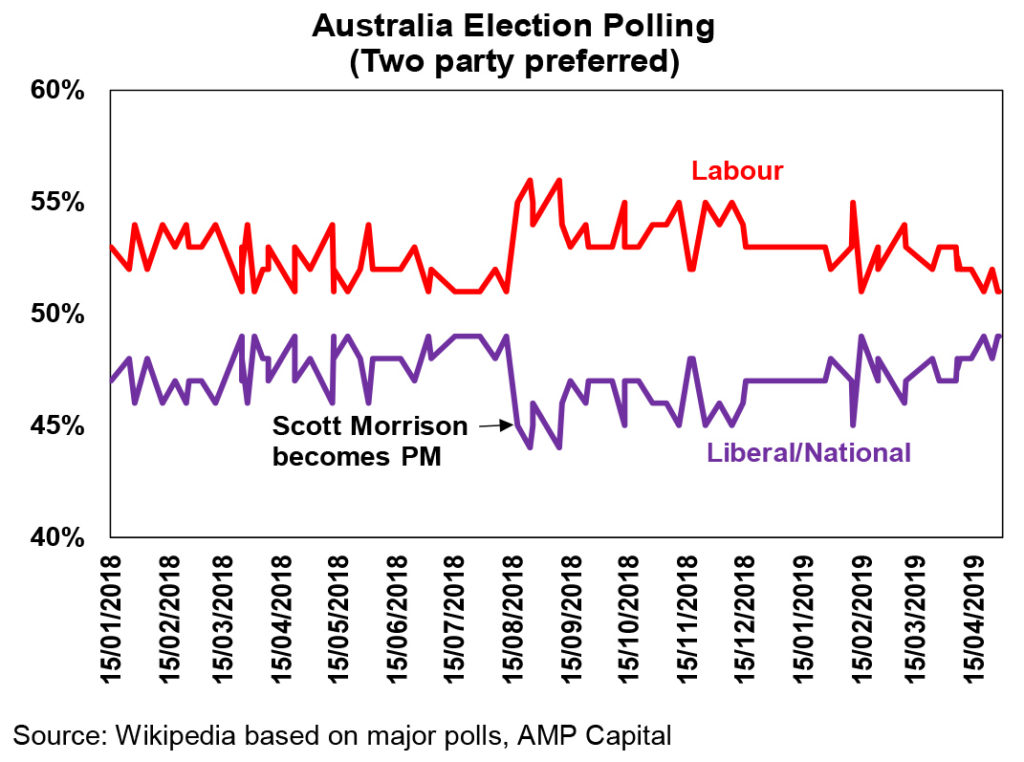
In Australia, its now only two weeks to the Federal election. The last few weeks of policy announcements have been consistent with a Labor Government taking a more interventionist approach compared to the Coalition – in terms of tax, spending, climate policy, regulation and industrial relations (including the use of wage subsidies). The polling gap still favours Labor albeit the gap has narrowed.

Major global economic events and implications
US data was a mixed bag with a fall in the ISM manufacturing conditions index and construction spending but a strong rise in consumer confidence, personal spending and pending home sales. Meanwhile growth in employment costs remained modest in the March quarter at 2.8% year on year and productivity growth surged to 2.4%yoy all of which is consistent with continuing benign inflation and is probably not so “transitory”.
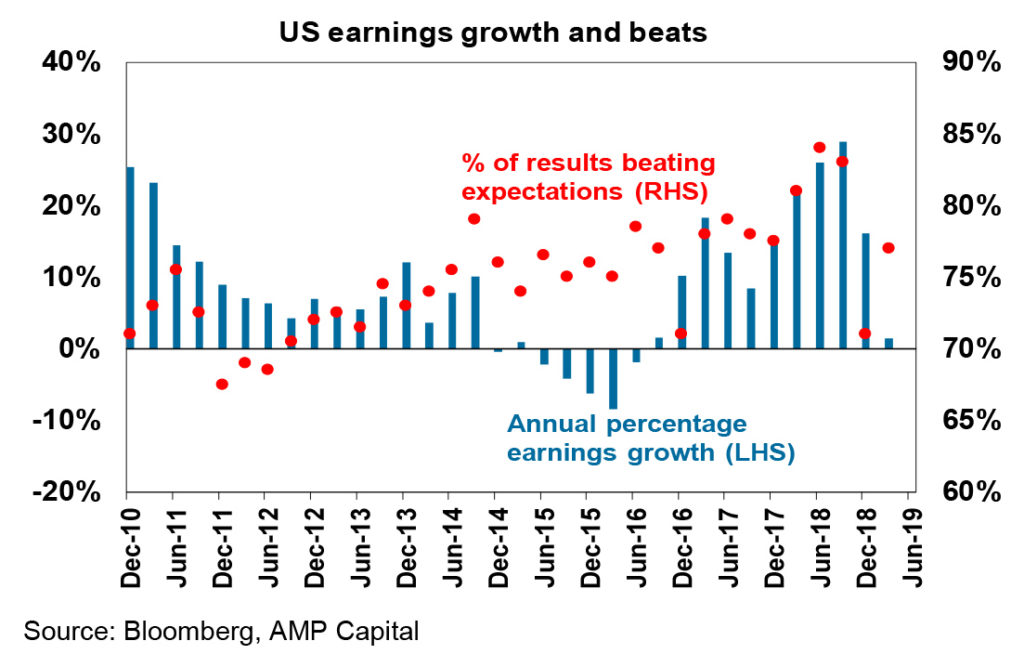
More than three quarters of US 500 companies have now reported March quarter earnings results and while corporates are cautious results overall remain far better than expected. 77% have beaten on earnings with an average beat of 6% and 56% have beaten on sales. Earnings growth started the reporting season with expectations for a 2% fall on a year ago but has now risen to around 1.5% and this is likely to mark the low point for this year.

Eurozone GDP growth was stronger than expected in the March quarter and suggests growth actually bottomed in the September quarter. Italy moved out of recession and Spain continues to see good growth. Even unemployment surprisingly edged lower in March. This will all take a bit of pressure off the ECB, but it will likely remain dovish given soft business surveys and inflation remaining well below target.
China saw some mixed PMIs for April, but they are up from recent lows and consistent with other data suggesting Chinese growth has likely bottomed but is not off to the races again.
Australian economic events and implications
Australian home prices continued to slide in April with the pace of decline slowing but more cities succumbing to falls. The slowing in the pace of home price falls, along with a bounce in housing finance, a pick-up in auction clearance rates and a stabilisation in new home sales according to the HIA are positive signs, suggesting we may be getting close to the bottom. At the very least we are not seeing any of the panic/forced selling that some had feared would occur. However, our view remains that there is still more to go yet (with national capital city prices having seen 10% of an expected 15% top to bottom fall) as the negatives around tight credit and surging supply remain significant. What’s more the nearly five-year decline in Perth and Darwin property prices has seen several phases where price declines slowed then accelerated again, the bounce in clearance rates looks seasonal and they remain weak and less favourable negative gearing and capital gains tax arrangements if there is an ALP victory could see renewed pressure on property prices next year. An earlier rate cut in May could bring forward the bottom in house prices as in the last two cycles they bottomed around four months after the first cut, although it is worth noting that stronger supply conditions, tighter lending standards, higher debt to income ratios and depressed investor confidence will likely constrain the response interest rate cuts this time around.
Meanwhile, building approvals fell back sharply in March and credit growth remained soft with lending growth to housing investors falling to a record low. Business conditions PMIs mostly rose in April, but they remain soft and well down from last year’s highs and employment components have fallen.
What to watch over the next week?
In the US, expect core CPI inflation for April to be released Friday to rise slightly to 2.1% year on year, confirming that US inflation remains benign keeping the Fed on hold. In other data releases expect March job openings (Tuesday) to rebound and the March trade deficit (Thursday) to deteriorate slightly. The flow of US March quarter earnings reports will continue and Chinese negotiators will be in the US for another round of trade talks.
Chinese trade data for April ((Wednesday) is expected show continued strength in exports but will be watched for a recovery in import growth. Inflation data (Thursday) is expected to show that underlying inflation remains benign.
In Australia, we have pencilled in the RBA cutting the official cash rate by 0.25% on Tuesday taking it to 1.25% which will be a new record low and the first move since August 2016. However, while we remain confident that rates will be cut to 1% by year end, it’s a very close call as to whether the Bank goes Tuesday or waits till after the election. The case to wait is that it will avoid the politicisation of interest rates in the election campaign, the RBA can wait to see who wins the election and get a better handle on what sort of fiscal stimulus will be delivered, we are yet to see a rising trend in unemployment and the RBA has yet to move to a clear easing bias. The case to go now though is that inflation has come in lower than expected and is going the wrong way, the RBA is likely to further revise down its inflation forecasts in the May Statement on Monetary Policy so waiting risks further damaging the credibility of the RBA’s inflation target, the fiscal boost is still several months away, waiting till unemployment rises may be too late, not cutting on Tuesday could see the $A bounce which would be a defacto monetary tightening and the RBA hasn’t always preceded moves by a change in its bias. We think the case to cut now dominates so we have pencilled in Tuesday for the first cut, but it’s a close call so it would hardly surprise if they decide to wait another month or so. If the RBA doesn’t cut on Tuesday, its likely they will move to some sort of easing bias. The RBA’s Statement on Monetary Policy to be released Friday will be watched for further clues on the interest rate outlook, but a further reduction in the RBA’s forecasts for underlying inflation to 1.75% for year end from 2% currently will be consistent with lower rates.
Meanwhile, on the data front in Australia, expect ANZ job ads (Monday) to show a rebound although this is likely to be due to a distortion caused by the close proximity of Easter and Anzac Day holidays this year. On Tuesday, the trade surplus for March will likely remain strong at around $4.6bn and March retail sales will likely slow to a 0.2% gain after their February bounce leaving real retail sales up 0.4% for the March quarter.
Outlook for investment markets
Share markets – globally & in Australia – have run hard and fast from their December lows and are vulnerable to a short-term pullback. But valuations are okay, global growth is expected to improve into the second half of the year, monetary and fiscal policy has become more supportive of markets and the trade war threat is receding all of which should support decent gains for share markets through 2019 as a whole.
Low yields are likely to see low returns from bonds, but government bonds continue to provide an excellent portfolio diversifier.
Unlisted commercial property and infrastructure are likely to see a slowing in returns over the year ahead. This is particularly the case for Australian retail property. However, lower for even longer bond yields will help underpin unlisted asset valuations.
Our base case is for national capital city house prices to fall another 5% or so into 2020 on the back of tight credit, rising supply, reduced foreign demand, price falls feeding on themselves and uncertainty around the impact of tax changes under a Labor Government. An earlier rate cut in May could bring forward the bottom in house prices as in the last two cycles they bottomed four months or so after the first rate cut.
Cash and bank deposits are likely to provide poor returns as the RBA cuts the official cash rate to 1% by year end.
The $A is likely to fall further into the $US0.60s as the gap between the RBA’s cash rate and the US Fed Funds rate will likely push further into negative territory as the RBA moves to cut rates. Excessive $A short positions and high commodity prices will likely prevent an $A crash though.
By Shane Oliver