

Matt Gaden
Key Points
- Company borrowings around the world surged to a record A$12.0 trillion in 2019, up 8.1% year-on-year, the fastest increase in at least 5 years
- Companies borrowed to fund takeovers, share buybacks and dividends, as well as to invest
- Debts have risen significantly faster than profits over the last 5 years
- In 2020, bond market analysis shows a sharp increase in borrowing to meet challenges posed by the COVID-19 pandemic
- Janus Henderson expects company debts to rise by A$1.45 trillion (or 12%) in 2020
- Volkswagen is the world’s most indebted company, owing almost as much as South Africa, though this partly reflects a huge car finance business
- Company debts have grown fastest in the US and Switzerland
- German debts are the second highest in the world after the US, thanks to the car manufacturers and their financing businesses
- Australia’s most indebted companies are Telstra and Transurban
- 2020 presents interesting opportunities for investors in bond
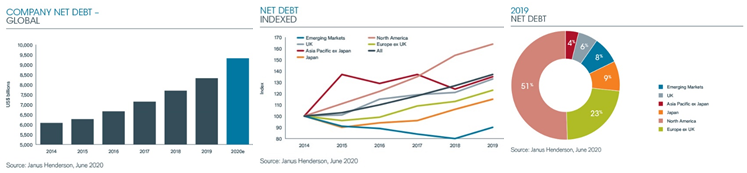

Notes to charts: Source – Janus Henderson, June 2020. Please note, charts and tables contained within this release have been shown in US dollars. All other references have been shown in Australian dollars, unless otherwise stated. Reference exchange rate utilised USD$1 = AUD$1.45241.
Even before the pandemic began to batter company balance sheets, company debts were soaring to new highs, according to the newly launched annual Corporate Debt Index from Janus Henderson (JHCDI). Net borrowings[1] around the world surged to a record A$12.0 trillion in 2019, an increase of 8.1% year-on-year.
Collectively net debts jumped by A$907 billion last year, the largest increase in the last five years. Company resources were depleted by debt-financed acquisitions, large share buybacks, record dividends, and the chilling effect on profits caused by trade tensions and a global economic slowdown. Growth in borrowing has been spurred on in recent years by very low interest rates that make servicing debts cheap, urged on by central bank attempts to stimulate economies.
Companies included in the Corporate Debt Index (the largest 900 non-financials in the world) today owe almost two fifths (37%) more than they did in 2014, and growth in debt has comfortably outstripped growth in profits. Pre-tax profits for the same group of companies have risen a collective 9.1% to A$3.3 trillion. Gearing, a measure of debt relative to shareholder finance, rose to a record 59% in 2019, while the proportion of profit devoted to servicing interest payments also rose to a new high.
These trends were accelerated in 2020 as the COVID-19 pandemic struck. Janus Henderson’s analysis of bond markets shows that companies in its index owe half their debts in the form of listed bonds. They issued an additional A$557bn in bonds between January and May, an increase of 6.6% compared to the end of December balances. Borrowing from banks has also increased sharply, though precise figures are not yet available. Janus Henderson estimates net borrowings overall will jump by up to A$1.45 trillion this year, an increase of 12%.
The most indebted company in the world is Volkswagen – its eye-watering A$278bn net borrowing is not far behind the sovereign debt of South Africa or Hungary, though this is inflated by its large car finance business. However, a quarter of the companies in Janus Henderson’s index have no debt at all, and some have vast cash reserves. The biggest of these stands at A$151bn and belongs to Google’s owner Alphabet. What seems like prudence, however, is often unpopular with shareholders, who may have better uses for this capital.
For investors in bonds, 2020 presents interesting opportunities to invest in companies that have the ability to repay its debt in a low interest rate environment.
Jay Sivapalan, Head of Australian Fixed Interest at Janus Henderson said: “As the economic cycle came to an abrupt end this year, companies faced the downturn with record borrowings. They have now scrambled to issue new bonds and borrow from banks to ensure they have enough ready cash to weather lockdowns of varying severity around the world. Some companies have taken emergency government support during the worst of the crisis when funding themselves commercially became very expensive for a time. With market conditions calmer, thanks to central bank support and a gradual reopening of economies, companies will want to reduce their reliance on state hand-outs, so we expect bond issuance to rise further.
“Acquisitions, share buybacks and dividends each funded by debt often precede an economic downturn. This has certainly been the case this time round. As the global recession takes hold, profits and cash flow will be sharply lower. Borrowing needs will be very large this year, even though companies in our index are set to cut their dividends by A$203bn to A$435bn[2] this year, are slashing share buybacks, putting acquisitions on hold and reducing capital expenditure. Much will depend upon the extent to which new borrowing is spent or held as cash reserves, and on how much companies issue in new shares to bolster their balance sheets. It’s clear, however, that 2020 will see net corporate debts soar to another new record, as much as A$1.45 trillion higher than 2019.
Matt Gaden, Head of Australia at Janus Henderson said: “The Janus Henderson team have a long-standing commitment to empowering clients to make better investment decisions. This new Corporate Debt Index is another clear example of that commitment as the findings speak volumes regarding changes occurring in the global fixed income marketplace.
Although more than half of the companies in our Index took on more borrowing last year, the report highlights that in many cases debt can increase shareholder returns, as long as it’s appropriate. The bond market continues to present strong investment opportunities and this report also highlights the valuable role debt can play in a well-functioning economy and in well managed companies, along with the risks. As long as companies have enough cash to bridge the lockdown gap, we think that corporate bonds returns may look increasingly attractive to investors.”
Australia forges its own path to corporate indebtedness
Defying Asia’s cultural aversion to debt, Australia is much more typically Anglo-Saxon with higher borrowing levels than its neighbours, but lower levels of debt compared to the rest of the developed world.
According to JHCDI, the net borrowings in Australia have fallen over the years from A$124 billion in 2014 to A$87 billion in 2019, with Industrials (31%) and Basic Materials (25%) and Communications and Media (19%) leading the pack.
This declining trend came off the back of including BHP and Rio Tinto in the analysis, as mining companies can typically sustain only low levels of debt because of their cyclical nature, and had paid down lots of debt over the past few years.
Mr Sivapalan further added: “As bond investors, we care most about a company’s ability to repay its debts. Most importantly we will be looking for signs that a company is strengthening its position when conditions improve – using surplus cash flow to pay down debts rather than spending it or issuing new shares to rebalance the financing mix between equity and borrowing. This pushes bond prices higher, generating capital gains for investors.
In Australia, we see a looming de-leveraging cycle, with total net debt having returned to 2014 levels of A$69 billion, down from 5-year highs of A$85 billion. Debt to equity ratios have also fallen markedly. If this de-leveraging by Australian corporates continues, this may represent a once in a decade event for credit markets.”
Australia’s most indebted companies are Telstra and Transurban.