

Mano Mohankumar and Ian Fryer
After a disappointing end to FY22, super funds kicked off the new financial year in style with the median growth fund (61 to 80% in growth assets) surging 3.1% in July. This was mainly on the back of a sharp rebound in share markets, although bonds also made a solid contribution. So in just one month, we’ve seen funds regain almost all of the previous financial year’s 3.3% loss.
Chant West Senior Investment Research Manager, Mano Mohankumar, says that global share and bond markets rallied sharply in July buoyed by signs that the pace of interest rate rises may slow down. “Australian shares surged 6% over the month. International shares were up 7.1% in hedged terms but the appreciation of the Australian dollar brought the return in unhedged terms down slightly to 5.4%. And after a torrid year, traditional bond markets also bounced back as yields fell, resulting in Australian and international bonds rallying 3.4% and 2.5%, respectively.
“The strong July result means that, despite the challenges over the past two-and-a-half years, the median growth fund is 11% ahead of the pre-COVID high that was reached at the end of January 2020. This should be a great comfort for fund members. Even more importantly, funds are continuing to meet their long-term return and risk objectives.
“In July, as expected, the US Federal Reserve raised interest rates by 0.75%. But the Fed Chair, Jerome Powell, hinted that the pace of rate hikes may now slow and that provided a much-needed boost to investment markets. During the month there was evidence that the global economy is slowing with the demand for goods down. Indeed, the US posted a second consecutive negative quarter in terms of economic growth. In the eurozone, the European Central Bank raised interest rates by a more-than-expected 0.5% bringing to an end the negative rates era. In the UK, there remains uncertainty with a contest for leadership of the Conservative Party after the collapse of Boris Johnson’s reign.
“While developed international share markets were up, the emerging markets index was down in July mainly due to weakness in China which is experiencing a slowdown in economic growth, continued lockdown measures as part of its zero-COVID policy and an ongoing property crisis.
“Back at home, the annual headline inflation rate released for the year to June was 6.1% – the highest annual pace since 2001. Earlier this month, we saw the RBA respond by raising the official cash rate by a further 0.5% to 1.85%.”
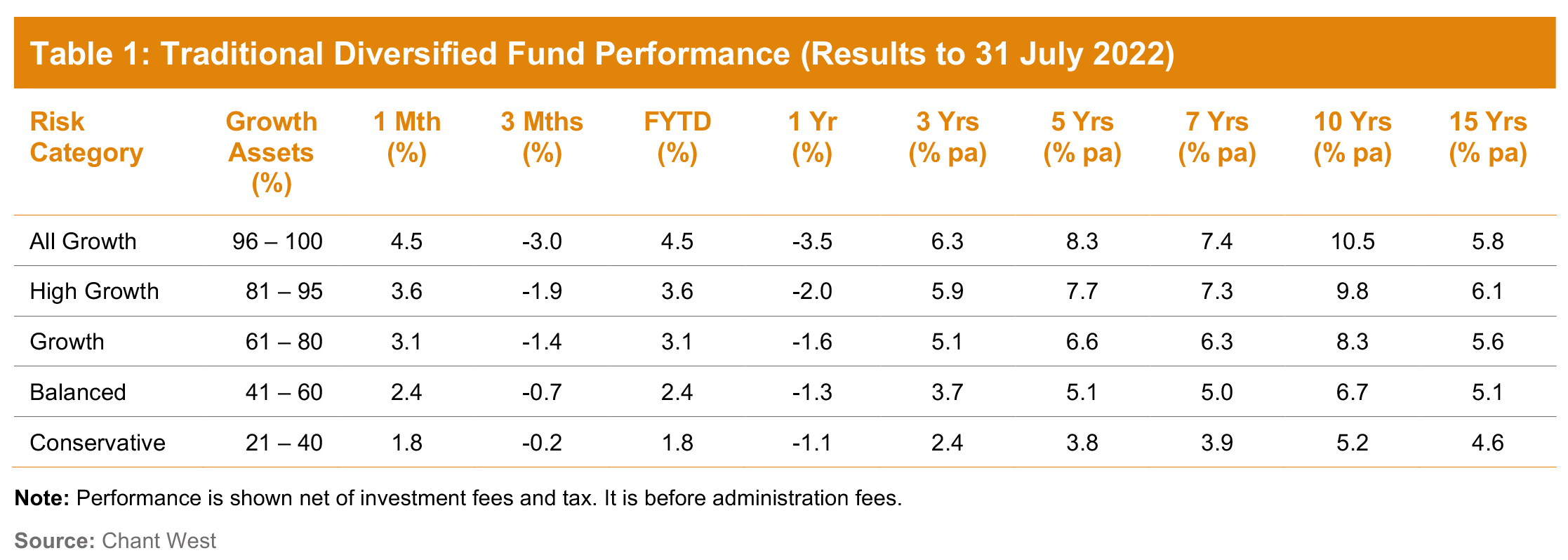
Table 1 compares the median performance to the end of June 2022 for each of the traditional diversified risk categories in Chant West’s Multi-Manager Survey, ranging from All Growth to Conservative. All risk categories have generally met their typical long-term return objectives, which range from CPI + 1.75% for Conservative funds to CPI + 4.25% for All Growth.

Lifecycle products behaving as expected
Mohankumar says that while the Growth category is still where most people have their super invested, a meaningful number are now in so-called ‘lifecycle’ products. “Most retail funds have adopted a lifecycle design for their MySuper defaults where members are allocated to an age-based option that’s progressively de-risked as that cohort gets older,” he said.
“It’s difficult to make direct comparisons of the performance of these age-based options with the traditional options that are based on a single risk category, and for that reason we report them separately. Table 2 shows the median performance for each of the retail age cohorts, together with their current median allocation to growth assets. For comparison purposes it also includes a row for traditional MySuper Growth options – nearly all of which are not-for-profit funds. Care should be taken when comparing the performance of the retail lifecycle cohorts with the median MySuper Growth option, however, as they’re managed differently so their level of risk varies over time.”
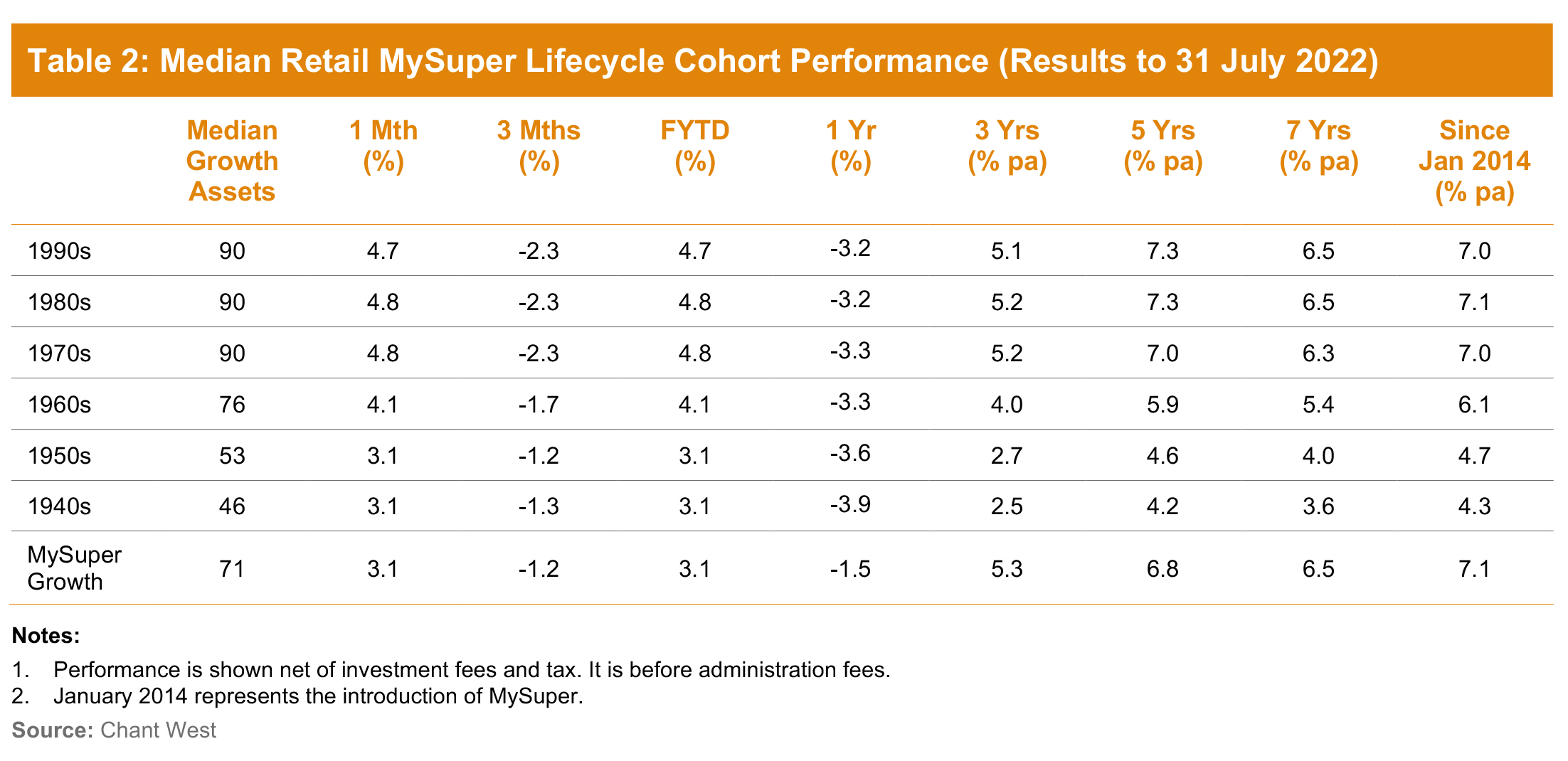

Despite the falls in global share markets so far in 2022, options that have higher allocations to growth assets have done better over most periods shown. Younger members of retail lifecycle products – those born in the 1970s, 1980s and 1990s – have held their own against the MySuper Growth median over the three-year period and longer. However, they’ve done so by taking on significantly more share market risk. On average, these younger cohorts have at least 20% more invested in listed shares and listed real assets than the typical MySuper Growth option.
The 1960s cohort has generally underperformed the median MySuper Growth option. This is partly due to a lower allocation to growth assets up until recently, when lifecycle product providers revised their glide paths to delay the de-risking process until older ages. Another reason for this underperformance is a lower allocation to unlisted assets, which have performed well, and a higher allocation to traditional defensive asset sectors, such as bonds and cash, which have been the weakest performing sectors since the introduction of MySuper.
The oldest cohorts (those born in the 1950s or earlier) are relatively less exposed to growth assets so you would expect them to underperform the MySuper Growth median over longer periods. Capital preservation is more important at those ages, so while they miss out on the full benefit in rising markets, older members in retail lifecycle options are generally better protected in the event of market weakness.
Long-term performance remains above target
MySuper products have only been operating for eight years, so when considering performance it’s important to remember that super is a much longer-term proposition. Since the introduction of compulsory super in 1992, the median growth fund has returned 8% p.a. The annual CPI increase over the same period is 2.5%, giving a real return of 5.5% p.a. – well above the typical 3.5% target. Even looking at the past 20 years, which includes four major share market downturns – the ‘tech wreck’ in 2002-2003, the GFC in 2007-2009, COVID-19 in 2020 and the first half of 2022 driven by high inflation and rising interest rates to combat it – super funds have returned 7.3% p.a., which is still comfortably ahead of the typical objective.
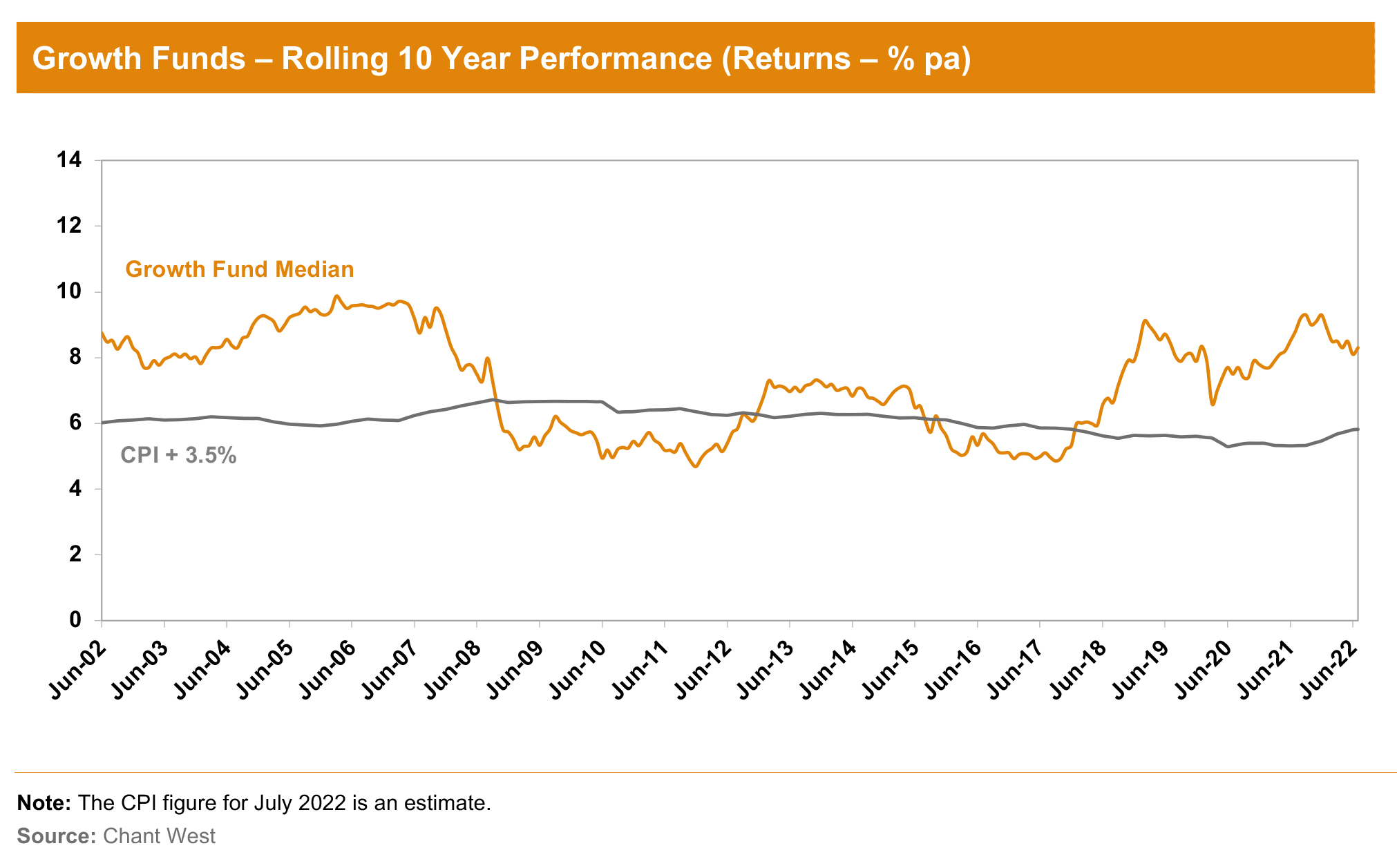
The chart below shows that, for the majority of the time, the median growth fund has exceeded its return objective over rolling 10-year periods, which is a commonly used timeframe consistent with the long-term focus of super. The exceptions are two periods between mid-2008 and late-2017, when it fell behind. This is because of the devastating impact of the 16-month GFC period (end-October 2007 to end-February 2009) during which growth funds lost about 26% on average.

By Mano Mohankumar, Senior Investment Research Manager and Ian Fryer,General Manager