

Whilst this framework has proved useful, the consumer protection policy narrative, both in Australia and overseas, has evolved, and in recent years governments and consumer groups have elevated their focus from financial literacy, or financial knowledge, to the more overarching concept of financial capability (a mixture of financial knowledge, skills, attitudes, and behaviours).
In early 2022, the Australian Federal Government formalised this evolution with the rollout of the National Financial Capability Strategy[2].
As well as being a driver of improved Financial Wellbeing, Financial Capability is also positively correlated with Financial Resilience, which, in the face of rising inflation, falling consumer confidence and volatile investment markets, has become more topical now than ever before.
Typically, we think of ‘financial resilience’ as a term used in the context of the most vulnerable members of society, and certainly this an important target for government sponsored initiatives.
But in its purest sense, financial resilience relates to our ability to recover from financial shocks, shocks which might include a temporary or permanent loss of income, the loss or destruction of assets, or a significant reduction in value of investments. These scenarios are ones faced by advice clients, and for which advisers build strategies, every day. In this sense, it could be argued that the most fundamental role of financial advice – the first thing it should aim to achieve – is to improve the financial resilience of clients, whether that be through specific products, or through planning, guidance, and coaching.
In this article, we will examine the societal context for financial resilience in Australia, including what it means, what drives it, and why it is arguably the single most important financial consumer protection focus to have right now. We will then look at resilience in an advice context, including the role advisers can play in building the financial resilience of their clients and associated stakeholders.
What do we mean by financial resilience?
In Australia, the term “financial resilience” first came to prominence in 2015, when the Centre for Social Impact (CSI) released its ground-breaking study Financial Resilience in Australia[3].
The authors of this report defined financial resilience as:
“The ability to access and draw on internal capabilities and appropriate, acceptable and accessible external resources and supports in a time of financial adversity”.
The research identified the resources that work together to enable financial resilience as being economic resources (such as savings), financial products and services (bank accounts, credit cards and insurance), financial knowledge and behaviour (including confidence and willingness to seek financial advice), and social capital (social connection and access to government support).


By constructing a survey containing questions across each of these four enabling areas, researchers were then able to calculate a financial resilience score, which was then equated to degrees of financial stress or financial security.
Examples of the questions asked by the survey include “If you had a financial emergency (e.g., your car breaks down, your washing machine stops working) would you be able to raise $2000 within a week? “, and “How would you rate your ability to get support from your social networks in times of crisis?”.
The results of this survey, initially involving around 1500 Australian adults, allowed the creation of a spectrum of financial resilience:
- severe financial stress
- high financial stress
- low financial stress
- financial security.
Results from the 2018 edition of the survey[5] revealed that around two thirds (66.1%) of Australians were experiencing some degree of financial stress.
Other findings included:
- more than 1 in 5 people (18.3%) reported having minimal social connections or being isolated or alone (3.7%) most of the time
- 1 in 6 (over 17%) people reported being over-indebted or just managing to meet their repayments
- 1 in 2 people reported limited to no savings.
Although it is now 4 years since that study was last run, there are a number of contemporary environmental factors that suggest the degree of financial stress today is quite possibly higher than it was in 2018:
- interest rate rises have seen the number of households experiencing mortgage stress increase to around one in four[6]
- rampant inflation, especially in non-discretionary areas such as energy and groceries, is creating a cost-of-living crisis
- natural disasters, driven by unfavourable weather patterns, have seen thousands of Australians displaced
- COVID-related isolation and the move to work from home has weakened social connections for many people.
Most advisers will have encountered clients for whom some, or even all, of the above issues are in play. Indeed, there are two major cohorts of advice clients who are particularly susceptible to the current economic climate:
- mature families with bigger households and larger mortgages
- self-funded retirees, stung by market downturns and rising inflation.
All of which makes an increased focus on the financial resilience of your clients even more important.
Financial resilience – the Australian financial advice context
Netwealth’s 2021 study of Advisable Australians[7] posited that the financial resilience of Australian adults was influenced by 3 factors:
- wealth indicators (levels of income, assets, debts, and saving habits)
- insurance uptake
- investment planning and engagement.
Their research found the largest proportion of Advisable Australians could be classed as having medium (28.1%) or low (27.3%) financial resilience. Other high-level findings include:
- 6% of those high resilience individuals use a financial adviser
- 8% of low resilience individuals say that are not prepared for retirement, and
- 5% of the low resilience group are not confident in achieving their financial goals.
Drilling down into the 3 factors driving resilience, the following findings were notable:
Wealth indicators
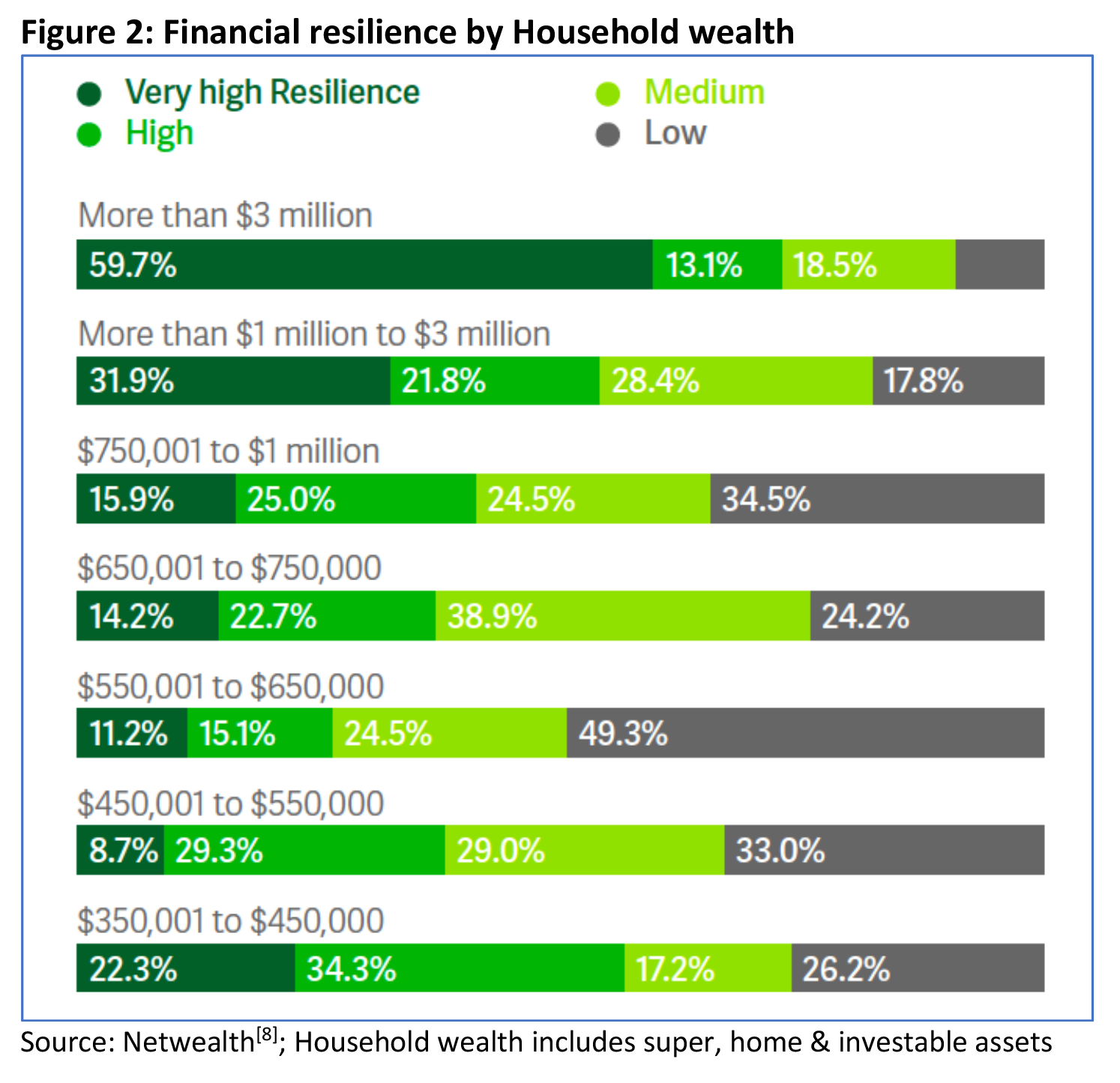
- Financial resilience was found to increase with wealth up to $450,000 in assets (at which point 22.5% of households were classed as high financial resilience), then reset and started increasing again (only 8.7% of households with $450k – $550k in assets were high resilience, climbing to 30% and higher once assets reached $1 million and over). A possible explanation for this is that higher asset households also had higher debts, and the cohort between $450k and $1m were more highly leveraged relative to their income, perhaps as younger mortgage holders).
- 32.1% of those earning $150k – $200k were high resilience, rising to 88% of those earning over $350k

Insurance uptake indicators
When the appetite for insurance and associated confidence in the adequacy of coverage was assessed, high resilience households were found to be more likely to take up more types of insurance (70.2% have death cover and 43.3% income protection), and more likely to be confident in the adequacy of their coverage, with around 88% of this group saying they were reasonably or extremely confident that they had sufficient and appropriate cover.
Investment planning and engagement
Financial resilience was found to be positively correlated with the degree of engagement one had with their investments.
Resilience was also found to be positively correlated with:
- portfolio diversification
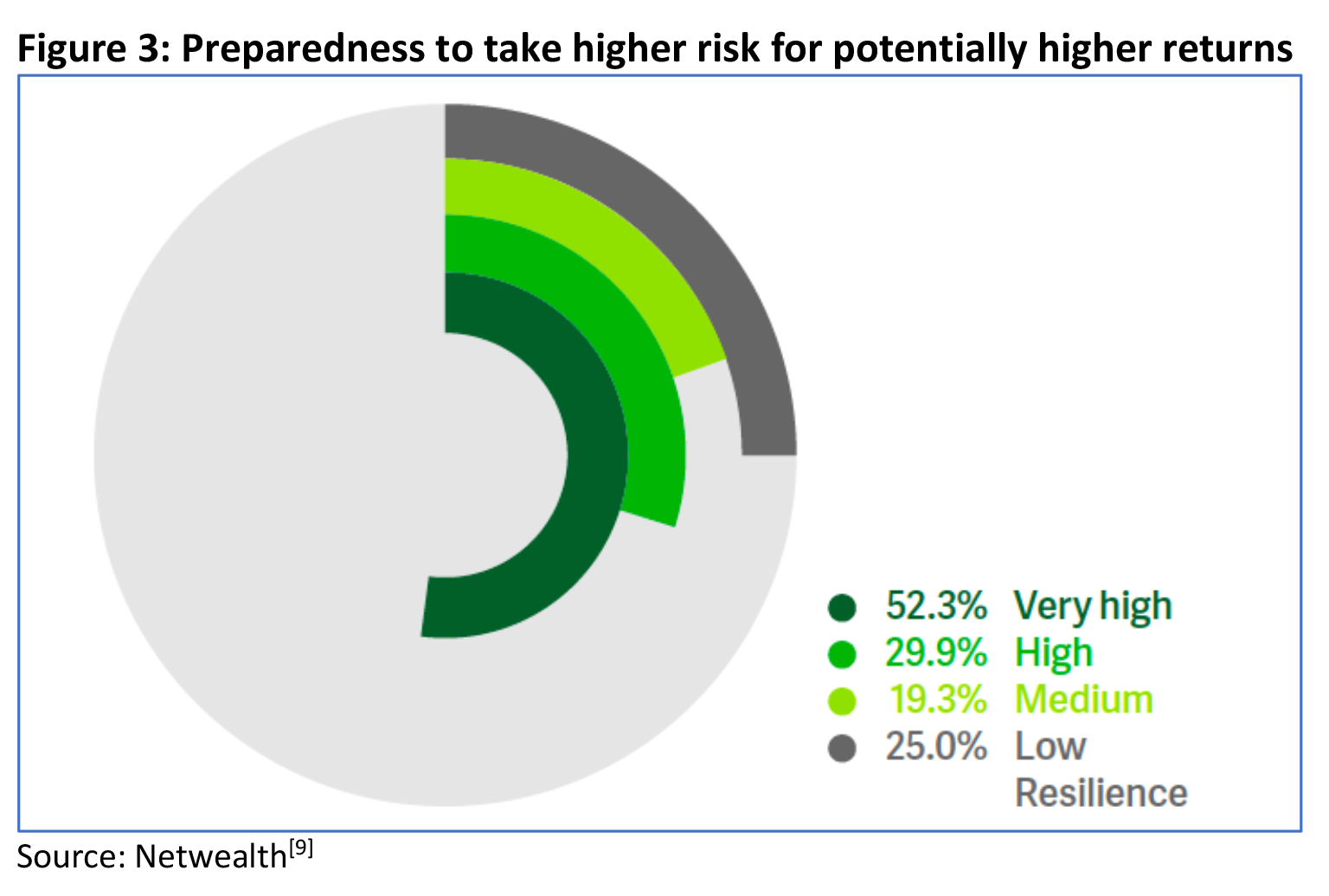
- preparedness to take more risk in order to achieve higher performance
- a longer-term perspective
- having specific investment goals.

The importance of optimism and confidence
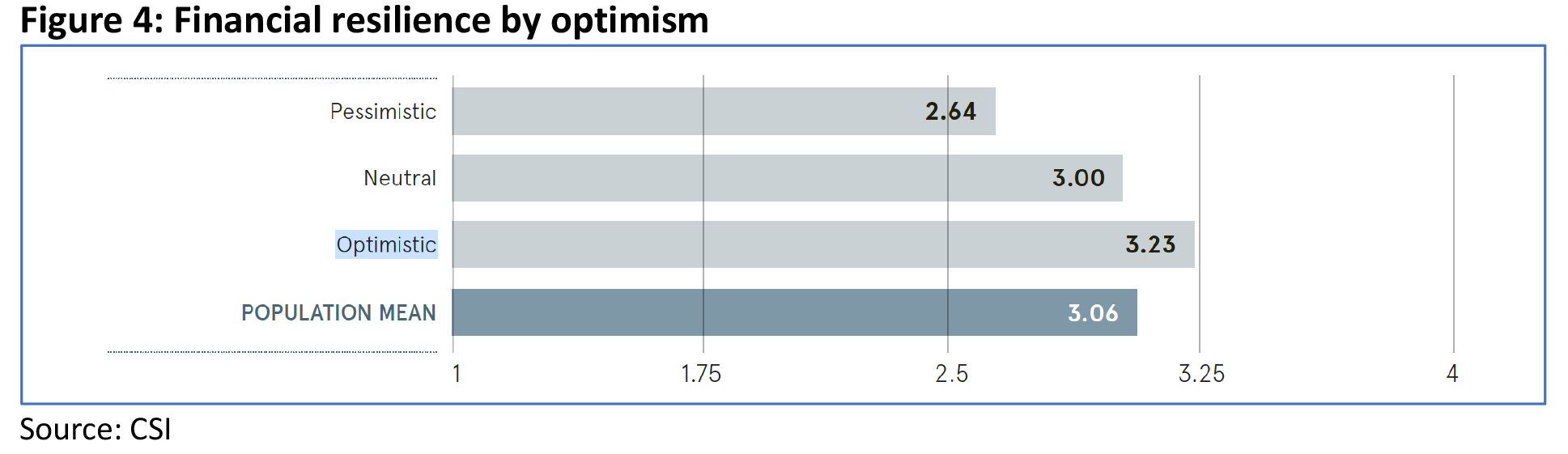
In the CSI model of financial resilience, optimism is seen as an important enabler of financial resilience, so much so that their benchmarking survey on resilience included specific questions to measure the optimism of respondents.
Whilst at first glance this relationship may seem obvious (people with more wealth feel more optimistic), in actual fact optimism is an independent enabler, and the relationship is far more complex.
A 2019 study of 2,000 US residents set out to test for optimism, financial health, and money attitudes and behaviours[10].
After controlling for wealth, income, skills, and other demographics, the survey results clearly showed that optimists were significantly more likely to experience better financial health than pessimists and engage in healthier habits with their money. Additionally, optimists were more likely to seek out and follow advice from someone they trust.
Similarly, in Australia the CSI study[11] reported that people who are optimistic have higher levels of financial resilience than people classified as neutral or pessimistic. Further, pessimism increases the probability of being in severe or high financial stress whilst optimism increases the probability of being financially secure. These findings were independent of mental health status.

Optimism, confidence, and investor behaviour
Notwithstanding the downside of confidence in an investment context (specifically, overconfidence in one’s ability, or being overly optimistic about a risky investment), optimism and confidence can also drive more rational, considered, and disciplined investor behaviour, much to the delight of their advisers!
Central to this is the concept of financial self-efficacy. Financial self-efficacy is one’s belief in their ability to behave in the ways necessary to achieve financial goals. Optimism and confidence underpin this belief.
This belief helps close the gap between stated risk tolerance and actual behaviour, a phenomenon that has taken on heightened importance during recent market upheavals.
Many advisers may be dealing with clients who indicated one level of risk tolerance, but, when faced with the reality of double-digit portfolio losses, are prone to panic selling and deviation from their plan. Hence the gap, caused by low self-efficacy. As well as leading to sub-optimal investment outcomes, this gap can lead to disputes and complaints, which is why building your client’s optimism and confidence is crucial.
Real life and recent evidence of this behavioral gap – and the role of financial advice in closing it – was found in a study by UK advice firm Dynamic Planner[12].
Participants in the study, conducted just prior to Covid, were asked what their investment behaviour and emotional response would be in the event of a sudden portfolio loss of 20%.
Serendipitously– for the research purposes at least – the February 2020 market crash occurred, allowing the results of people who completed the survey either side of the crash to be compared, along with the benefits of having worked with a financial adviser.
At a high level, people who had worked previously with a financial adviser were more comfortable with taking risk and were also generally more resilient.
People who had previously worked with a financial adviser were also more optimistic and less concerned about the hypothetical 20% loss than those who had not.
Interestingly, the survey also found the most optimistic group of all were those who had an adviser and completed the survey post the crash. This suggests that having experienced a real life crash, the core messages from their adviser about ‘’staying the course’ and not panicking resonated more strongly than for others.
The role of advisers in engendering optimism was reinforced in another UK survey[13], conducted by the Embark Group, and published in October 2022, which found advised investors were 25% more bullish about the prospects for equities than non-advised investors.
(Of course, optimism cuts both ways, and interestingly, the same survey found advisers’ confidence in their clients’ ability to meet their retirement plans had fallen at a much faster than their clients!).
Improve your clients’ self -efficacy and increase their resilience
An important way to build confidence and knowledge is by setting a plan with specific, realistic targets and frequent milestones.
The emotional benefits of making visible progress towards a goal are well documented in psychological literature, and explain why even the financial planning process itself can have tangible psychological wellbeing benefits.
Documenting, achieving, and celebrating targets, no matter how modest, also builds confidence, knowledge, and self-belief, all drivers of financial resilience.
Building resilience in the current economic climate
In addition to your role as a mentor and coach, the current economic climate has created some specific opportunities to help build your clients’ financial resilience. This is because many of your clients don’t just need encouragement to ‘stay the course’ in the face of volatile investment markets, they actually need help with getting their budgets in order, as inflation and interest rate increases play havoc with household finances, even those of previously financially comfortable clients.
These opportunities could include advice around cash flow, budgeting, and debt management. Now could be the time to partner with a mortgage broker as clients seek to refinance after several super-size rate increases.
To the extent that insurance plays a vital role in building financial resilience, the focus now should be on ensuring your clients have the right cover in place, and if affordability becomes an issue, guide your client on the many options they have to trim costs whilst keeping the same core cover in place.
Building resilience through superannuation remains as important as ever. As challenging as it is right now, encouraging your clients to keep up with their superannuation contributions will pay dividends in the future, especially given the benefits of buying into a depressed market.
Conversely, withdrawing money during a depressed market depletes capital faster. For self-funded retiree clients, increasing their resilience might mean reviewing which assets are being redeemed to fund pension payments.
For clients who have suffered major life and financial shocks, your role as an adviser may also be to help facilitate access to the appropriate government support (e.g., disaster payments, disability benefits) as well as encouraging them to tap into social networks for emotional support.
Of course, your ongoing role as a financial educator is more important now than it has ever been. Financial knowledge is a key enabler of resilience, so ensure you continue to educate and inform, as well as guide, your clients throughout these challenging times.
Summary
Consumer protection policymakers around the world have elevated their focus from financial literacy to the broader concept of financial capability, and the corollary outcome of financial resilience. Whilst the topic of financial resilience – one’s ability to recover from financial shocks – is generally discussed in the context of financially vulnerable members of society, it is a concept equally relevant to financial advisers and their clients, especially in the midst of a perfect storm of high inflation, soaring interest rates, and depressed and volatile investment markets.
Researchers have identified four key enablers of financial resilience: economic resources, financial products & services, financial knowledge and behaviour, and social capital, and advisers are ideally placed to assist their clients in all these areas, meaning they have a key role in building the resilience of their clients. In doing so, they will not only ensure their client has more robust protection against financial shocks, but that they are more able to stick to their financial plans and thus more likely to achieve their financial and lifestyle goals.

