Key takeaways
- With inflation still climbing at an above-target rate, the Fed left its benchmark interest rate unchanged at the fifth straight monetary policy meeting.
- Consumers are feeling the effects of multiyear-high interest rates and inflation, creating mounting pressures for the key driver of economic growth.
- The combined effects of slowing consumer spending and a cooling job market should give the Fed room to start cutting rates later this year.
As expected, persistent inflation prompted the Federal Reserve (Fed) to leave interest rates unchanged on Wednesday, March 20. But the Fed believes its still-restrictive monetary policy will ultimately have the desired effects. Despite a February uptick in consumer prices, policymakers remain confident that inflation and economic data will slow sufficiently to warrant easing later this year.
The Fed left intact its projection for three interest rate cuts this year, even as economic growth remained firm and prices edged higher. Fed Chair Jerome Powell touted progress in slowing inflation but noted he still needs more confidence that the 2% target is within reach. He also indicated that policymakers expect economic, labor market and inflation data to slow gradually, leading to rate cuts later this year.
Bringing inflation back to target levels has been an ongoing challenge for the Fed and its peers. The European Central Bank left interest rates at their historically high levels at its March meeting. And most observers expect the Bank of England to keep its key lending rate at a 16-year high when policymakers meet on March 21.
Economy is likely to downshift
We expect the economy to slow to below-trend growth or even flatline this year. But we don’t foresee a rapid succession of rate cuts. Instead, we believe Fed policy will remain restrictive until its effects weaken consumer spending, the labor market and ultimately, the broad economy.
Consumers finally feeling the pinch
Consumer spending represents the largest driver of economic activity. According to the Federal Reserve Bank of St. Louis, it accounts for nearly 70% of the nation’s gross domestic product (GDP). Just as consumers largely kept the economy afloat in recent years, they will likely drive the pending pullback as their spending subsides.
Fed tightening has historically triggered changes in consumer behavior. The impact of the latest tightening cycle has been delayed, though, largely due to significant savings accumulated in the COVID era. However, the fallout from the Fed’s fastest rate-hike cycle in 40 years is starting to appear:
- Savings are dwindling. The total excess savings U.S. consumers amassed during the pandemic, which supported a surge in post-pandemic spending, has shrunk. Excess savings totaled $2.1 trillion in August 2021 and likely plunged to $110 billion in January 2024.[1]
- Wage growth is slowing. Wage growth peaked at all-time highs in mid-2022, fueling several quarters of solid economic growth.[2] Since then, overall wage growth has steadily declined, but still solid real wage growth remains a driver of consumption. We expect the rate to continue declining and settle near longer-term averages.
- Debt is soaring. Total credit card debt recently surged to a record high, topping $1.1 trillion in the fourth quarter. Furthermore, total consumer debt jumped $212 billion in the fourth quarter to a fresh high of $17.5 trillion.[3]
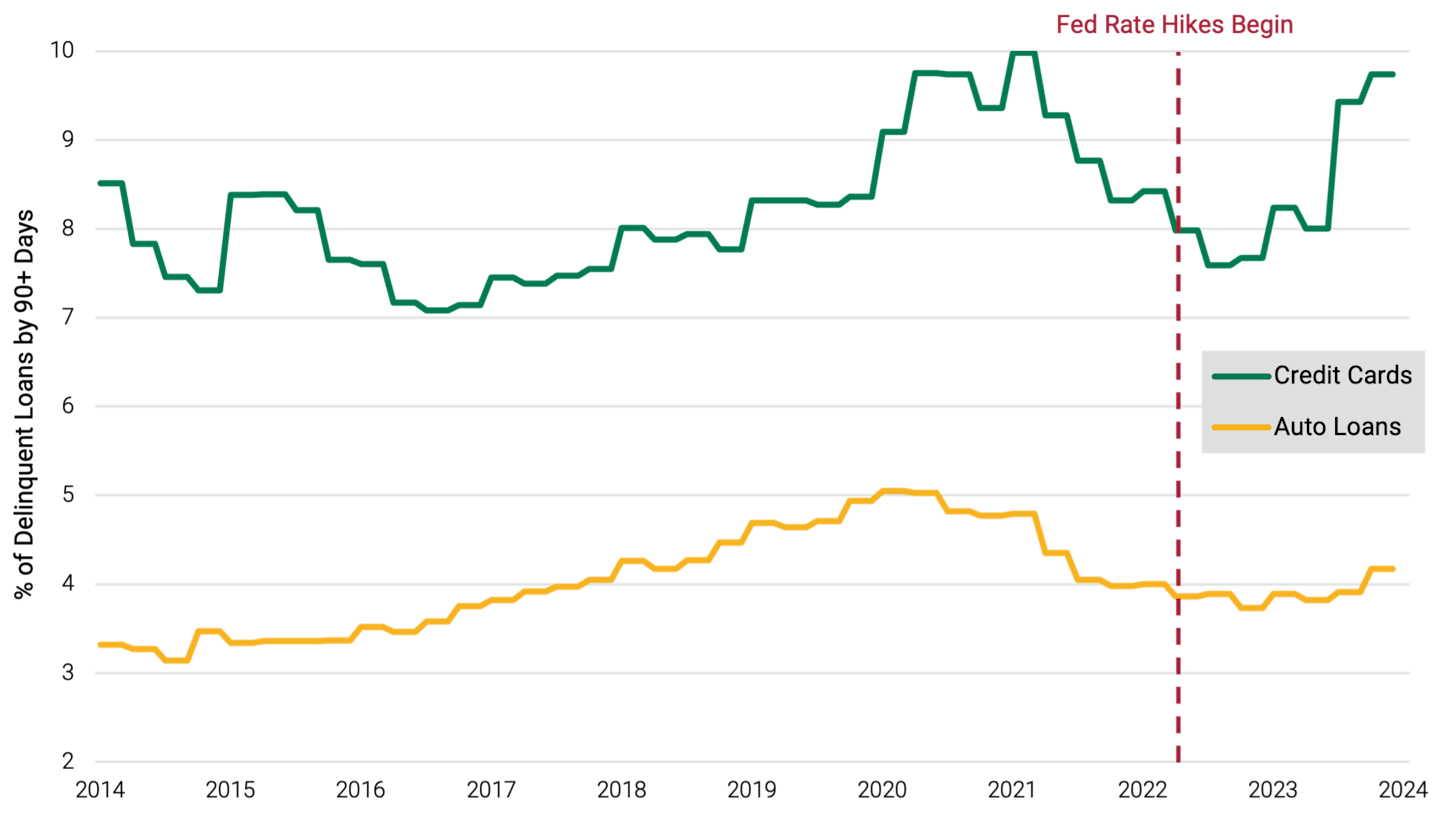
- Loan delinquency rates are rising. As we’ve mentioned previously, Fed policy has a lagging effect, which is evident in the consumer credit arena. As Figure 1 illustrates, credit card delinquencies spiked in mid-2023 – nearly one year after the Fed started raising rates – and remain on the rise. Auto loan delinquencies are slowly trending in the same direction.
Figure 1 | Loan Delinquencies Are on the Rise

Data from 1/31/2014 – 12/29/2023. Source: FactSet.
Job market conditions are normalising
In addition to persistent inflation, a robust job market has fueled the Fed’s restrictive bias.
However, recent data suggest labor market conditions may be easing.
- Amid increasing layoffs, the U.S. unemployment rate ticked up to a two-year high of 3.9% in February from 3.7% in January.
- In its February employment report, the government revised downward the number of jobs created in December and January by 167,000. This report marked the 11th downward revision in monthly job numbers since January 2024.[4]
- The number of U.S. job openings declined 15% for the 12-month period ended January 31, 2024.[5]
- U.S.-based companies announced 84,638 job cuts in February, up 3% from January and 9% from February 2023.[6]
Employees are staying put
Against this backdrop, the number of Americans quitting their jobs has dropped to historical averages after surging during the pandemic. The “quits rate,” which measures voluntary job resignations as a proportion of total employment, dropped in January to its lowest level since August 2020.[7]
This metric provides insight into how Americans view the job market. The quits rate typically rises when jobs are abundant, and employees feel confident about finding a new opportunity. Conversely, the quits rate usually declines when job openings fade and employees have few alternatives.
Fed policy shift is likely by midyear
If these trends persist, the Fed will have little incentive to keep its target rate at the current 23-year high range of 5.25% to 5.5%. Consumers power the U.S. economy, and as wage growth slows and savings diminish, we expect GDP to succumb to weaker spending.
Additionally, the strength characterising the post-pandemic job market appears to be waning, potentially removing one of two factors keeping Fed policy restrictive. The other factor — inflation — remains higher than the Fed would like, but prices may ease further as spending slows and the economy weakens.
We still believe at least three Fed rate cuts are possible this year, with the first likely to arrive this summer.