

Simon Doyle
Investors are increasingly turning to active management to strengthen portfolio resilience and capture specific investment opportunities amid mounting economic uncertainty and market volatility, according to Schroders’ flagship 2025 Global Investor Insights Survey (GIIS).
The survey, which spans nearly 1000 institutional investors and wealth managers globally, including 79 Australian respondents, encompassing US $67 trillion in assets, revealed that 80% of global investors are somewhat or significantly more likely to increase their use of actively managed investment strategies in the year ahead. For Australian investors, that number is slightly higher at 84% more likely, with 77% confident that active management can deliver value in the new investment landscape.
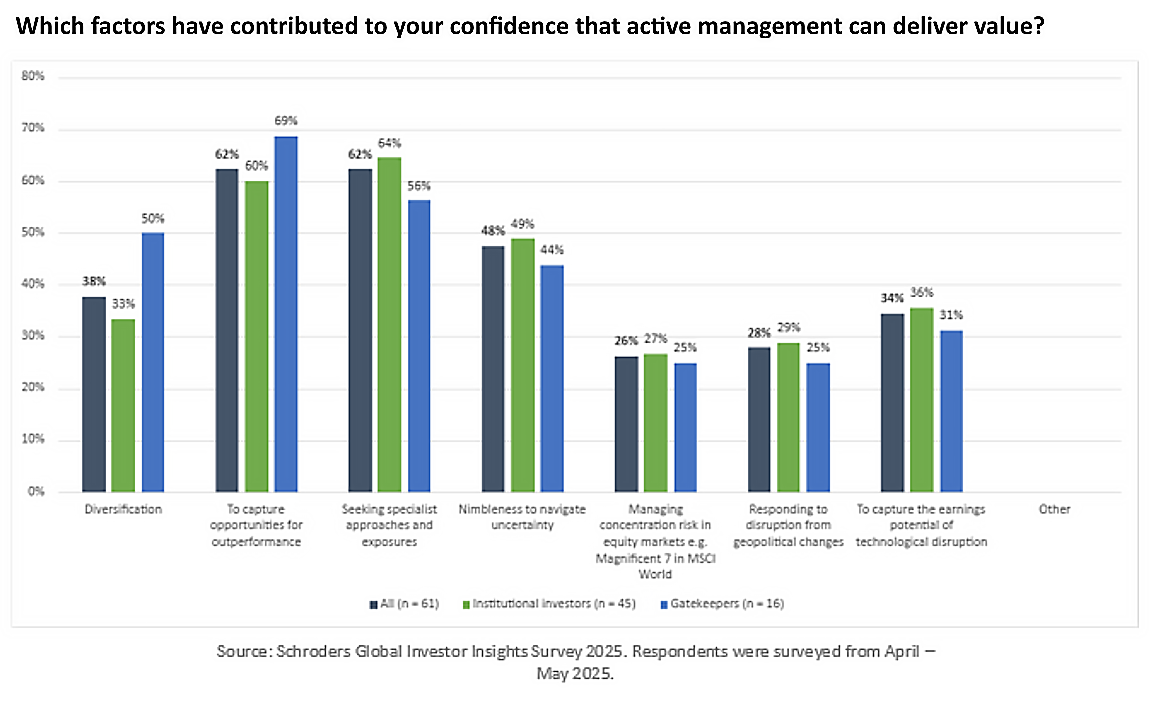
Investors stated that the top factors contributing to this confidence include the opportunity to capture outperformance (62%), seeking specialist approaches and exposures (62%), and harnessing nimbleness to navigate uncertainty (48%).
The research follows significant market volatility earlier this year, largely triggered by the US Government’s decision to introduce wide-ranging trade tariffs.
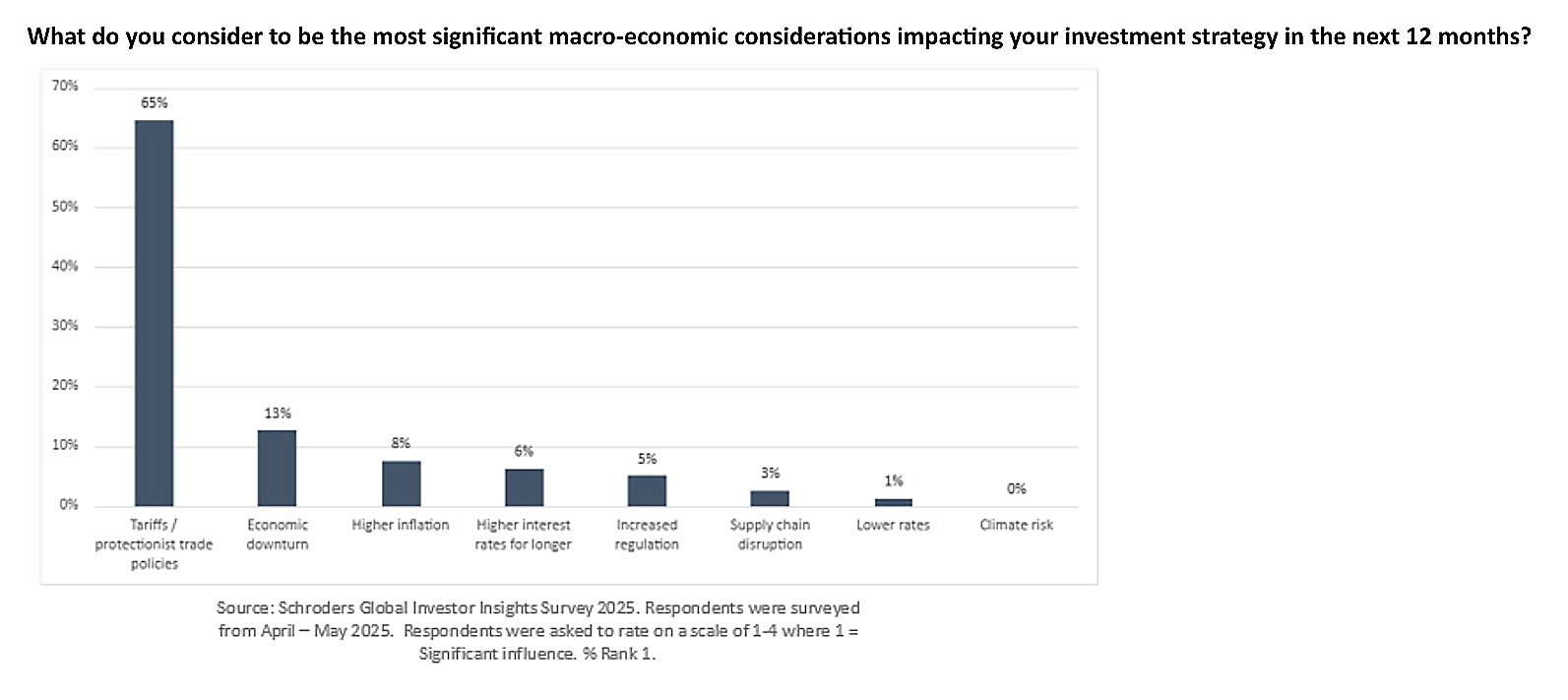
Nearly two-thirds of respondents (65%) said that these tariffs are their biggest macroeconomic concern – five times more than the next highest perceived risk. Similarly, continued uncertainty in US foreign policy, for more than half of respondents (56%) was highlighted as the greatest geopolitical risk impacting investment decision-making. This trade and policy uncertainty is likely to have fuelled investors’ strong focus on ‘portfolio resilience’ over the next 18 months – which was the overwhelming top priority for portfolios, having been selected by more than half of all surveyed (58%).

Of the investors who prioritised portfolio resilience, 84% said they are increasingly looking to harness active management. This was driven by a recognition that capturing investment opportunities (53%) and rigorous research into companies and industries (46%) were the top attributes investors sought from their active fund managers.

“Against the backdrop of trade and geopolitical uncertainty, investment priorities have shifted, with resilience now front of mind. Since broad market gains can no longer be taken for granted, active strategies are playing a crucial role in helping investors manage complexity, build resilience within portfolios, and identify compelling opportunities.”
The hunt for return opportunities is crucial during market volatility
Investors are actively seeking selective opportunities to generate returns through exposure to both public and private markets.
Public equities (46%) and private equity (53%) have emerged as the preferred asset classes for return generation in the current environment.
For those currently investing in private equity, enhanced long-term return potential (67%) – with half of Australian investors believing APAC (including India) will deliver the strongest returns – and access to small and growing businesses (49%) being the top two roles it plays in their portfolios.
Small-to-mid cap buyouts are seen as compelling by 71% of investors, reflecting a pivot towards investments more likely to be insulated from global trade tensions.
Notably, more than two-thirds of investors (69%) who believe public equities will deliver strong returns, believe global equity allocations will deliver the strongest performance. This shift underscores a growing conviction in reducing concentration risk and diversifying away from US mega caps, as 80% identified the S&P 500 as the index giving investors the greatest cause for concern about market concentration.
The new income toolkit
The survey showed how income generation is evolving from a traditional fixed income allocation to multi-channel, risk-adjusted sources encompassing traditional bonds, corporate debt and asset classes within private debt and credit alternatives (PDCA).
PDCA was the most attractive allocation option for global investors looking to generate income over the next 12 months, selected by half (51%) of investors, followed by high yielding equities (37%) and increasing exposure to real estate (30%).
However, bonds continue to play a crucial role in investors’ portfolios, particularly in today’s evolving market environment. Investors like their ability to provide diversification (70%), their function as a defensive asset to help manage risk (58%), and their contribution to portfolio liquidity (46%). This demonstrates that despite, changing conditions, bonds remain central to building resilient and well-balanced investment strategies.
Simon Doyle added: “In today’s environment of ongoing market volatility, Australian investors are demonstrating a clear shift towards diversification and selectivity in their pursuit of returns, increasingly turning to active management. We are seeing strong interest in both public and private markets, with conviction in global equities and private equity opportunities amongst Australian investors. Bonds continue to play a vital role in building resilient portfolios through diversification, downside protection, and liquidity. This dynamic, actively-managed approach highlights the importance of adaptability in achieving robust long-term investment outcomes.”