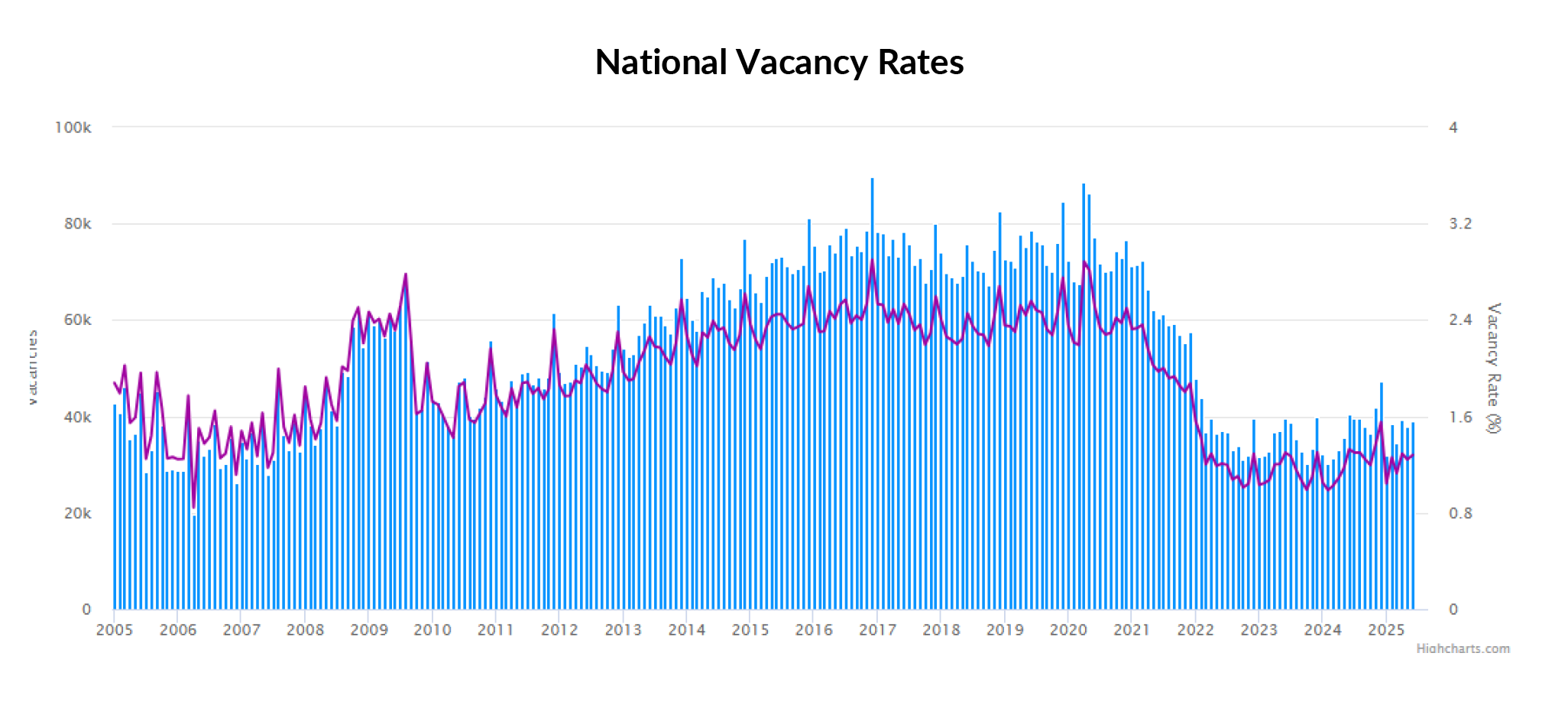
SQM Research has released its latest data on residential property vacancy rates.
Australia’s rental market posted a slight uplift in vacancy rates in June 2025, rising nationally from 1.2% to 1.3%, according to SQM Research. While the monthly increase may suggest early signs of stabilisation, many capital cities continue to grapple with persistent undersupply, keeping rental conditions firmly in favour of landlords.
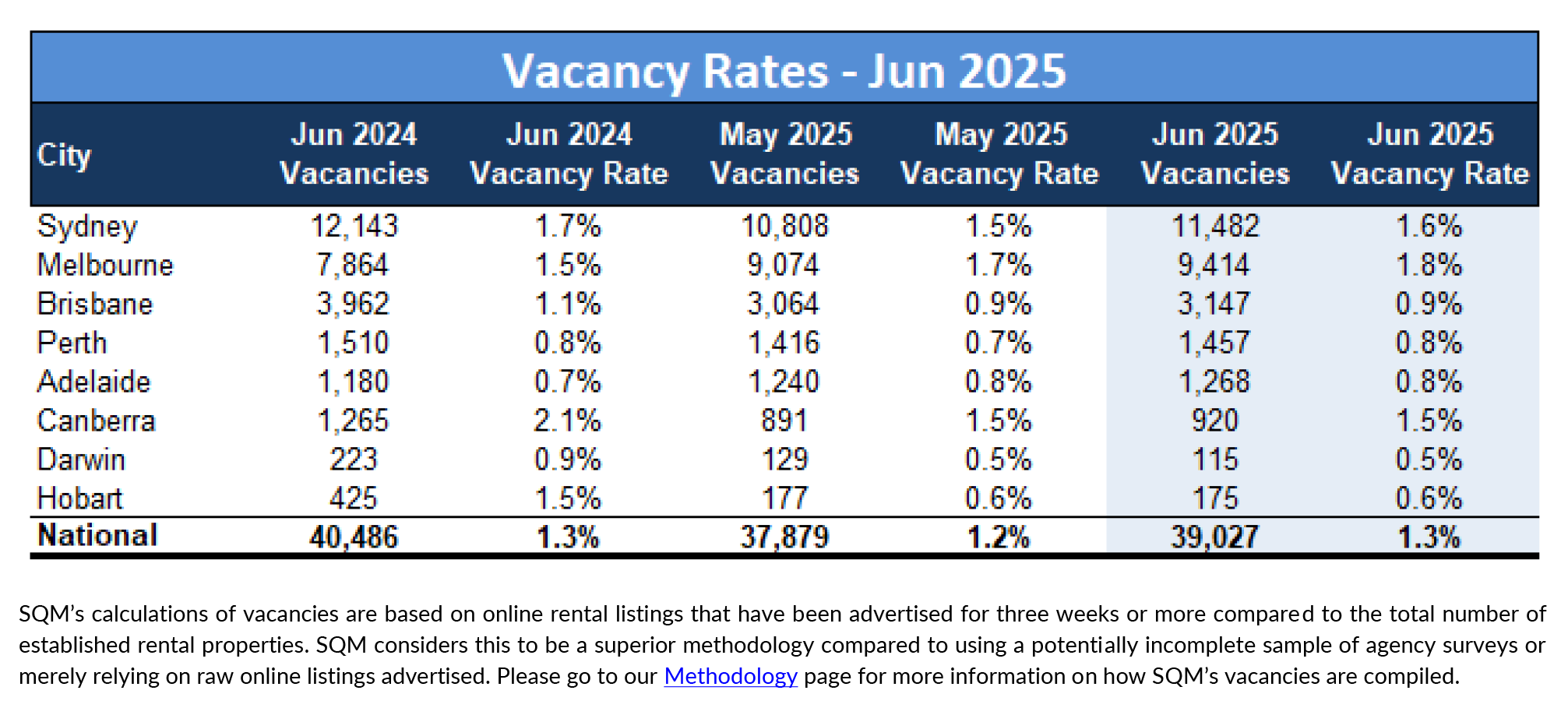

Despite small monthly rises, vacancy rates across most capitals continue to signal demand-driven pressure. Landlords in tighter markets may retain pricing power, while renters in cities like Melbourne and Canberra could see gradual shifts toward balance.
- Sydney: 1.5%, up 0.1% year-on-year, stable since April 2025.
- Melbourne’s vacancy rate continues to climb, reaching 1.8% — indicative of easing demand or new supply entering the market.
- Sydney’s modest uplift to 1.6% hints at seasonal fluctuations rather than a market shift.
- Brisbane, Perth, Adelaide, Darwin and Hobart all maintain sub-1% rates, reinforcing ongoing pressure on tenants.
- Canberra has stabilised after a sharp year-on-year decline, possibly reflecting renewed leasing activity or moderate supply increases.
Advertised rents analysis
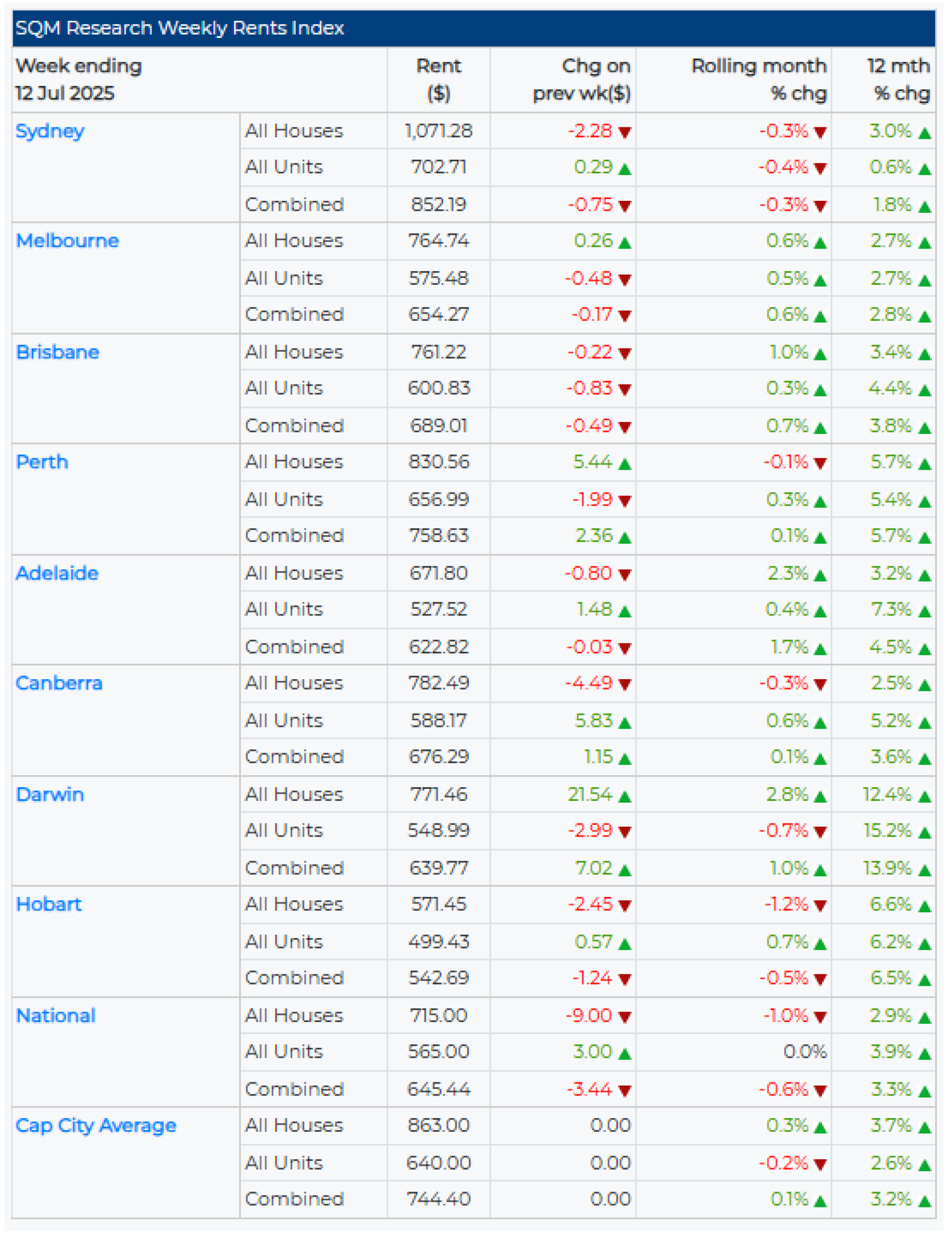
SQM Research’s latest Weekly Rents Index for the week ending 12 June 2025, available via its property index, tracks weekly rental prices, monthly percentage changes, and year-on-year percentage changes for houses and units combined, based on listings active for at least three weeks.
National trend
Australia’s rental market continues to display nuanced dynamics, with capital cities diverging in performance over the past week. According to SQM Research’s Weekly Rents Index, national combined rents declined modestly to $645.44, while annual gains held firm at 3.3%. The standout performer was Darwin, where combined rents jumped over 1.0% week-on-week and soared nearly 14% year-on-year, highlighting pressure in smaller housing markets.
City-specific insights
Sydney
- Combined rent: $852.19 (↓ $0.75)
- Rolling month: -0.3%; annual: +1.8% o Market softening slightly amid seasonal turnover; unit rents up, houses down.
Melbourne
- Combined rent: $654.27 (↓ $0.17)
- Rolling month: +0.6%; annual: +2.8%
- Houses remain resilient, overall growth steady.
Brisbane
- Combined rent: $689.01 (↓ $0.49)
- Rolling month: +0.7%; annual: +3.8%
- Units and houses gaining traction; solid growth continues.
Perth
- Combined rent: $758.63 (↑ $2.36)
- Rolling month: +0.1%; annual: +5.7%
- Houses surged $5.44; competition intensifies in outer metro areas.
Adelaide
- Combined rent: $622.82 (↓ $0.03)
- Rolling month: +1.7%; annual: +4.5%
- Units driving momentum; affordability keeping demand elevated.
Canberra
- Combined rent: $676.29 (↑ $1.15)
- Rolling month: +0.1%; annual: +3.6%
- Unit rents rebound, balancing softer house performance.
Darwin
- Combined rent: $639.77 (↑ $7.02)
- Rolling month: +1.0%; annual: +13.9%
- Houses rose over $21; lowest vacancy rate nationally fuelling sharp growth.
Hobart
- Combined rent: $542.69 (↓ $1.24)
- Rolling month: -0.5%; annual: +6.5%
- Units climbing while houses cool; winter lull evident.
Commentary Louis Christopher, Managing Director of SQM Research, commented: “The marginal increase in vacancies nationally should not be interpreted as a market turnaround. Most regions still show signs of stress, and the recent spike in dwelling approvals needs to translate into physical supply before rental conditions meaningfully improve.
June’s figures suggest the beginning of a seasonal rebalancing in some regions. However, we are far from a renter’s market, especially in cities like Darwin and Hobart where vacancy rates are critically low,” said Louis Christopher, Managing Director of SQM Research.”