

Shane Oliver
Key points
- Compound interest is an investor’s best friend but can be a borrower’s worst nightmare.
- The higher the return, the earlier and bigger the investment contribution and the longer the period the more it works.
- To make the most of it, ensure an adequate exposure to growth assets, contribute early & often to your investment portfolio and turn down the noise around investing.
“Compound interest is the eighth wonder of the world. He who understands it, earns it; he who doesn’t, pays it.” – Albert Einstein
Introduction
If there is “one thing” investors should know about investing, it’s the power of compound interest or returns. In the ever-rising obsession with short-term developments impacting investment markets around the economy, interest rates, profits, politics, etc, it’s often forgotten about. It can be the worst nightmare of borrowers as interest gets charged on interest if debt is not paid down. But it’s the best friend of investors. The well-known Australian economist Dr Don Stammer refers to it as “magic”. Unfortunately, research by AMP shows many don’t understand the concept, particularly younger Australians with 2 out of 5 men under 40 responding in a survey that they don’t understand it and 2 out of 3 women. This is unfortunate as it’s when you are young you can make the most of it. Given its importance, this note has another look at what it is, how it works, various issues around it and why investors often miss out.
What is compound interest?
Compound interest is simply the concept of earning interest on interest or getting a return on past returns. Any interest or return earned in one period is added to the original investment, so it all earns a return in the next period. And so on. It’s best demonstrated by some examples.
- Suppose an investor invests $500 each year and receives a 3% pa return (Case A in the next table). After 20 years the investment will have risen to $13,838, for a total outlay (or $ Flow) of $10,000.
- But if the investor put the same flow of money in say a higher risk asset returning an average 7% a year, after 20 years it will have grown to $21,933 (Case B). And in year 20, annual earnings are now $1,435, far above the investment earnings in Case A of $403.
- Finally, if the process was kicked off by an initial $2000 investment at the start of the first year, with $500 each year thereafter and still earning 7% per annum then after 20 years it will have grown to $27,737 (Case C). By year 20 in this case the annual investment earnings will have increased to $1,815.
Of course these examples are relatively simple and all sorts of complications can affect the final outcome including inflation (which would boost the nominal results as the table uses relatively low nominal returns), more frequent compounding which occurs in investment markets (which would also boost the final outcome) and the timing of the average return from the high growth/more risky asset through time in that it won’t be a steady 7% year after year.
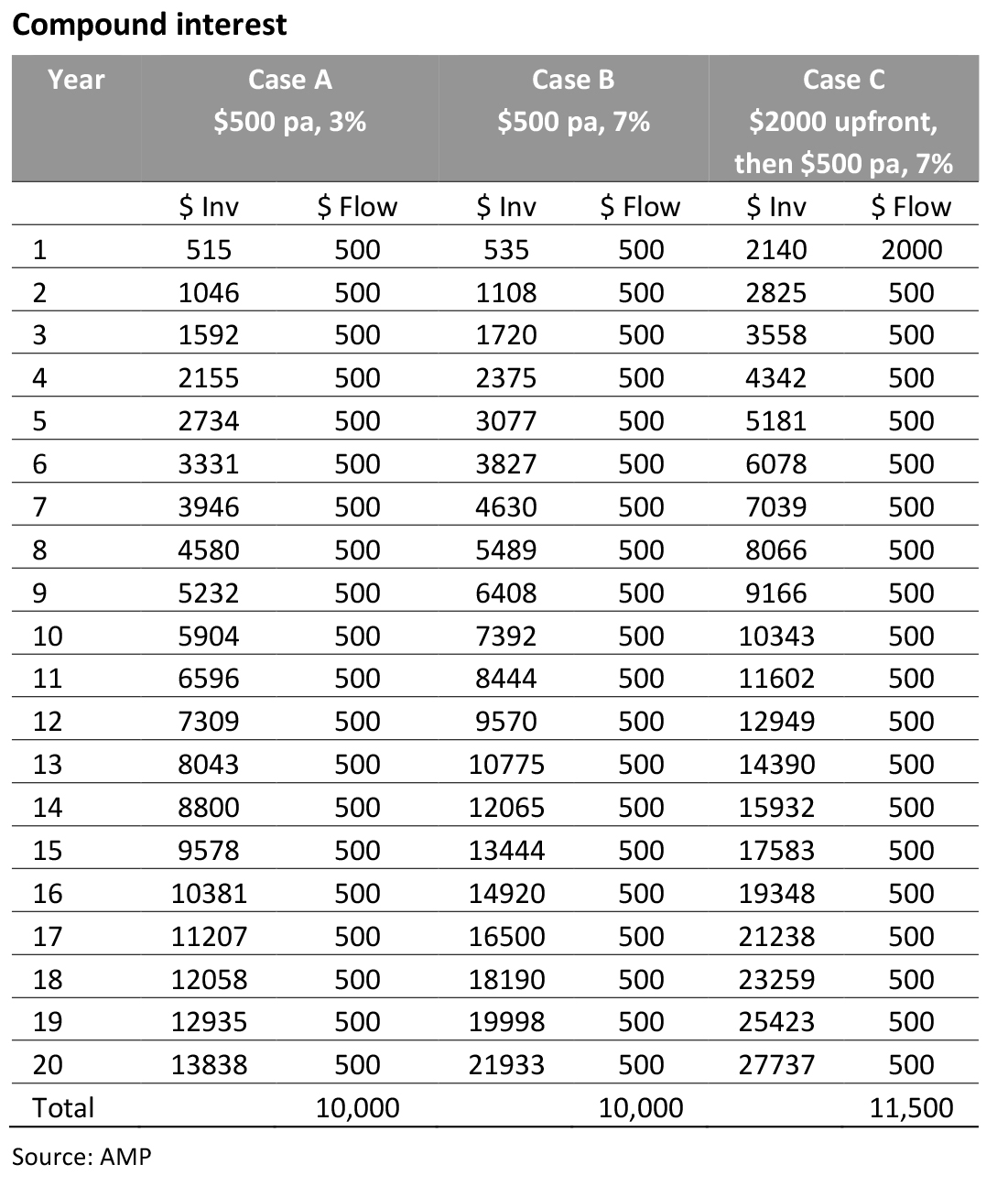

But they do serve to highlight the power of compounding. And, it can be seen that there are three key drivers of how powerful it is:
- The rate of return – the higher the better.
- The contribution – the bigger the better. The $2,000 upfront contribution in Case C boosted the outcome after 20 years by $5804 versus Case B. Not bad for just an extra $1,500 investment.
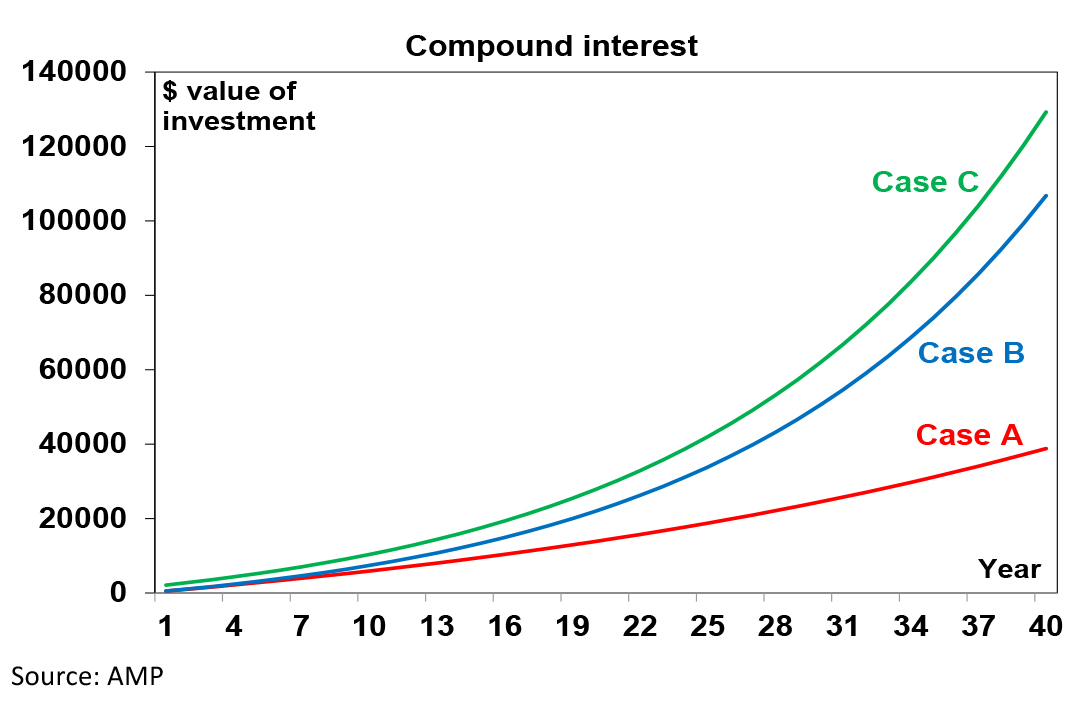
- Time – the longer the better as it means the longer the compounding of returns on returns has to run. Time also helps smooth year to year volatility in returns. After 40 years the investment strategy in Case A will have grown to $38,832 but Case B will rise to $106,805 and Case C will have grown to $129,267.
The next chart illustrates how after about 15 to 20 years the value of the investment in the higher returning cases starts to rise exponentially as returns build on top of returns. This is why compound interest is often described as “magical”. It explains why younger members, in particular, should be in the high growth option and not the conservative option in their super. As an aside it also explains why credit card debt can quickly balloon if you don’t make your payments and why the number of super members hit by the Government’s proposed $3 million super tax (and the associated revenue it raises) will balloon in the years ahead if the super balance threshold is not indexed over time.

Compound interest in practice
Growth assets like shares and property provide higher returns than defensive assets like cash and bonds over long periods, as their growth potential drives higher long run returns compensating for their higher volatility. The next chart shows the power of compound interest in action with the value of $1 invested in 1900 in Australian cash, bonds and shares with earnings on each asset reinvested along the way. Since 1900 cash has returned 4.6% pa, bonds 5.7% pa & shares 11.7% pa.
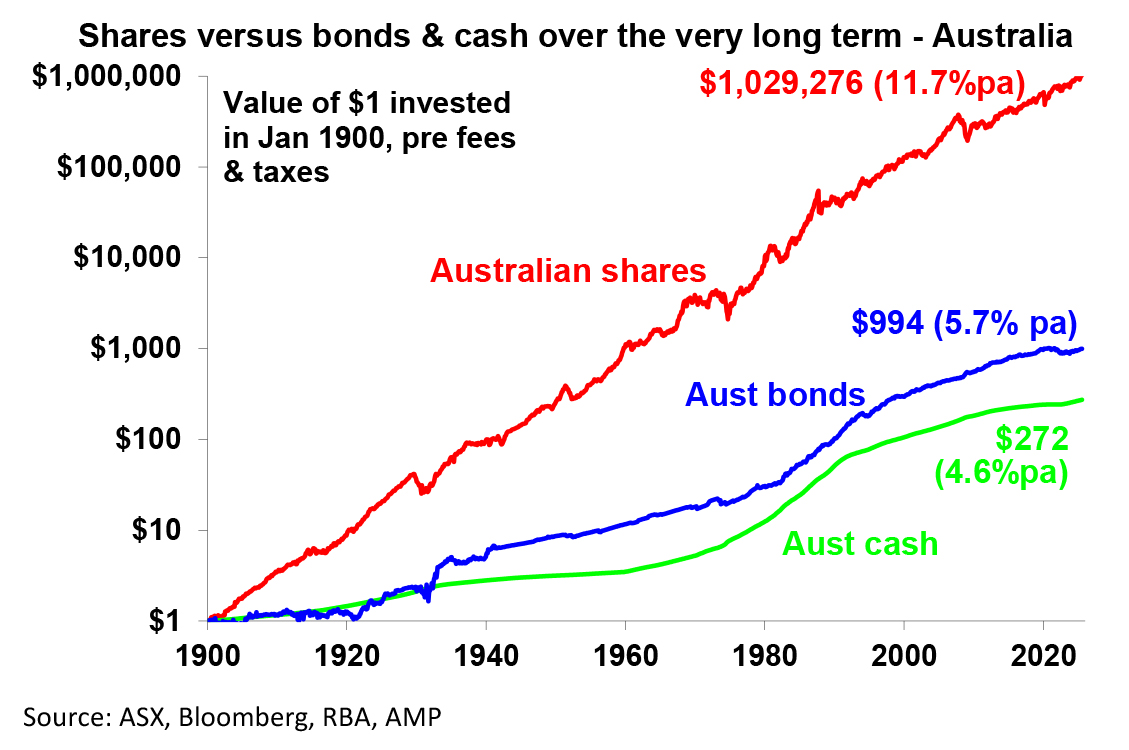

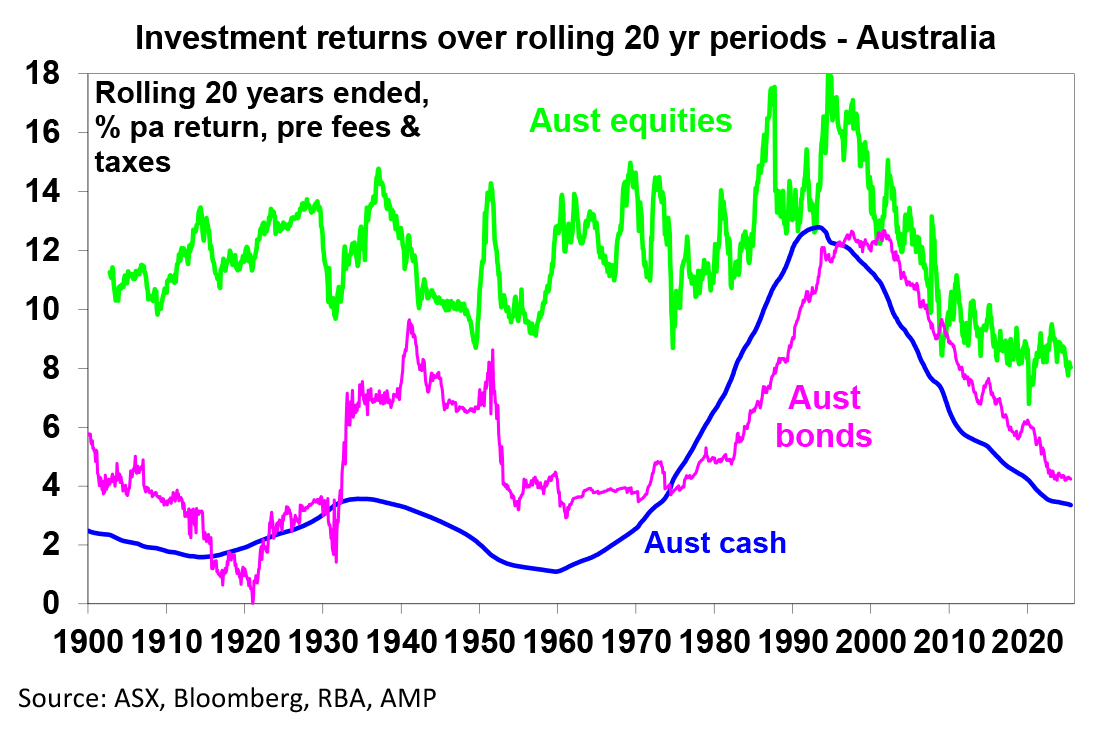
Shares are more volatile than cash and bonds. However, the compounding effect of their higher returns over time results in much higher wealth accumulation from them. Although the return from shares is only double that of bonds, over 125 years the $1 invested in 1900 will have grown to around $1,029,276 today, whereas the $1 investment in bonds will only be worth $994 and that in cash just $272. Of course, investors don’t have 125 years. But the next chart shows rolling 20 year returns from Australian shares, bonds and cash and its evident shares invariably outperformed over 20-year periods.

Some issues
What about property? Over long periods Australian residential property has had similar total returns to Australian equities. For example, since 1926, housing returned 10.8% pa versus 11.2% pa from shares.
What about fees? Fees on managed investment products will reduce returns over time, but for equities the impact will be offset by franking credits in the case of Australian shares (which add around 1% pa) and which have not been allowed for in the last two charts.
Are these returns sustainable? This is a separate issue, but the historical returns likely exaggerate their future medium term (say 10 year) return potential. Cash rates and bank term deposit rates are falling below 4% with RBA rate cuts and may only average 3.5% over the medium term. Meanwhile, current 10-year bond yields around 4.2% suggests more constrained bond returns for the decade ahead than the average over the last 125 years. And returns from Australian equities may be closer to 8% pa, reflecting a dividend yield with franking credits around 4.5% and capital growth around 3.5%. This sort of return still leaves significant potential for investors to reap rewards from the power of compounding.
But why do investors often miss out?
What can cause investors to miss out on the power of compounding returns if it’s so obvious? There are several reasons:
- First, investors may be too conservative in their investment strategy, opting for lower returning defensive assets like bank deposits. This may avoid short term volatility but won’t build long term wealth.
- Second, they leave it too late to start investing or don’t contribute much initially. This makes it difficult to catch up in later life & leaves them more at the whim of financial market swings. Fortunately, the superannuation system forces Australians to start early in life.
- Third, they attempt to “beat” the market by either trying to time market moves up or down or trading individual stocks. The trouble is that investors often end up getting it wrong – buying at the top and selling at the bottom which destroys wealth.
- Fourth, they are not diversified enough.
- Finally, some are sucked into investment opportunities seeming to promise a free lunch, which then fail. The key is to check the asset is not just dependent on the crowd pushing it higher.
Implications for investors
There are several implications for investors looking to take advantage of the power of compound interest and returns.
- First, take a long-term approach and focus on growth assets like shares and property with a long-term track record.
- Second, start contributing to your investment portfolio, including super, as much as you can and as early as you can.
- Third, find a way to manage cyclical swings so you can stay the course in a long-term strategy designed to make the most of compounding. Eg, invest a bit of time in understanding that short term volatility is a normal part of investment markets and partly explains why growth assets have a higher return in the first place. Finally, avoid or minimise assets that look too good to be true.
By Dr Shane Oliver, Head of Investment Strategy and Chief Economist