

What is the CAR and the importance of balancing clarity and compliance when communicating and documenting advice?
Introduction
The forthcoming replacement of Statements of Advice (SOAs) with Client Advice Records (CARs) has once again shone a spotlight on the vexed issue of client communication within financial advice.
As a key pillar of financial consumer protection, adequate disclosure in areas such as advice outcomes, tax, fees, performance, risk, and product limitations, are clearly important enablers of informed decision making – and the avoidance of financial harm – by advice clients.
But, with a prevailing ‘compliance first’ culture among many licensees, critical advice processes and documents, such as the SOA, have been seen by many primarily as a tool to improve the defensibility – rather than client comprehension – of financial advice.
This issue has caught the attention of regulators, policymakers, and industry stakeholders, many of whom have lamented that – paradoxically – longer, more information-dense, advice documents undermine client comprehension, and rather than offering advisers more protection in the event of a complaint, actually offer less.
The 2025 re-election of the Federal Labor government has cleared the path for it to continue to legislate Tranche 2 of the Delivering Better Financial Outcomes (DBFO) reforms, including the replacement of SOAs with CARs. This change represents a pivotal juncture for advice. What was intended to represent a broader cultural shift towards client communication that was more clear, accessible, and client-centric, risks being dismissed as a mere tweak to current document formats – a change in name only. Of all the stakeholders who will determine the success of this transformation, advisers themselves will be the most influential.
This article explores the rationale behind advice document reform, its regulatory underpinnings, implementation challenges, and the importance of ensuring a balance between compliance and clarity in client communications. It also considers how these reforms align with consumer protection objectives and what role AFCA and ASIC will play in shaping expectations.
Information asymmetry – a risk to be mitigated
The SOA is an unloved child. Advisers see it as a costly burden, and clients don’t read them.
But to understand the context for the SOA it is important to understand the concept of information asymmetry – those situations where one party has more information about a particular subject than the other.
The highly specialised, complex nature of financial services means that in almost every scenario, the adviser has far more information, knowledge, and understanding than the client. This can put the client at a distinct disadvantage and makes it much harder for them to judge the quality and appropriateness of the advice being given.
Of course, information asymmetry isn’t limited to financial advice. Every time we engage an electrician, motor mechanic, or countless other experts who have specialised knowledge that we don’t, there is a danger we will be taken advantage of. Could you tell if the spark plugs on your car really needed to be replaced? And would you be able to tell they actually had been? If a mechanic gave you a detailed diagram of an engine to explain the problem, would that be helpful, or confusing?
In financial advice, correcting this asymmetry – as a form of consumer protection – and building the trust crucial when one party is so disadvantaged from a knowledge perspective, rests on the quality of the communication between the client and their adviser. This communication includes various regulatory disclosures, advice documentation (including the SOA), and verbal exchanges.
Michelle Levy, having recognised that information asymmetry was a central issue within advice – and believing that overly long and complex SOAs were reinforcing rather than correcting this asymmetry – specifically included an associated question in one of her various stakeholder consultations for the Quality of Advice Review (QAR), asking:
“How successful have SOAs been in addressing information asymmetry?”
SOAs get out of control
There is no shortage of experts who have bemoaned the evolution of SOAs into the big, bloated documents they have become today. In answering Levy’s question above as part of their submission to the QAR consultation, the Australian Financial Complaints Authority (AFCA) observed the following[1]:
“It is AFCA’s experience that SOAs are of limited value in addressing information asymmetry. Many retail clients do not read or comprehend SOAs in full (as they are lengthy, use financial / legal jargon and contain information that does not assist their decision making).
AFCA’s experience is that SOAs also are primarily drafted with an eye to legal requirements and the needs of the advisory firm’s compliance department, rather than a consumer-centric document drafted to assist a client to decide whether to take up particular advice.
Many SOAs seen by AFCA in financial advice complaints still exceed 50 or more pages, are difficult to navigate, contain irrelevant information and do not use plain English to explain the advice, or its benefits and risks.”
Fear as a driver
Another problem sensed by Michelle Levy was the extent to which the problem of overly long SOAs was driven not by strict legislative requirement, but by the industry’s own interpretations and attitudes. This prompted her to pose a further question as part of her consultation process:
“To what extent is the length of the disclosure documents driven by regulatory requirements or existing practices and attitudes towards risk and compliance adopted within industry?”
Fear – of both Professional Indemnity (PI) insurer scrutiny, and the defensibility of advice in the event of a client complaint – is undoubtedly a key driver of both ‘scope creep’ in SOAs and the broader industry culture of ‘compliance first’. Arguably, that fear is not unreasonable, especially given that AFCA themselves will place a great deal of weight on the contents of the SOA when assessing any complaint against an adviser.
But importantly, AFCA will focus on the clarity and content of an SOA – not its length – as part of its investigation. And, as they made clear above, they often equate longer documents with those that are harder to navigate and full of technical jargon.
A fear-based tendency to ‘throw the kitchen’ sink into the SOA, just to be safe, can therefore backfire. Clients overwhelmed by length and complexity may miss key information or make poor financial decisions—undermining the core purpose of the SOA.
Clients have had enough too
The quality of communication is one of the key areas of complaint amongst advice clients. 2025 Research by compliance firm Assured Support – reported in Money Management[2] – found that clients feel most frustrated when they are “confused, misled, overcharged or ignored” by their adviser.
According to the firm, while advisers often view compliance through the lens of ticking regulatory boxes and staying off ASIC’s radar, clients have a very different idea of what compliance means.
“Clients don’t read RG175 or keep a copy of the Corporations Act on their bedside table. Their version of non-compliant is when they feel confused, misled, overcharged, or ignored. This misalignment creates a nasty little trap. Advisers may believe they’ve done everything right yet still face complaints that AFCA upholds because the client experience didn’t match the paper trail.”
The comments echo the findings of research released by Morningstar[3] in May 2025 that revealed clients’ biggest frustrations. In addition to being irritated by advisers who took more than a week to complete a task, or who suggested investments without going into detail, many of the clients’ biggest bugbears were around communication. Clients particularly disliked not being given a detailed breakdown of fees charged, and an overuse of jargon by the adviser. Lengthy reports and documents also came in for extensive criticism, being disliked by 79% of clients surveyed.
Enter the CAR: A regulatory pivot
One of the final acts of the former Financial Services Minister Stephen Jones was to introduce draft legislation for Tranche 2 of DBFO, which included the replacement of SOAs with CARs.
What is a CAR? The Government perspective
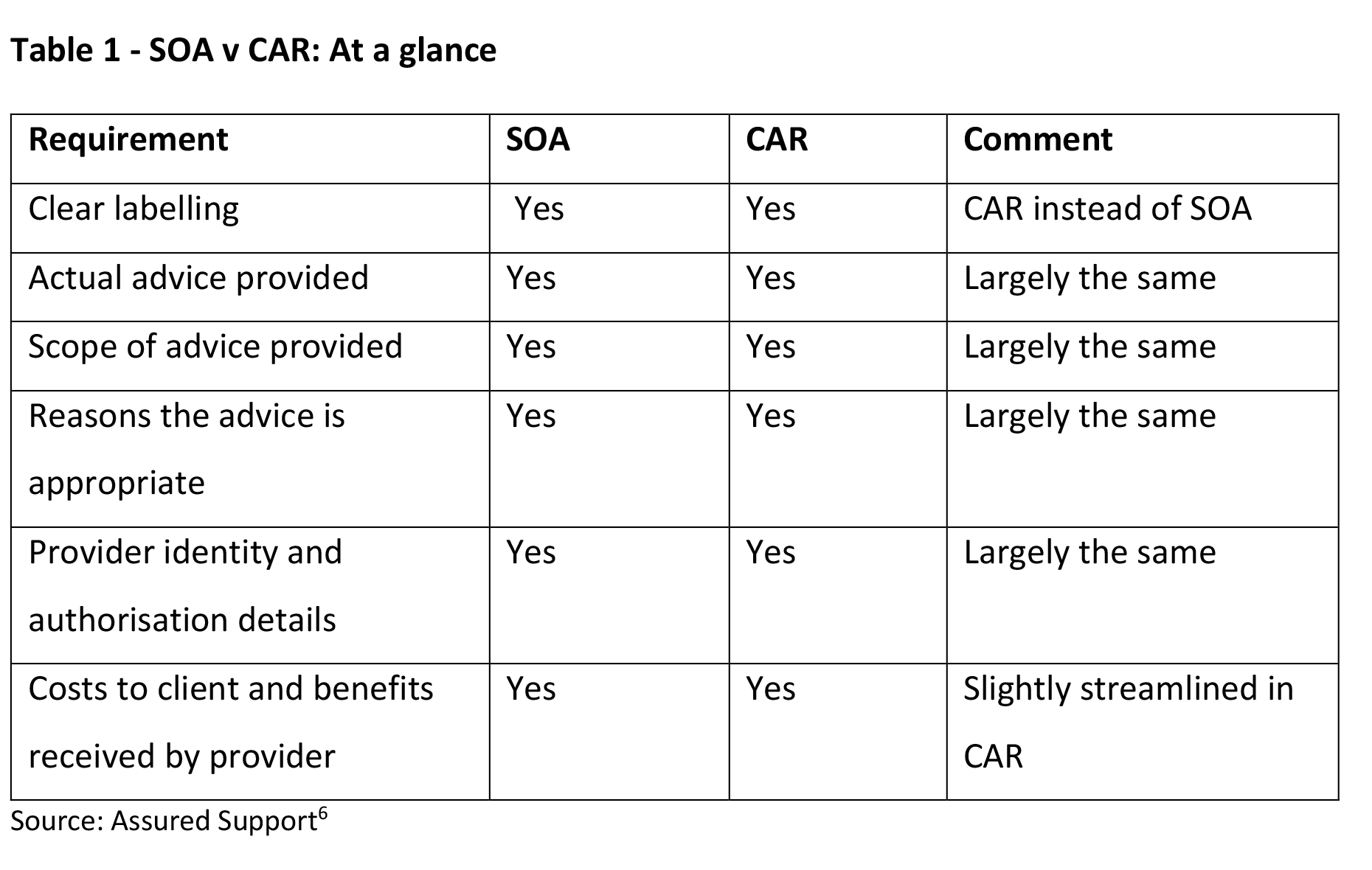
While some critics have complained that the CAR and SOA are virtually indistinguishable, policymakers believe there are significant differences.
Explanatory notes[4] accompanying the draft legislation outline that the main difference between the new CAR and SOAs is that record-keeping and proof of compliance with statutory requirements can be detailed elsewhere:
“While the circumstances in which a CAR must be provided to a client remain the same as under the current SOA requirements, the presentation and content requirements are modified to ensure the CAR supports the client to make an informed decision about the advice provided.
In line with the current arrangements for an SOA, a CAR may be the means by which the advice is provided or a separate record of the advice. This obligation is separate to the record-keeping and proof of compliance obligations…”
Treasury also articulated their expectations that the CAR be proportionate and appropriate – in terms of length and format – to the complexity of the advice involved.
The Exposure Draft Explanatory Materials included the following[5]:
“The type and format of information provided in the CAR is expected to vary depending on the specifics of the situation, such as the complexity of the advice, to reduce the compliance burden on the provider. For example, a written document may be appropriate when providing comprehensive advice with complex client circumstances to support the client’s ability to understand and act on the advice. It may be appropriate to provide an audio recording or email when providing relatively simple limited or single-issue advice that is easy to implement with minimal client considerations.”

Practitioner perspectives: Hope, scepticism, and early adoption
The critics
There has been no shortage of critics who believe the differences between the CAR and the SOA are so small as to be inconsequential, and the hoped-for opportunity to significantly reduce the red-tape and cost burden associated with these documents has therefore been squandered.
One such critic is Ben Marshan, former FPA policy lead, who described the change as “disappointing”, saying that “outside of rejigging the numbering and slightly tidying up the language” not much has changed[7].
The FAAA were similarly underwhelmed, noting in a media statement[8]:
“Analysing the requirements for the new ‘Client Advice Record’ or CAR, we haven’t found a material difference between these obligations and those for Statements of Advice, in the legislation,” FAAA chief executive Sarah Abood said.
“We were hoping for a much lower level of prescription, and greater recognition of professional judgement, as well as indications as to how the other areas of prescription (notably the impact of ASIC interpretation) would be dealt with.”
The optimists
Despite the underwhelming reception given to CAR in some quarters, there are many who have pointed out the positives, including Marshan himself, who noted the apparent eradication of the requirement to provide the client with the CAR unless asked for by the client.
“The bits that have to be in the Client Advice Record don’t necessarily have to be provided to the client. What you could provide to the client after every meeting and every time you make a recommendation is a summary document,” said Marshan[9].
Some licensees are already viewing CARs as an opportunity, allowing advisers to separate the advice provided to clients from the compliance record kept internally.
One – IFM Securities principal Lionel Rodrigues – told an industry audience the new CAR is more client-centric and separates the advice from compliance record keeping.
“The Client Advice Record is about the client. It’s not about compliance, it’s not about ASIC, it’s not about the adviser. This is a big step forward and I think that’s not been appreciated.”[10]
Rodrigues noted that the CAR consists of short form documents which is supported by other information the adviser keeps on record. On the topic of complaints to AFCA, he noted:
“[AFCA] want to see that the client has an informed document to make an informed decision. The compliance thing comes secondary.”
The Timeline for CARs
In addition to the SOA change, DBFO Tranche 2 also included reforms around targeted ‘nudges’ by superannuation funds, and the controversial ‘New Class of Adviser’. While the consultation process for the legislation closed in May 2025[11], Treasury will likely need some time to consider the many different perspectives received and reflect this in final draft legislation.
With the legislative agenda for the re-elected government not yet clear, it is hard to predict the priority the proposed legislation will be given. And even when the legislation is passed, the CARs won’t come into being until 12 months after Royal Assent is received.
Meaning SOAs are still very much around for a while yet.
And while some forward-looking licensees and institutions may start to plan ahead and experiment with new templates and processes, the vast majority will undoubtedly wait until the legislation has passed, the details are known, and ASIC guidance has been issued.
And given how much advisers and licensees already have on their plate, it’s hard to argue this isn’t a sensible approach.
In summary
This article examines the persistent tension between regulatory compliance and effective client communication in financial advice, using the evolution from Statements of Advice (SOAs) to the proposed Client Advice Records (CARs) as a focal point. While SOAs were originally intended to support informed client decision-making, a prevailing culture of fear has seen them have become long, jargon-filled documents designed more for defensibility than clarity—often failing to mitigate the information asymmetry that underpins client vulnerability. The CAR, part of the government’s Delivering Better Financial Outcomes (DBFO) reforms, aims to address these shortcomings by promoting shorter, client-centric records that vary in format and complexity based on the advice provided.
However, industry sentiment is mixed. Critics argue that the proposed CAR regime changes little, and risks becoming SOA 2.0 if licensees and advisers simply rebrand existing documents without meaningful simplification. Others see promise in the flexibility CARs offer, particularly the potential to separate compliance record-keeping from client-facing communication. The article explores these perspectives while highlighting the role of regulators, licensees, and advisers in ensuring the reform’s intent of clearer, more accessible advice is realised in practice.
Take the FAAA accredited quiz to earn 0.25 CPD hour:
CPD Quiz
The following CPD quiz is accredited by the FAAA at 0.25 hour.
Legislated CPD Area: Regulatory Compliance & Consumer Protection (0.25 hrs)
ASIC Knowledge Requirements: Regulatory Environment (0.25 hrs)
please log in to start this quiz

———–
References:
[1] https://treasury.gov.au/sites/default/files/2022-06/c2022-259464-afca.pdf
[2] https://www.moneymanagement.com.au/news/financial-planning/confusing-and-misleading-advice-among-biggest-client-bugbears
[3] https://www.moneymanagement.com.au/news/financial-planning/are-you-annoying-your-clients
[4] https://storage.googleapis.com/files-au-treasury/treasury/p/prj344d0591b29014c92eccb/survey/c2025_637814_em.pdf
[5] Ibid
[6] https://www.assuredsupport.com.au/articles/when-everything-old-is-new-again-understanding-the-new-client-advice-record-requirements/
[7] https://www.professionalplanner.com.au/2025/03/new-cars-stalled-as-soa-reform-offers-little-change/
[8] Ibid
[9] Ibid
[10] https://www.professionalplanner.com.au/2025/03/new-advice-record-a-big-step-forward/
[11] https://www.kwm.com/au/en/insights/latest-thinking/delivering-better-financial-outcomes-tranche-2a-a-missed-opportunity.html
CPD Quiz
The following CPD quiz is accredited by the FAAA at 0.25 hour.
Legislated CPD Area: Regulatory Compliance & Consumer Protection (0.25 hrs)
ASIC Knowledge Requirements: Regulatory Environment (0.25 hrs)
please log in to start this quiz
