

Advisers need a sound understanding of the benefits an allocation to listed private equity can have in client portfolios.
Private Equity (PE) traditionally refers to ownership interests in corporate entities that are not publicly traded on a stock exchange. PE managers raise substantial capital, typically from high-net-worth individuals and institutions, to create specialised funds. These funds are used to invest in private companies or acquire and take public companies private. The overarching goal is to execute long-term, intensive strategies to create significant value in the underlying businesses. PE investment vehicles can be structured as either listed or unlisted entities. Listed Private Equity (LPE) includes publicly traded entities that specialise in investing in private companies, PE funds, or the firms that manage these funds.
Incorporating PE and LPE into an investment portfolio can offer diversification benefits, and many successful global investors have significant allocations to private equity (figure one). Consequently, there’s been significant growth in this sector. A recent publication from ASIC asserts that global private market AUM had grown from US$8.2 trillion in December 2014 to US$28.1 trillion at March 2024[1]. Dry powder reserves – the amount of capital committed but not yet deployed – sat at US$2.5 trillion at June 2025[2].
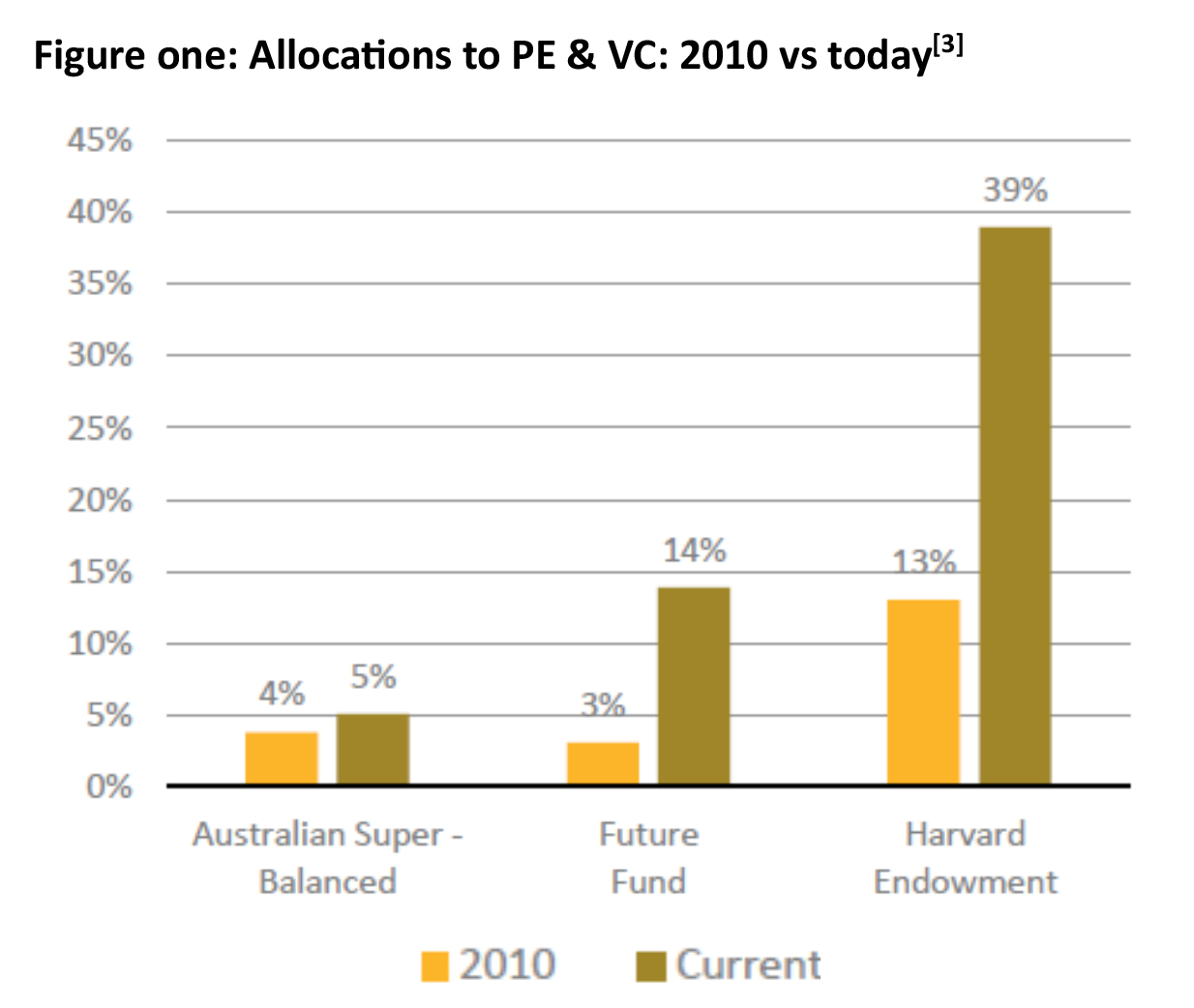

Both PE and LPE give investors access to a broader investment universe, including companies in the earlier stages of growth that are not listed on public stock exchanges. This is increasingly important as more companies choose to “stay private for longer,” prompting investors to consider how they can tap into these growth opportunities.
About Private Equity
Every company starts with an idea. Some ideas fade, while others grow into organisations generating billions in revenue. Throughout a company’s lifecycle, there will be moments when access to capital is essential, and different types of investors are suited to support each stage of growth (figure two).
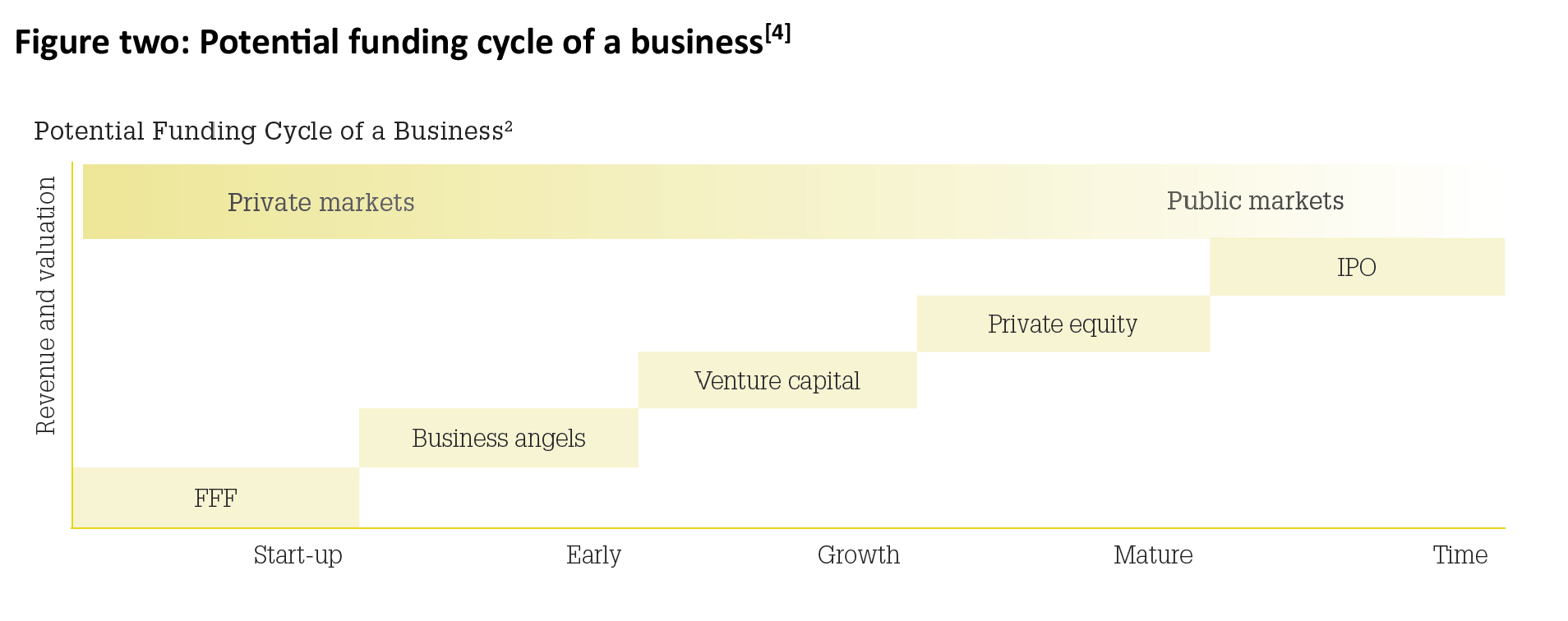

PE represents one of these funding stages and is available to a range of businesses, not just private companies. In fact, public companies are increasingly receiving significant PE backing.
PE has traditionally referred to investment funds that acquire and restructure non-publicly traded companies, often viewed as a distinct asset class involving both equity and debt. Over time, the term has also come to describe taking a company into private ownership, restructuring it and then selling it for potential profit.
PE investments are typically made by private equity firms, venture capital firms or angel investors. Each investment stage has its own goals, strategies and preferences, but all provide capital to help a company expand, develop new products, or restructure its operations, management or ownership.
Importantly, PE is not just about funding; it’s about transforming a company, enhancing its performance, and unlocking greater value for both owners and investors.
Why should client portfolios include an allocation to PE?
This century, PE has grown twice as fast as public market capitalisation. As a result, private markets have graduated from the fringes of the global economy to the mainstream[5] A confluence of factors has combined to create strong tailwinds for the PE industry and the attraction of PE as a standalone asset class for investors. These factors include:
- Trends in private markets growth: e.g. companies are staying private for longer
- Market factors, which include elevated valuations in equity markets, increased market volatility and lacklustre fixed income markets
- The performance characteristics of PE
- Structural growth in institutional allocations
- Diversification benefits.
- Public markets are shrinking and more concentrated
- Improved governance and alignment of private equity ownership.
Performance characteristics of private equity
The hunt for yield in a sustained low-interest rate environment continues to fuel investor appetite, with PE and private debt seemingly filling that void. Despite ongoing uncertainty with respect to interest rate markets and some of the factors driving central bank decision making, yield levels on traditional cash and cash-like investments remain modest in real terms. At the same time, ‘sticky’ inflation continues to erode returns. Consequently, investors seeking meaningful yield are likely to continue to look beyond traditional asset classes to meet their needs.
The PE model has generated strong returns on invested capital over long periods for several reasons. A private company’s partnership with a PE-backer is the product of a genuine alignment between the PE-backed company and the PE owners/management. As well as a strong alignment of interests, this creates a strong governance culture. PE managers tend to have representation on the private company’s board, remain in very close communication with the management team and operate a remuneration model far more aligned to value creation.
Good PE firms can affect significant transformational change on underlying companies. Such firms can generate attractive multiples on invested capital. This ability to generate outsized returns, often coupled with lower correlation to public markets, makes PE particularly appealing in volatile or low-interest-rate environments. This attractive nature of the return potential from PE has been a significant driver of growth in investor demand and inflows into this alternative asset class.
Diversification benefits
When used as part of a broader investment strategy, PE can deliver diversification benefits to a client’s portfolio. It does this by providing investors with exposure to an investment universe that sits outside of the types of businesses that underlay traditional asset classes. For example, PE offers exposure to companies in the earlier stages of their growth lifecycle and private companies not listed on public stock exchanges.
There are also sectors and regions where PE can provide better access relative to listed equity markets – for example, industries such as consumer facing businesses, healthcare and information technology.
Private market investing does have its challenges, particular for individual investors. Direct investment into private companies and traditional private equity funds require:
- Large capital outlays
- Long lockup periods
- A concentrated, illiquid exposure to a small number of private companies, some of which may be leveraged.
Access to PE investing has evolved over many years, particularly as a great number and range of investors develop interest in this asset class. This evolution is exemplified by the notable growth in the Listed Private Equity universe. Publicly traded entities that invest in privately held businesses, and PE-backed listed companies, are an attractive gateway for a broader range of investors to access the diversification and risk/reward characteristics of PE.
Because many investors do not have the capacity to own illiquid, long term PE investments, or the capital required to meet the minimum investment levels to gain exposure, LPE can provide an accessible entry point to this investment opportunity.
The growth in PE focused investment firms
There’s a growing roll call of global LPE firms: Apollo Global Management LLC, Blackstone Group, Brookfield Asset Management Inc, Carlyle Group and Kohlberg Kravis Roberts/KKR & Co to name some of the most well-known. Many have diversified beyond PE, to invest in other alternative assets such as hedge funds, real assets such as property and infrastructure, as well as private debt/credit.
Many PE managers have also become more specialised, with firms often focusing on specific industries, sectors or aspects of the businesses lifecycle. The PE firm often brings with them a broad range of skills, resourcing and capabilities that company management can draw upon. These attributes might include:
- Knowledge of specific industries
- Operational experience
- Financial modelling and analytical skill
- Customer, competition and market research
Each of these specialist skills can be leveraged to benefit the strategy and direction of the company the PE manager is backing.
What is Listed Private Equity?
LPE is a publicly traded vehicle that is liquid, regulated, diversified and easily investable. There are more than 200 LPE entities and over 500 PE-backed listed companies worldwide. The majority of these companies are domiciled in the UK, Europe and the US. There are a small number in the Asia Pacific region.
The sector includes listed entities that specialise in some, or all, stages of PE investing, including:
- Buyouts, including leveraged and management buyouts
- Expansion or growth capital
- Venture capital
- Distressed or special situations
- Mezzanine capital
- Secondary investments
- Fund of funds, and
- Private debt
Typically, a company will specialise in one of these investment strategies and will often limit their focus to certain geographic regions.
A diversified exposure to private markets
Traditionally only the largest institutional investors have had the resources to build out a diversified portfolio of PE funds, and even then, it can take years to achieve. Conversely, investments in LPE tend to be globally diversified across funds, strategies and vintages. A portfolio of LPE securities can provide an instant portfolio of private equity interests – diversified by geography, deal stage, vintage year and manager[6].
Vintage exposure
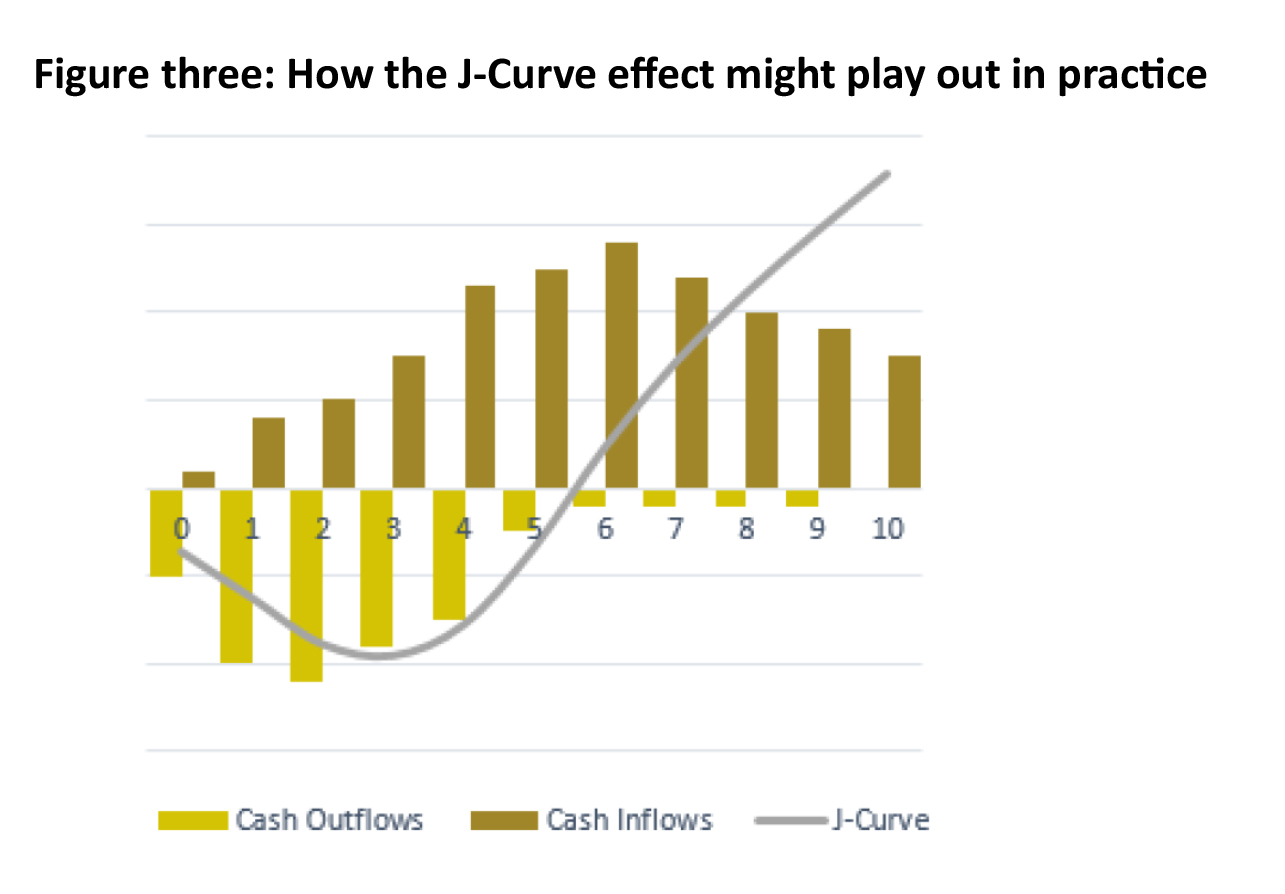
Vintage exposure refers to the year in which a fund began making investments or, more specifically, the date in which capital was deployed to a particular company or project. Unlike investments in traditional asset classes, the commitment to a PE fund is gradually drawn over the investment period (anywhere between three and five years) and does not require an upfront investment of the entire amount[7]).
What is significant about vintage exposure is that investments in unlisted PE funds can experience what is known as the ‘J-Curve’ effect (figure three). This refers to a phenomenon whereby an initial investment in a PE fund stagnates for two to three years before appreciating. It can take time for general partners to deploy capital and for investments to pay off. Meanwhile, management fees eat into the principal.
A LPE fund, on the other hand, can reduce this effect because the underlying portfolio will typically comprise a range of existing investments that are at differing stages of maturity.

Sector exposure
Sector exposure refers to different types of LPE investments. Often the various sectors are in different parts of the private equity cycle, which reinforces the benefits of being able to selectively diversify across these sectors.
Sector examples include:
Buyouts / venture capital / growth capital: A buyout refers to an investment transaction where one party (for example, a PE firm) acquires control of a company, either through an outright purchase or by obtaining a controlling equity interest. The buyout can be funded through debt or equity financing; more often, it’s a structured combination of both.
The transaction often occurs in situations where the purchaser considers a firm to be undervalued or underperforming and has the potential for improvement operationally and financially under new ownership and control. Like any other investment, a buyout will take place when the acquiring party believes there is an opportunity to make a positive return on their investment.
Some companies specifically focus on readying the organisation to be buyout target, whether by a PE firm or a competitor. For other companies it may be the unintended consequences of poor management, or an unforeseen opportunity that arises. The source of return is generated mainly from earnings growth from the underlying portfolio companies, which leads to growth in its net asset value.
PE-backed listed companies: A PE-backed listed company is one where a PE manager holds significant equity ownership, or controlling stake, of a listed public company’s shares. The PE manager would typically have representation on that company’s board.
Alternative asset managers: An asset manager that manages alternative assets, which might include PE, venture capital, real assets (such as property and infrastructure), hedge funds, commodities, derivatives or private debt. Its source of return is generated mainly from management fees and performance fees; however, it may also hold a balance sheet of investments on which returns are generated.
Private debt: Private debt is a transaction where a lending source directly provides a loan to the borrower without the use of an intermediary. This is facilitated by the lender working directly with the PE sponsor or owner/operator of a middle market company, commercial project or commercial real estate. Its source of return is generated primarily from loan interest.
Geographic exposure
Geographic exposure refers to the underlying countries where the investments are domiciled. LPE comprises entities listed on international stock exchanges whose main activity is investing in private companies or PE funds.
The investment case for LPE
Access to private equity, and the investable ecosystem of private market opportunities, continues to evolve, which is largely due to LPE funds. LPE creates a system where a PE firm has access to permanent capital to fund its investment activities, and one that provides investors with greater flexibility because of the liquidity that comes with a listed vehicle. In short, LPE has made PE more accessible to a broader range of investors.
The PE model provides a superior governance and ownership model, one that enables PE managers to take a genuine and strategic long-term view to execute on value creation and maximise returns on capital for both the PE fund and LPE investors.
There is also evidence to support that:
- PE outperforms public markets over the medium term; global PE outperformed public equity markets by approximately 4.5% per annum over the past two decades[8]
- LPE net asset values (NAVs) perform similarly to traditional PE[9]
- Investor returns are ultimately driven by net asset value growth
- Inefficiencies in the LPE market arise from information asymmetry, lack of broker research coverage and a lack of attention from institutional investors.
LPE has diversification benefits when used as part of a broader investment strategy. It does so by providing investors with exposure to an investment universe that sits outside of the types of businesses that underlay the traditional asset class options. Investors get immediate exposure to a diversified portfolio of companies that are at varied stages of operational improvement, which better distributes the return to investors through time.
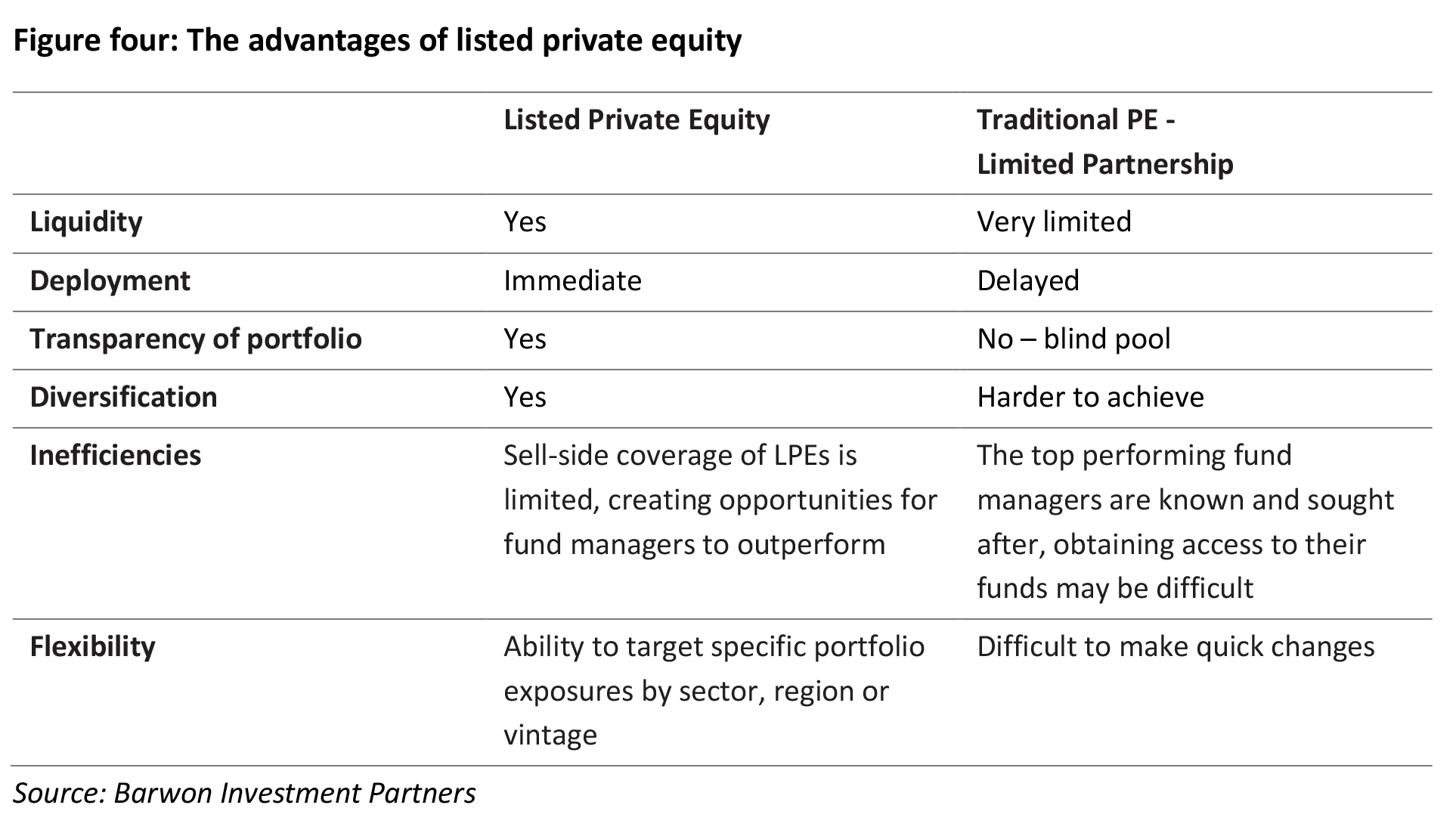

PE has demonstrated an attractive return profile over many years, relative to public equity returns. As an inefficient market, there is good potential for manager skill to generate alpha from the active management of this universe. LPE provides investors with the potential to capture the private equity return premium over time but with genuine daily liquidity. LPE does carry more market-like volatility given the daily priced nature of its listed investible universe.
How can investors access LPE?
LPE offers investors an attractive opportunity to enhance portfolio diversification and invest in assets that offer additional sources of potential return. Increasingly, when it comes to PE, investors have options available to them. They can:
- Invest directly in an individual LPE
- Invest in an ETF that mimics an LPE focused index such as the LPX50; this represents the global performance of the 50 most highly capitalised and liquid LPE companies
- Invest in an actively managed fund that invests in LPE opportunities.
Investing in LPE through an actively managed fund offers a compelling way for investors to access the benefits of private markets – exposure to high-quality private companies, potential for superior long-term returns and enhanced portfolio diversification – while maintaining the liquidity and transparency of public markets.
Active management adds another layer of value, allowing skilled managers to navigate market inefficiencies, select top-performing LPE opportunities and adapt to changing conditions. For investors seeking to balance growth potential with flexibility and risk management, an actively managed LPE fund represents a strategic and accessible route into the private equity universe.
Take the FAAA accredited quiz to earn 0.5 CPD hour:
CPD Quiz
The following CPD quiz is accredited by the FAAA at 0.5 hour.
Legislated CPD Area: Technical Competence (0.5 hrs)
ASIC Knowledge Requirements: Alternative Assets (0.5 hrs)
please log in to start this quiz
———
Notes:
[1] ASIC, Advancing Australia’s evolving capital markets: Discussion paper response report, Nov 2025
[2] S&P Global, Global private equity dry powder continues fall from 2023 peak, 4 July 2025
[3] Fund/endowment annual reports. Allocations as of 31 December 2024 for Australian Super (Balanced) and Future Fund and 30 June 2024 for Harvard Endowment
[4] Firstlinks, The ‘six or out’ VC approach to portfolios, 2019
[5] McKinsey & Company, Private markets come of age, 2019
[6] Morningstar, Where Public Meets Private: Accessing Private Markets Through Listed Equities, 2020
[7] Salman Shah & Chen Liangzi on The Business Times, Diversifying your portfolio with private equity, 2019
[8] MSCI, Tracking Private Equity: Closing the Performance Gap, September 2025
[9] Harris, Jenkinson & Kaplan in Journal of Investment Management, How do Private Equity Investments Perform Compared to Public Equity? 2015
Important information: While every care has been taken in the preparation of this document, PAN-Tribal Asset Management Pty Limited ABN 35 600 756 41 AFSL 462065 doesn’t make any representation as to the accuracy or completeness of any statement in it, including without limitation, any forecasts. Past performance is not a reliable indicator of future performance. This document has been prepared for the purpose of providing general information, without taking account of any particular investor’s objectives, financial situation or needs. An investor should, before making any investment decisions, consider the appropriateness of the information in this document, and seek professional advice, having regard to the investor’s objectives, financial situation and needs. This document has been prepared for use by sophisticated investors and investment professionals only and is solely for the use of the party to whom it is provided.
CPD Quiz
The following CPD quiz is accredited by the FAAA at 0.5 hour.
Legislated CPD Area: Technical Competence (0.5 hrs)
ASIC Knowledge Requirements: Alternative Assets (0.5 hrs)
please log in to start this quiz
———