

Layered uncertainty across global markets highlights rising geopolitical risks, shifting growth dynamics, and the need for resilient, diversified investment strategies.
Resilient global headline growth has continued masking widening divergence across countries, industries, and households, as AI-fueled investment and wealth have offset tariff-related pressures. What has changed is the addition of a major new source of risk: the conflict in the Middle East. If this proves to be a short-term disruption, as markets are currently pricing, then the baseline outlook still assumes moderate global growth. However, a prolonged disruption would pose more significant challenges and increase global recession risks.
Geopolitical risks tend to transmit to the economy through changes to consumer and business confidence, financial conditions, and – most importantly today – energy prices. The Strait of Hormuz, a critical waterway for oil and energy shipments, remains effectively blocked. Similar to Russia’s invasion of Ukraine in 2022, this threatens to spark a global energy supply shock.
Energy supply shocks are stagflationary
Unlike in 2025, when divergent trends left global growth broadly unchanged, the Middle East conflict is likely to be stagflationary, lifting inflation while hurting growth. We see four main transmission channels:
- higher energy and food prices
- disrupted supply chains and trade flows
- tighter financial conditions
- lower business and consumer confidence.
Negative oil supply shocks are inflationary for all economies, while growth effects will differ. Higher energy prices are stagflationary for net oil importers – transferring income abroad through more expensive energy imports while reducing household real (inflation-adjusted) income and business real profit – and expansionary for net oil exporters.
Within developed markets (DM), Europe, the U.K., and Japan are energy importers and face larger downside growth risks. Canada and Australia should benefit from their net energy export status.
Two decades of shale production increases have turned the U.S. from a net energy importer to a slight exporter. However, the U.S. is still a large economy with an energy sector as opposed to a commodity economy. Since energy is an important input into all goods it imports, the U.S. will likely still behave as a net energy importer to some extent.
The U.S. also enters this period with vulnerabilities. The energy shock will exacerbate K-shaped economic trends for households – with potential for a larger pullback in real consumption. Higher energy prices act as a transfer from households (via lower real incomes) to energy companies and their capital owners. Low- and middle-income households, with the highest propensity to consume relative to their real income, will be hurt the most.
Beyond the global drag from lower oil production, indirect effects – confidence and financial conditions – will also likely weigh on growth. Markets have reacted by tightening global financial conditions. The shortest-dated interest rates across DM have shifted toward pricing central bank rate hikes, along with generally higher real yields and lower equity prices.
A prolonged closure of the Strait of Hormuz also risks disruption to Asian manufacturing, the dominant supplier of goods to the rest of the world, which is particularly reliant on Middle East oil. Products across chemical, plastics, autos, electric vehicles, construction materials, and other sectors risk supply disruption, not just higher manufacturing costs.
Central banks face a tug of war – but this isn’t 2022
The risk of higher inflation alongside lower growth puts central banks in a tricky spot. Conventionally, central banks tend to look through supply shocks, especially in economies that are net energy importers. After the elevated post-pandemic inflation period, however, central banks will be closely focused on the risk that a large supply shock could lead to more persistent pressures as inflation expectations and wages also adjust higher.
Yet economies are in much different positions than they were in 2022, when Russia’s invasion of Ukraine sent energy prices soaring and central banks hiked rates aggressively. At that time, the world was still dealing with pandemic-related pent-up demand, and governments had injected trillions of dollars into the private sector. The result was a large demand shock on top of a large supply shock. Labor markets were also extremely tight as the pandemic spurred early retirements and job hiatuses, prompting one of the largest-ever mismatches in labor supply and demand. Across economies, job openings relative to the number of unemployed accelerated, driving both nominal wages and prices higher.
Today, by contrast, fiscal policy is tight across many regions as elevated post-pandemic sovereign debt forces restraint. The global economy doesn’t have a similar stockpile of savings from fiscal transfers. Labor markets are much looser. Monetary policy is already neutral to slightly restrictive across most DM economies. In emerging markets (EM), real rates have remained elevated despite moderating inflation. As a result, economies are much more likely to adjust to the current shock through lower real incomes, weaker nominal wage adjustments, and greater recessionary risks.
In practice, the knee-jerk market reaction toward tighter financial conditions and more hawkish monetary policy is already doing much of the hawkish work for policymakers. In the end, if inflation does prove temporary while downside growth risks materialise, central banks may need to ease more aggressively.
The Bank of England and the European Central Bank have been at the eye of the storm in terms of the repricing of central bank expectations (see Figure 1). But there has been a general move across DM, including the pricing out of the previously expected rate cuts by the Federal Reserve.
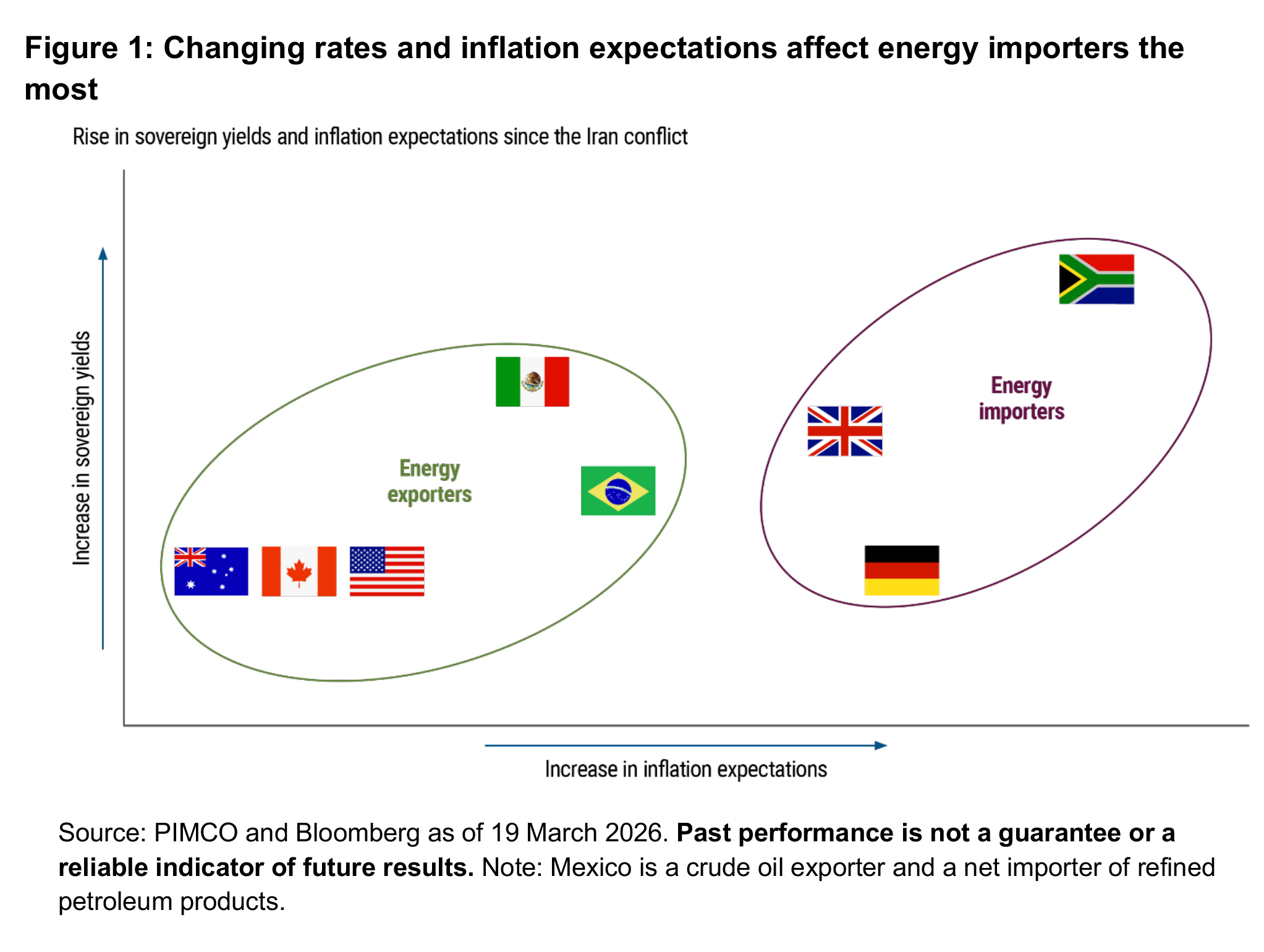

Similarly, in EM economies, prospective easing has mostly been priced out – again with greater differentiation between energy importers and exporters. EM central banks will have an even harder task than their DM counterparts in looking through the first-round inflation impacts of the energy shock, but most also started off with a greater real yield buffer owing to elevated policy rates going into the shock.
In the baseline of energy markets moving in line with the forwards, we anticipate significant reverses of the sell-off in front-end rates across DM and EM economies. But in line with the tone of central banks’ commentary at their March meetings, there is a lot of uncertainty in the immediate outlook.
Investment outlook: Repositioning portfolios toward quality and liquidity
This is not an environment set up to reward bold forecasts or narrow bets. Instead, today’s conditions favor more liquid, high quality portfolios built to weather shifts in market sentiment and a range of potential outcomes.
Markets rarely price geopolitical risk well. When there is a global shock, portfolio liquidity can allow investors to take advantage of market inefficiencies and valuation gaps that arise. Similar to the volatility that followed U.S. tariff announcements in April 2025, the rapid repricing of central bank expectations in response to the Middle East conflict has created localised volatility and opportunities to invest against the prevailing narrative.
Treat liquidity as an asset
After a decade of strong private credit returns supported by rapid growth (see Figure 2), imbalances are coming into view. Signs of late‑cycle conditions are already visible within corporate direct lending, including elevated shadow default rates and greater reliance on payment‑in‑kind features. Smaller and midsize companies, the main borrowers within this market, are vulnerable to rising energy input costs, tariff pressures, and technology disruption, including from AI.
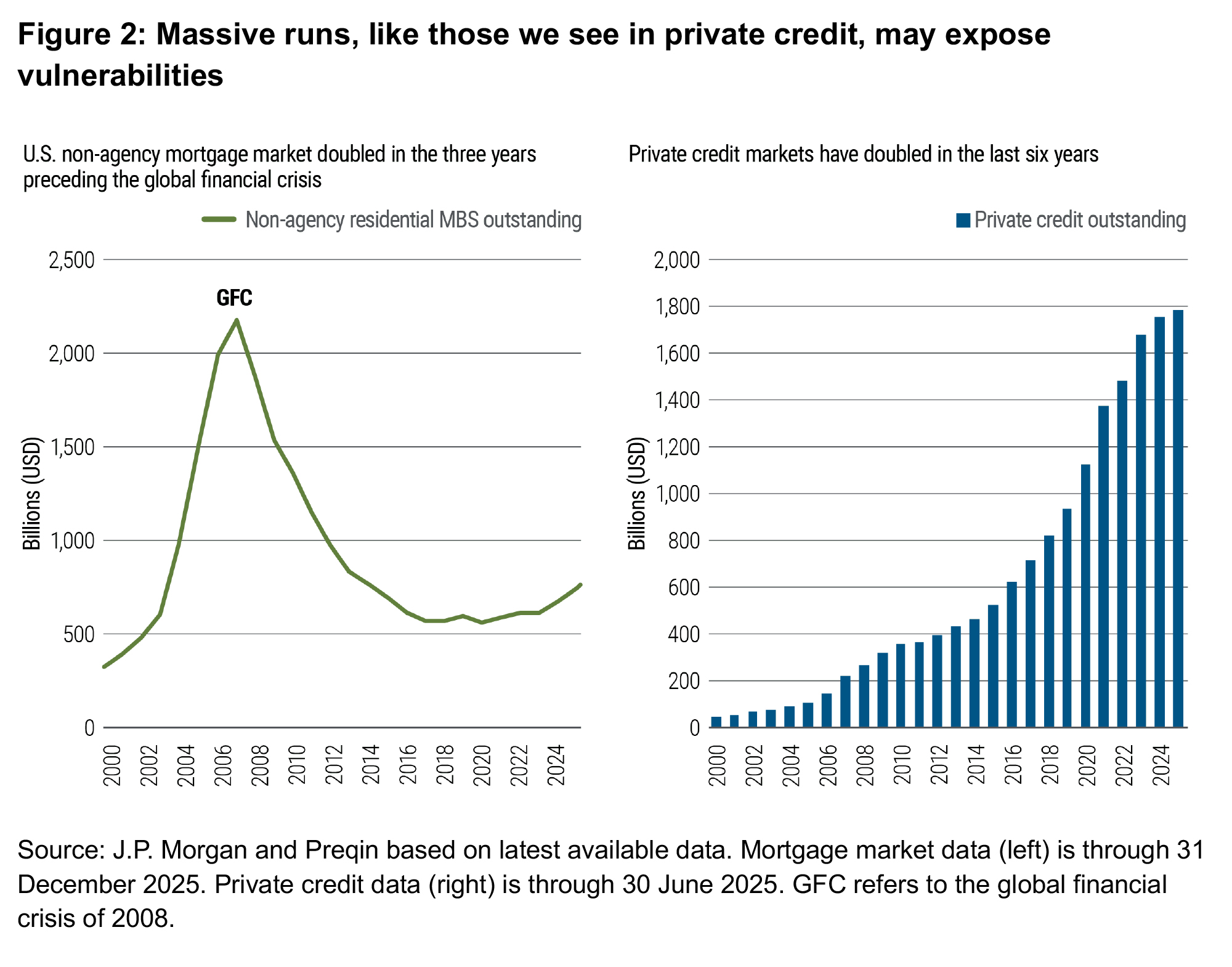

For investors, the trade‑off looks far less compelling in direct lending, the segment that has driven much of private credit’s growth, as financial conditions tighten. There is nothing inherently wrong with owning private assets – provided investors are adequately compensated for illiquidity. But in direct lending, that illiquidity premium has compressed just as refinancing risk, underwriting slippage, and questions around pricing transparency have become more pronounced. Direct lending strategies rely on reported price stability rather than market-based price discovery and may appear resilient until stress emerges – as it has lately.
As investors reconsider illiquidity risk, the disconnect between public and private market valuations has deepened. Publicly traded business development companies (BDCs) – investment vehicles for private direct lending – are trading at significant discounts to their net asset values (see Figure 3). This is a direct lending problem, in our view, not an indictment of private credit as a whole, which still encompasses strategies where illiquidity is better compensated and risks are more explicitly priced.
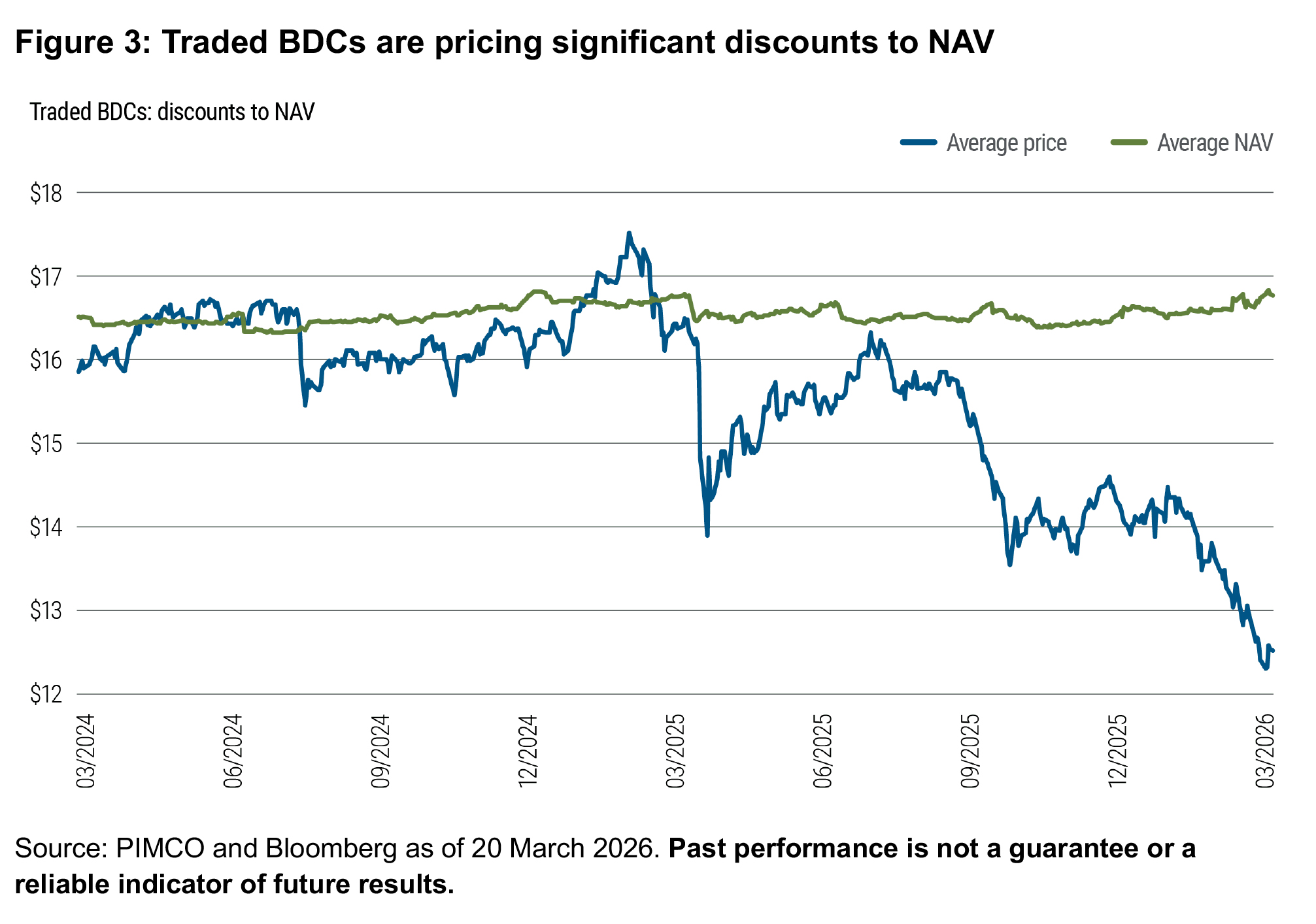

From a relative value perspective, this favors a shift out of direct lending and into high quality public fixed income. Many investments with attractive liquidity profiles and transparent pricing now offer yields comparable to private credit. As volatility rises and dispersion widens, the ability to manage downside risk and redeploy capital as conditions evolve matters more than trying to capture incremental yield by forfeiting liquidity.
Private credit does not pose a systemic risk, in our view, and there are many areas of the market that remain attractive (for more, see our publication, “Private Credit’s Other Lanes Still Offer Value”[1]). Still, stress in private credit could contribute to tighter financial conditions and weigh on hiring and investment.
As the cycle matures, credit markets – private and public – increasingly reward bottom-up analysis and differentiation. Balance sheet strength, durable cash flows, and high quality collateral matter more than headline yield, particularly in sectors undergoing structural change. It’s critical to focus on maximising investment outcomes rather than simply deploying capital into an asset manager’s area of focus.
At PIMCO, we’ve managed through credit cycles for more than five decades. Looking across the continuum of public and private credit today, we see the greatest value in areas including U.S. agency mortgage-backed securities (MBS), investment grade issuers with stable, predictable cash flows, and high quality securitised credit.
In private credit, we favour asset‑based finance (ABF) and senior commercial real estate debt. While competition in ABF has grown, it remains a large and attractive market that offers collateral backing and is less correlated with the corporate earnings cycle than direct lending. Because global real estate has already gone through a cyclical downturn, investors can lend against assets that may be 15%–40% below peak values.
By contrast, we are cautious on direct lending and bank loans with weak covenants, lower‑quality high yield issuers, and many vehicle structures offering liquidity that doesn’t match the underlying assets.
Across credit markets, risk has been repriced only modestly in the wake of the Middle East conflict. Our emphasis is on adding downside mitigation, given risks have grown more than market pricing may reflect.
Fixed income is back at the centre of portfolio construction
High quality bonds once again play a meaningful role in portfolios and look attractive across a variety of economic scenarios. For portfolios that have drifted heavily toward equities (see Figure 4), this is a practical moment to consider rebalancing. Yields across more liquid fixed income remain attractive, laying a solid foundation for market-driven income and return. When you overlay opportunities arising from volatility and mispricing, it creates an exceptional environment for active management to seek alpha, or outperformance versus the broader market.
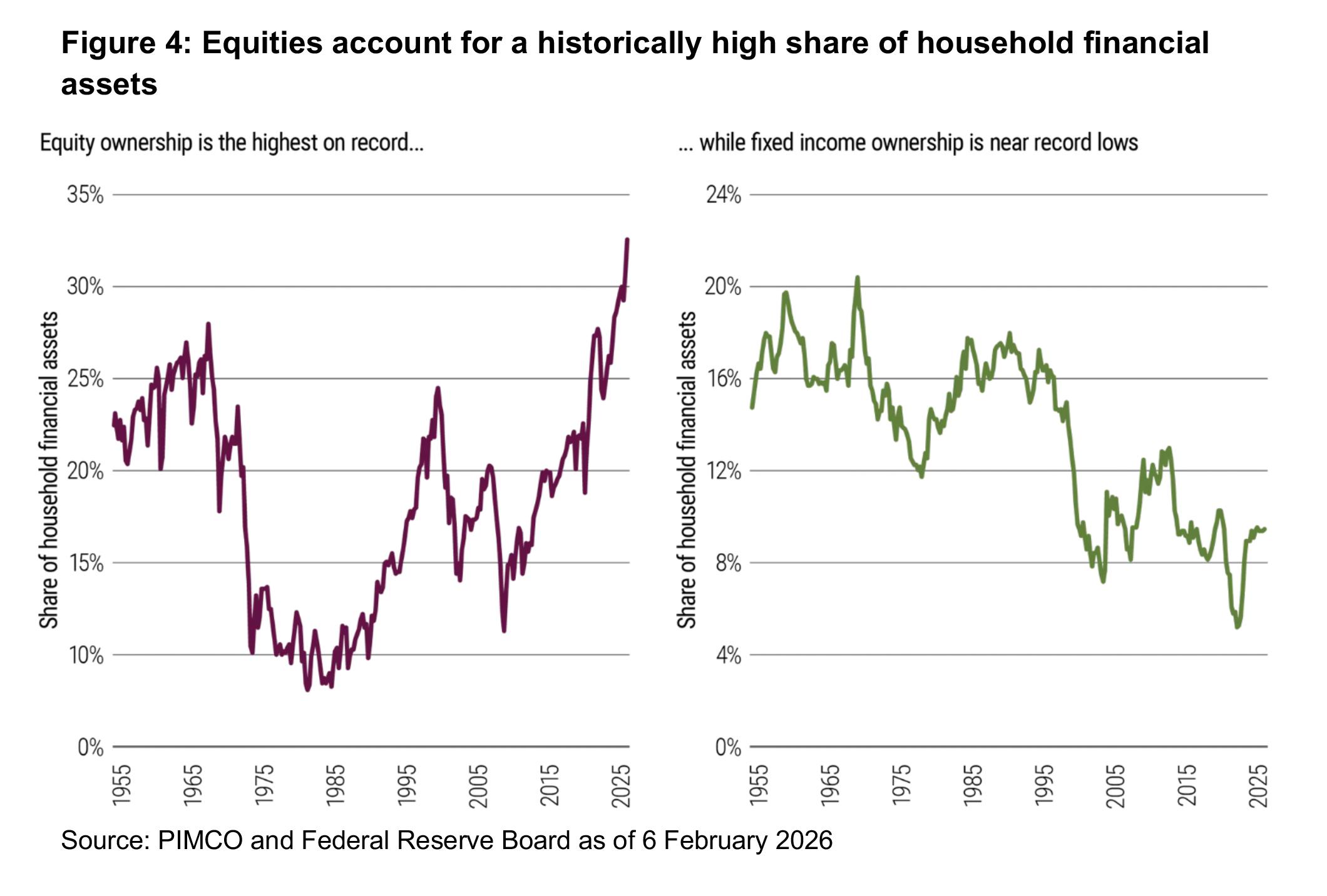

High quality bonds can serve as a return generator, cushion against equity volatility, offer valuable diversification if growth disappoints or risk sentiment deteriorates, and provide liquidity that can be redeployed when markets dislocate.
We prefer a modest overweight to duration. In the U.S., the Treasury market is still a source of perceived “safe haven” yield and portfolio diversification benefits. We prefer more balanced curve exposure as yields look attractive across a range of maturities.
The case for global diversification also remains strong. Differences across countries are widening, creating both risks and opportunities. Rather than assuming correlated global outcomes, investors can potentially benefit from targeted exposures to select DM and EM countries with attractive real yields and credible policy frameworks.
Currency positioning matters more in this environment, particularly given the growing divergence between energy exporters and importers. Inflation‑sensitive assets also deserve a more deliberate role in portfolios today. Commodities, real assets, and Treasury Inflation-Protected Securities (TIPS) can help hedge real‑world purchasing power and diversify returns when traditional asset relationships become less reliable. These exposures may help improve portfolio resilience.
Conclusion
This is a market that rewards preparation for an uncertain set of outcomes. Higher yields, wider dispersion, and greater volatility create a favourable backdrop for active management, in our view, when portfolios are built with liquidity and flexibility in mind.
For investors, we believe it’s a compelling time to consider recentreing portfolios toward fixed income, to use global diversification and inflation tools intentionally, to treat liquidity as an asset, and to emphasise quality and collateral in credit.
In short, this is a moment to consider rebalancing toward resilience – positioning portfolios to navigate dispersion while staying ready to act when opportunities arise.
Take the FAAA accredited quiz to earn 0.25 CPD hour:
CPD Quiz
The following CPD quiz is accredited by the FAAA at 0.25 hour.
Legislated CPD Area: Technical Competence (0.25 hrs)
ASIC Knowledge Requirements: Managed Investments (0.25 hrs)
please log in to start this quiz
———–
References:
[1] Private Credit’s Other Lanes Still Offer Value
CPD Quiz
The following CPD quiz is accredited by the FAAA at 0.25 hour.
Legislated CPD Area: Technical Competence (0.25 hrs)
ASIC Knowledge Requirements: Managed Investments (0.25 hrs)
please log in to start this quiz