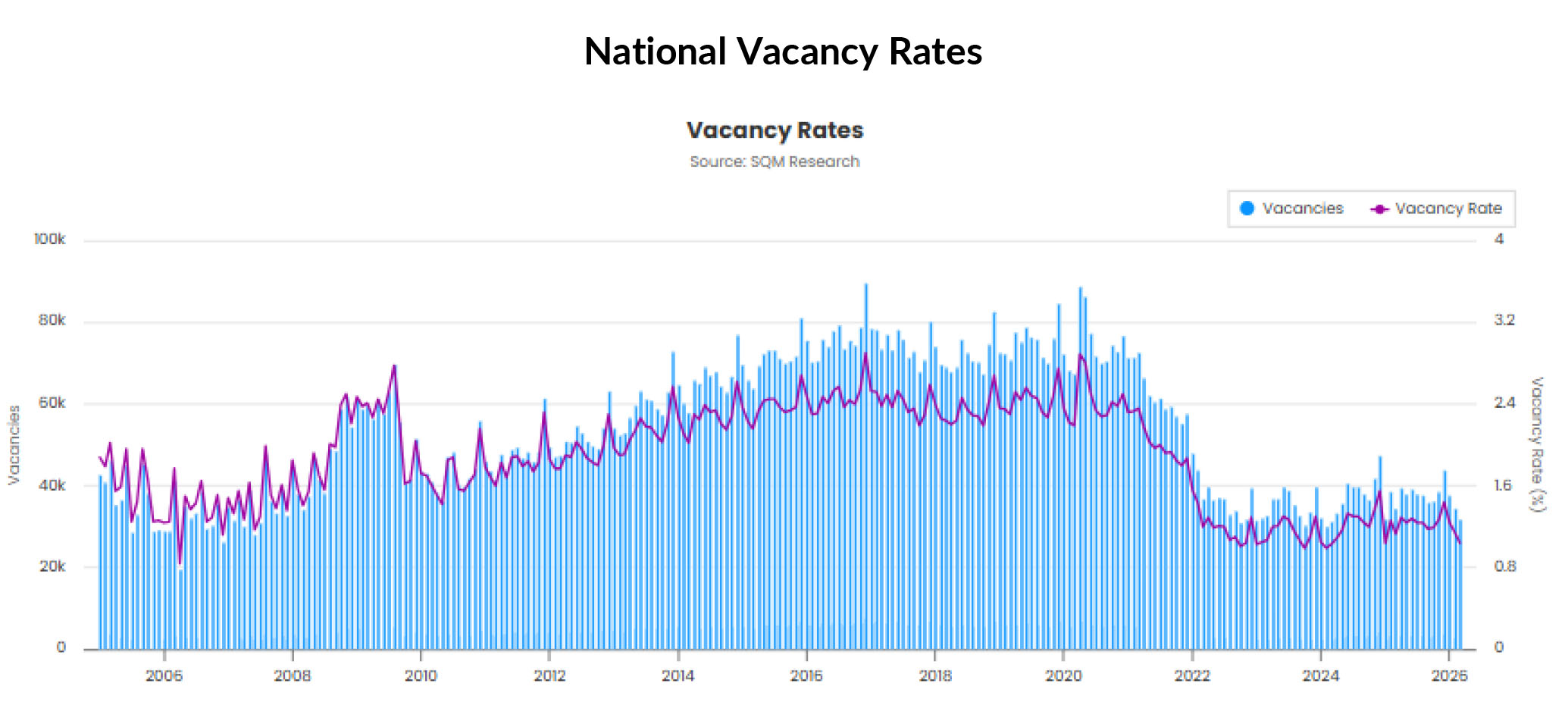
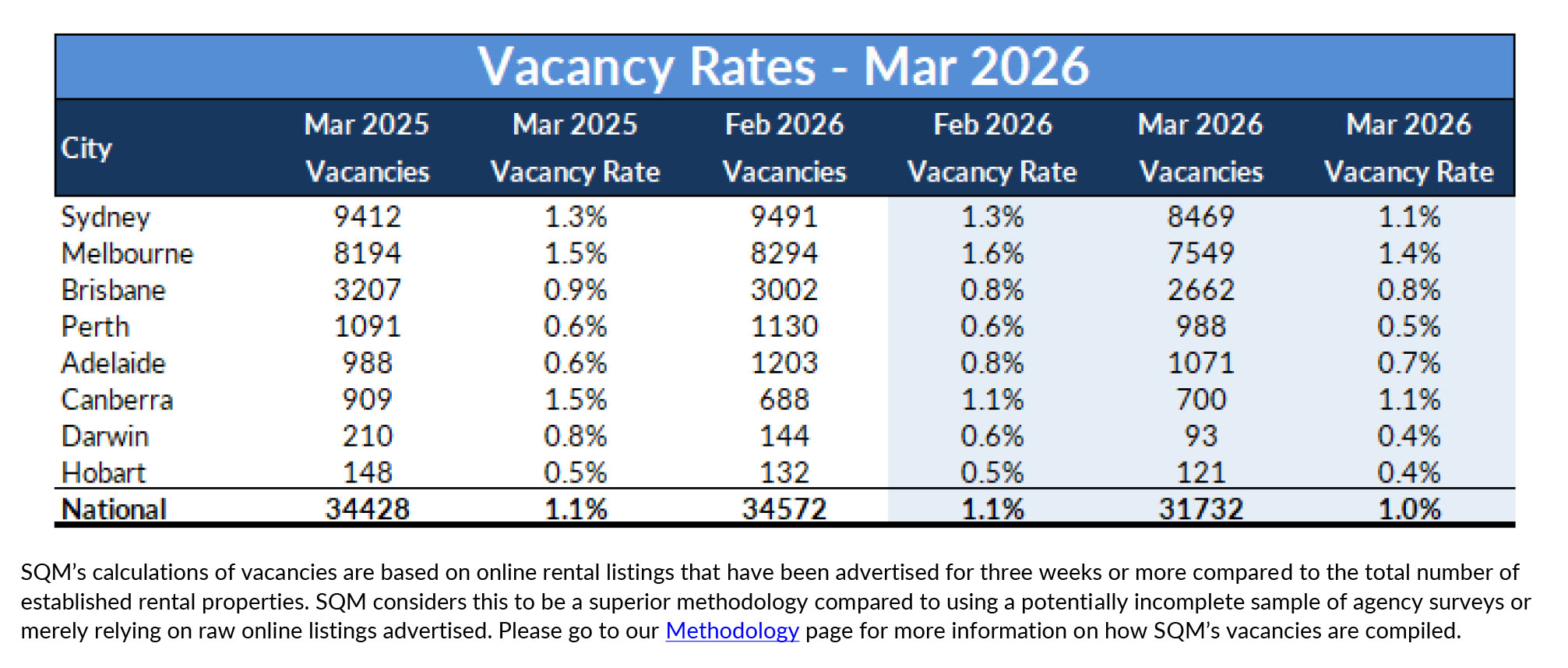
SQM Research has released its latest data on residential property vacancy rates. Australia’s national residential vacancy rate fell to 1.0% in March 2026, down from 1.1% in February. The total number of residential vacancies declined to 31,732 dwellings, marking a continued tightening in rental market conditions nationwide.
The March result indicates that strong tenant demand continues to absorb available rental stock, with vacancy rates now approaching critically low levels across several capital cities.

SQM’s calculations of vacancies are based on online rental listings that have been advertised for three weeks or more compared to the total number of established rental properties. SQM considers this to be a superior methodology compared to using a potentially incomplete sample of agency surveys or merely relying on raw online listings advertised. Please go to our Methodology page for more information on how SQM’s vacancies are compiled.
Capital city highlights
Sydney: Vacancy rates declined to 1.1%, down from 1.3%, with 8,469 dwellings available. The market continues to tighten following strong leasing activity.
Melbourne: Vacancy rates eased to 1.4%, from 1.6%, with 7,549 vacancies recorded. Conditions remain relatively balanced compared to other capitals.
Brisbane: Vacancy rates held steady at 0.8%, with 2,662 dwellings available, maintaining one of the tightest rental markets in the country.
Perth: Vacancy rates fell further to 0.5%, from 0.6%, with 988 dwellings vacant. Perth remains among the most constrained rental markets nationally. Page 2 of 5
Adelaide: Vacancy rates declined to 0.7%, down from 0.8%, with 1,071 dwellings available. Supply remains limited.
Canberra: Vacancy rates held steady at 1.1%, with 700 dwellings available, indicating a stabilisation following earlier fluctuations.
Darwin: Vacancy rates dropped to 0.4%, from 0.6%, with just 93 dwellings vacant, marking one of the lowest vacancy levels nationally.
Hobart: Vacancy rates remained tight at 0.4%, with 121 dwellings available, continuing to reflect constrained rental supply.
Advertised rents analysis
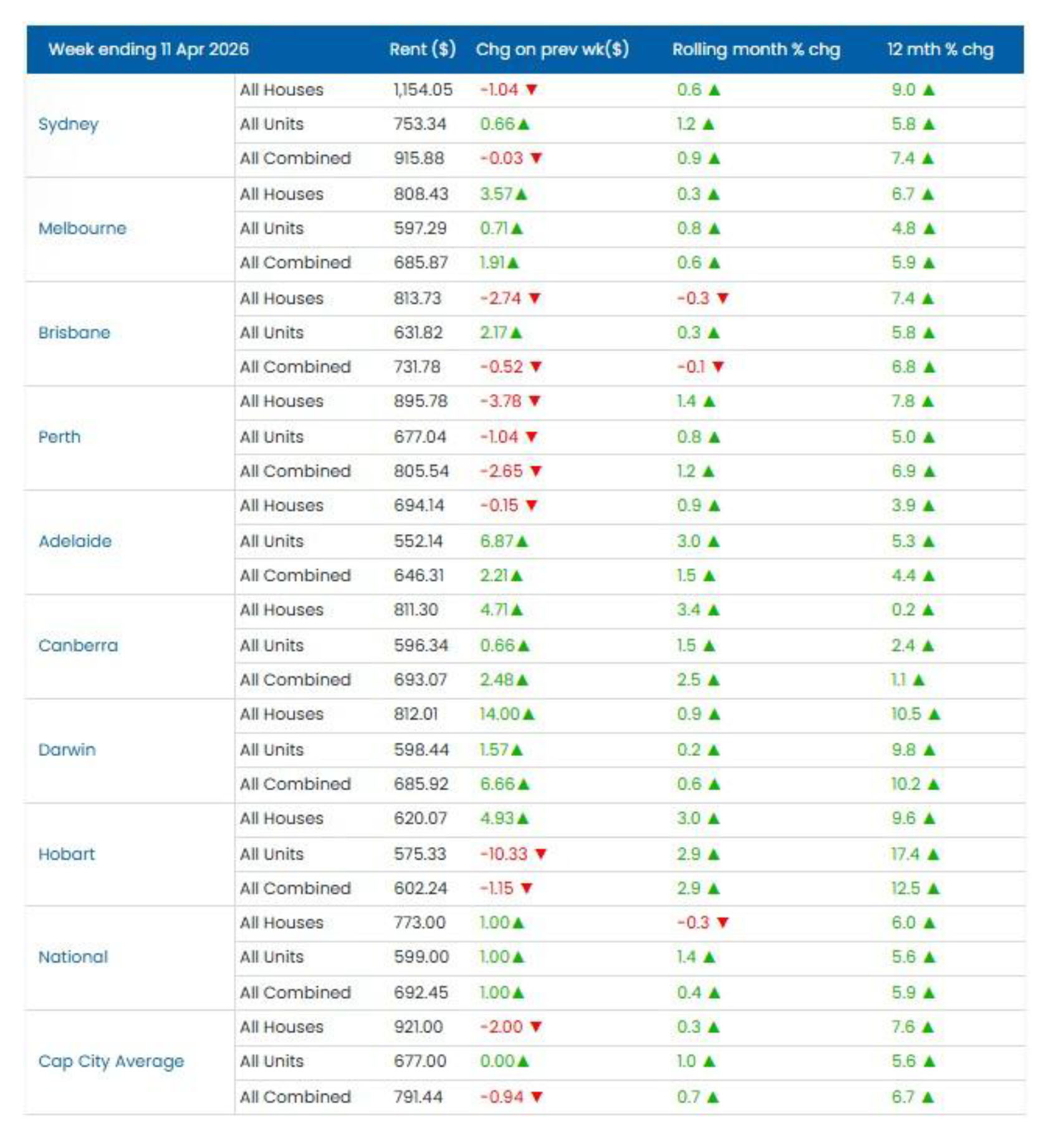
National advertised rents continued to rise through early April, with combined rents increasing 0.4% over the past 30 days and 5.9% higher year-on-year, reflecting ongoing supply shortages across most capital cities.
The national combined rent average now stands at $692.45 per week, while the capital city average has increased to $791.44, supported by steady growth in both house and unit rents.
Nationally, house rents were broadly flat over the month (-0.3%) but remain 6.0% higher over the year, while unit rents rose 1.4% monthly and 5.6% annually, suggesting continued demand for medium-density accommodation.
Sydney: Combined rents rose 0.9% for the month and 7.4% year-on-year, with house rents averaging $1,154.05 per week.
Melbourne: Combined rents increased 0.6% monthly and 5.9% annually, supported by steady leasing activity.
Brisbane: Combined rents edged down 0.1% for the month but remain 6.8% higher over the year, indicating a pause following strong growth.
Perth: Combined rents rose 1.2% for the month and 6.9% annually, reflecting ongoing rental shortages.
Adelaide: Combined rents increased 1.5% monthly and 4.4% annually, supported by rising unit rents.
Canberra: Combined rents rose 2.5% for the month and 1.1% annually, indicating renewed momentum following earlier softness. Page 3 of 5
Darwin: Combined rents lifted 0.6% monthly and 10.2% annually, maintaining strong annual growth.
Hobart: Combined rents rose 2.9% for the month and are 12.5% higher year-on-year, reflecting ongoing tight rental conditions and limited supply.
Louis Christopher, Managing Director of SQM Research, commented: “The national vacancy rate dropping to 1.0% highlights just how tight Australia’s rental market has become. We are now seeing vacancy rates at critically low levels in several cities, particularly Perth, Darwin and Hobart.
“While some markets are showing brief pauses in rental growth, the overall trend remains upward due to the ongoing imbalance between supply and demand.
“Without a significant increase in new housing supply and/or a stabilisation of population growth rates, it is likely that rental pressures will remain elevated throughout 2026. These accelerated rates of rental increases will no doubt feed through to the CPI at some point this year.”