Australia’s exchange‑traded fund (ETF) industry recorded one of its strongest quarters on record in early 2026, with net inflows of $15.6 billion, even as global equity volatility picked up late in the period.
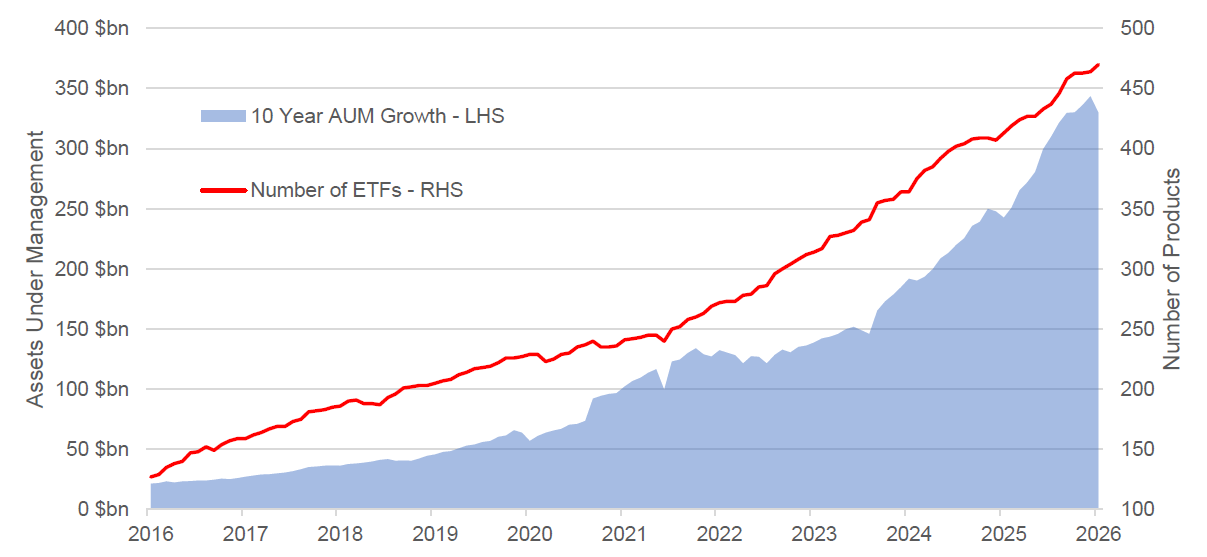
Industry assets reached an all‑time high of $343.5 billion in February before easing to $329.7 billion by the end of March, reflecting a strong start to the year followed by a sharp equity sell‑off in March. Over the past 12 months, total ETF assets have grown by approximately 36%, highlighting the continued structural shift toward low‑cost, exchange‑traded investment vehicles.

“Global equities remained the dominant allocation over the quarter, capturing nearly half of all ETF flows”, said Chad Troja, Manager, Direct Equities at Lonsec. “Although, the allocation of flows when compared to 12 months ago have visibly shifted away from US-concentrated and hedged strategies toward broader global diversification.”
Allocation towards global equities ($6.90 billion) was followed by Australian equities ($4.15 billion) and Australian bonds ($2.73 billion), as investors balanced growth exposure with defensiveness. Global bond ETFs recorded modest net outflows, marking the weakest asset class for the quarter.
Performance was increasingly polarised. Commodities and energy‑themed ETFs led returns, supported by geopolitical tensions and supply disruptions, while precious metals also performed strongly over the rolling 12 months. In contrast, cybersecurity, crypto‑linked products and speculative growth exposures were among the weakest performers, particularly during the March market drawdown.
Active ETFs continued to expand their footprint, accounting for around 36% of Australia’s 400+ listed ETFs, while passive strategies remained a significant component of new product issuance. Thirteen new exchange-traded products launched during the quarter, with global equity exposures dominating new supply.
The quarter highlighted both the resilience of ETF demand and the speed at which market sentiment can shift. As the product universe continues to expand across active, thematic and income‑oriented strategies, dispersion in returns and flows is becoming more pronounced.