

Kirby Rappell
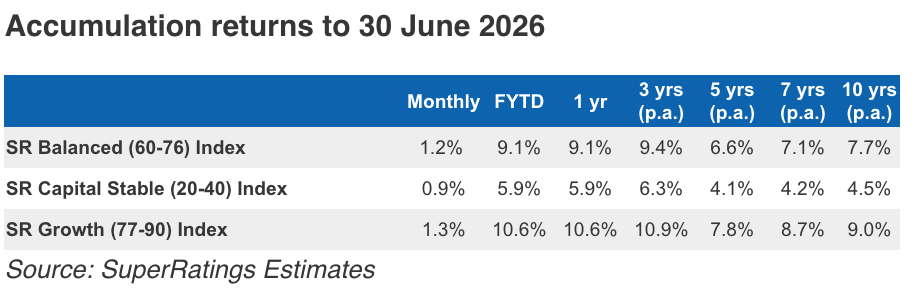
For the fourth consecutive year, superannuation funds have delivered strong returns to their members, with leading superannuation research house SuperRatings estimating that the median balanced option returned 1.2% over the month of June, bringing the return for the year to 30 June 2026 to an estimated 9.1%. This result arrives largely off the back of the strong performance of international share markets, whilst Australian markets delivered a more modest gain.
Despite the strong headline result, investors have experienced considerable ups and downs over the course of the year. In the nine months to 31 March 2026, the median balanced option had returned just 2.8%, as the outbreak of conflict between the US and Iran weighed heavily on investment markets. However, as the situation in the Middle East saw signs of stabilising, and the growth of AI continued, international shares regained ground, driving funds toward a rapid recovery in the final quarter of the financial year. Standout performers within the international shares sector included chip, storage and other hardware manufacturers supplying companies involved in the artificial intelligence sector.
Director of SuperRatings, Kirby Rappell, said “This year was characterised by considerable market volatility, especially following the outbreak of the US-Iran conflict in March, which placed pressure on super fund performance. However, we once again saw the benefits of staying the course, as funds delivered strong performance to close out the financial year.”
The median growth option exhibited an estimated a 1.3% return over the month, while capital stable options, which hold more traditionally defensive assets such as cash and bonds, returned 0.9%.

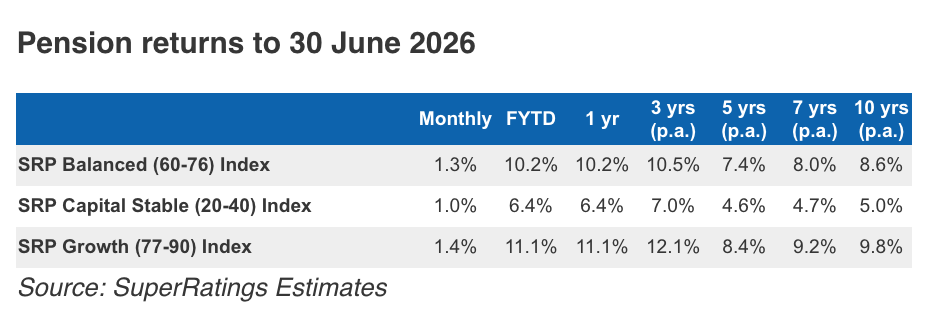
Pension returns also ended the financial year strongly, with the median balanced pension option up an estimated 1.3% over June. The median growth option rose by 1.4%, whilst the median capital stable option is estimated to deliver a 1.0% return for the month.

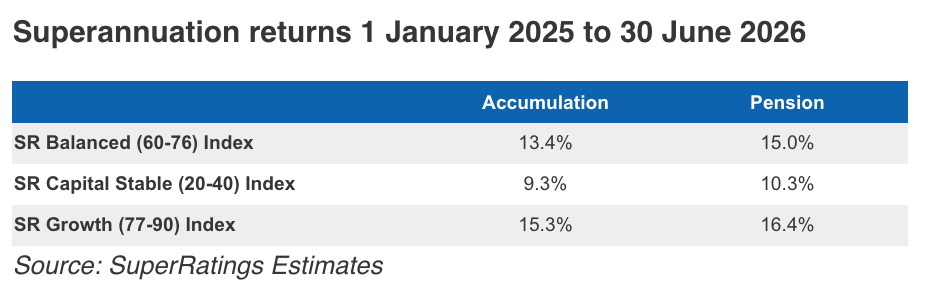
With the key driver of performance continuing to be international, and particularly US, shares the policy decisions of US President Trump have significantly impacted fund returns since taking office. During the shocks of the Iran conflict and with ongoing threats of tariffs following ‘Liberation Day’, members may have seen their super balances decline over shorter periods of time. However, if they have remained invested in the median balanced option, they would have received an estimated 13.4% return over the initial 18 months of the second Trump presidency (Trump took office on 20 January 2025, returns are calculated from 1 January 2025 to 30 June 2025), further underscoring the importance of maintaining an investment strategy in the face of short-term market shocks.
Superannuation returns 1 January 2025 to 30 June 2026

Mr Rappell commented “Despite considerable market volatility, super funds have continued to perform strongly. Looking ahead there remains uncertainty around market performance over the next 12 months, including whether anticipated productivity gains from AI will translate into economic and corporate growth. In Australia, persistent inflation remains a concern, with recent RBA rate increases underscoring the ongoing challenge. If inflationary pressures persist, they could act as a headwind for Australian markets and investment returns.”
Super fund performance resilient amid market volatility
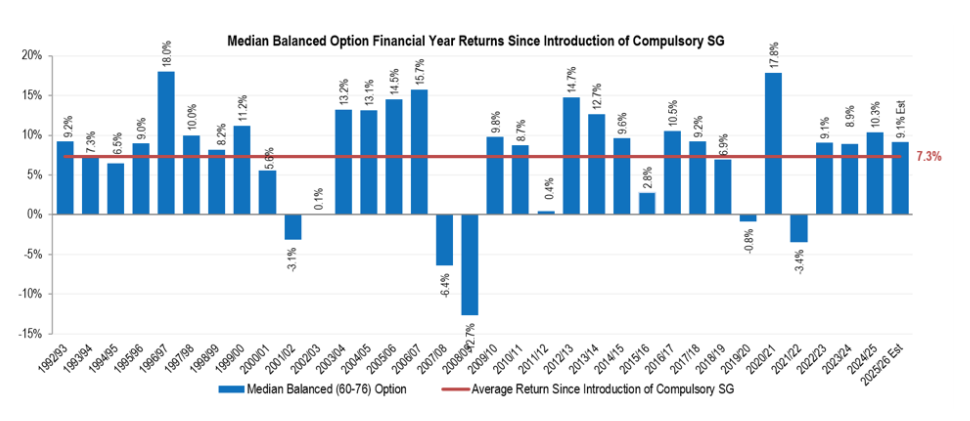
The chart below shows that the average annual return since the inception of the superannuation system is estimated to be 7.3%, with the typical balanced fund exceeding its long-term return objective of CPI+3.0%.

Global share markets were the key driver of super fund returns in FY2026, marking a fourth straight year in which listed equities underpinned performance. Investor enthusiasm for AI remained strong, with technology infrastructure and hardware manufacturers benefiting the most from the AI investment boom, replacing the traditional ‘Magnificent Seven’ technology stocks which drove returns over previous years as the standout performers for FY2026.
In contrast, Australian shares lagged their international counterparts with the ASX200 returning 2.8% compared to over 20% delivered by the S&P 500. While mining and commodities stocks generated strong returns, these gains were tempered by weakness in the banking sector, with CBA and NAB shares both finishing the financial year with share prices lower than where they started the year.
Even amid recent market volatility and geopolitical unrest, members can take comfort in knowing their retirement savings continue to grow, with super funds experiencing just four periods of negative returns over the past 34 years.
SuperRatings continues to highlight the importance of staying focused on long-term investment objectives when it comes to superannuation. Despite periods of heightened market volatility, the strong returns delivered over the past four years highlight the benefits of remaining invested. Members who moved into lower-risk options with larger allocations to cash and fixed interest investments during market downturns may have missed out on substantial gains during subsequent recoveries.
With super funds issuing their annual statements in the coming months, SuperRatings encourage members to take this as an opportunity to review their investment strategy, assess their fund’s investment performance, review the fees they are paying and ensure that any insurance arrangements remain suitable for their needs. Members seeking greater clarity or advice should reach out to their fund or a trusted professional financial adviser to understand the support available and any costs for getting advice.
“It’s been another incredible year for the retirement balances of Australians,” said Mr Rappell. “However, with uncertainty lingering and markets sitting at or near record highs, investors should continue to expect volatile returns and temper their enthusiasm for similarly strong performance over coming years.”