

Advisers nedd to be able to identify how complaints are defined, recorded and reported under RG 271, including ASIC’s increased scrutiny of complaints data.
Complaints are so big right now
2026 has been a big year for financial services complaints, and not just numerically.
Certainly, the volume of complaints is noteworthy. AFCA data[1] released in August 2026 showed it had received over 100,000 complaints for the third year in succession, an unwanted kind of hat trick. And yes, complaints about investments, advice and superannuation recorded the biggest increases, with advice complaints jumping 56% on the prior period, although that increase is almost solely explained by the Shield and First Guardian failures[2].
But arguably the bigger reason for complaints being in the spotlight is the launch in March 2026 of the ASIC Internal Dispute Resolution (IDR) dashboard[3], which gives unprecedented public visibility of AFSL-level complaints data and represents a new era of comparability and accountability in the way client dissatisfaction is managed.
For advisers, these developments make it timely to revisit some of the fundamentals around complaints, starting with the deceptively simple question of what actually constitutes a complaint. This article will look at where that line is drawn under RG 271, what advisers and licensees need to do once it has been crossed, and how complaints are captured through the IDR reporting regime. We will also look more closely at ASIC’s new public dashboard, what it means for the visibility and comparability of complaints data, and why the way complaints are identified, recorded and reported is taking on greater regulatory significance.
What are you complaining about?
Across the broad financial services ecosystem, AFCA received a record 119,949 complaints for the 25/26 financial year, an increase of 19 per cent on the previous year.
In raw numbers, banking and finance complaints accounted for the largest share, with 66,971 complaints, an increase of 23 per cent. Transaction accounts were the most complained-about financial product overall, followed by motor vehicle insurance and credit cards.
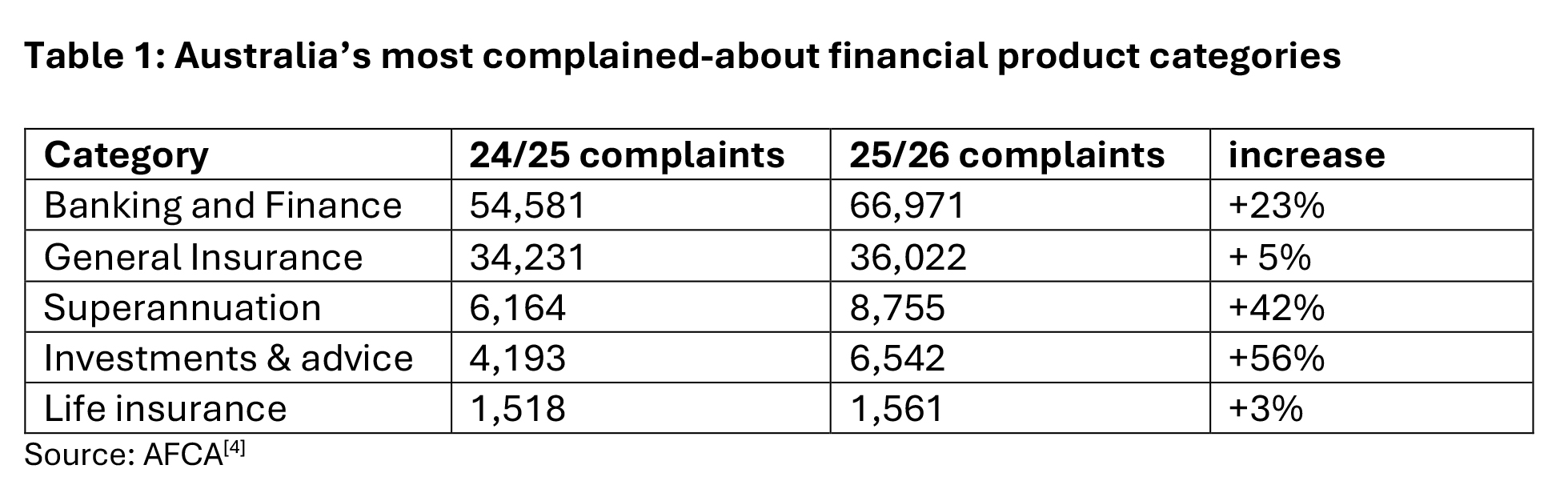

The Superannuation and Investments & Advice categories stand out for a different reason, recording increases of 42 per cent and 56 per cent respectively, although as previously explained, the First Shield and Guardian failures account for much of the increase in advice complaints.
These numbers do nevertheless provide an important snapshot of the quantum of complaints that have progressed as far as external dispute resolution by AFCA. Before a matter ever reaches AFCA, however, it generally starts much closer to home, as an expression of dissatisfaction made directly to a financial firm.
Which raises an important question for advisers and licensees: when does client dissatisfaction actually become a complaint? In an era where AFSL performance on this front is open for all to see, answering this question has arguably never been more critical.
What is and isn’t a complaint?
Not every unhappy client is lodging a complaint. But more clients are complaining than many advisers probably realise, because when it comes to defining a complaint, RG 271 – the ASIC Guide to Internal Dispute Resolution[5] – sets the bar lower than most would assume.
RG 271 adopts the definition of ‘complaint’ set out in the Australian Standard for complaint management, AS/NZS 10002:2014[6]. Critically, it doesn’t require a client to say the word ‘complaint’, put anything in writing, or point to a dollar figure they’ve lost. Rather, three things need to be present:
- Has dissatisfaction been expressed?
- Does that dissatisfaction relate to the firm’s advice, service, staff or handling of a previous issue?
- Is some kind of response explicitly or implicitly expected, or legally required?
While these points seem clear-cut, grey areas requiring judgement calls can be quite common. A client venting about market volatility isn’t necessarily complaining about their adviser. A client who’s had to chase the same request three times almost certainly is, even if they never use the word.
The table below illustrates just how “messy” things can become:
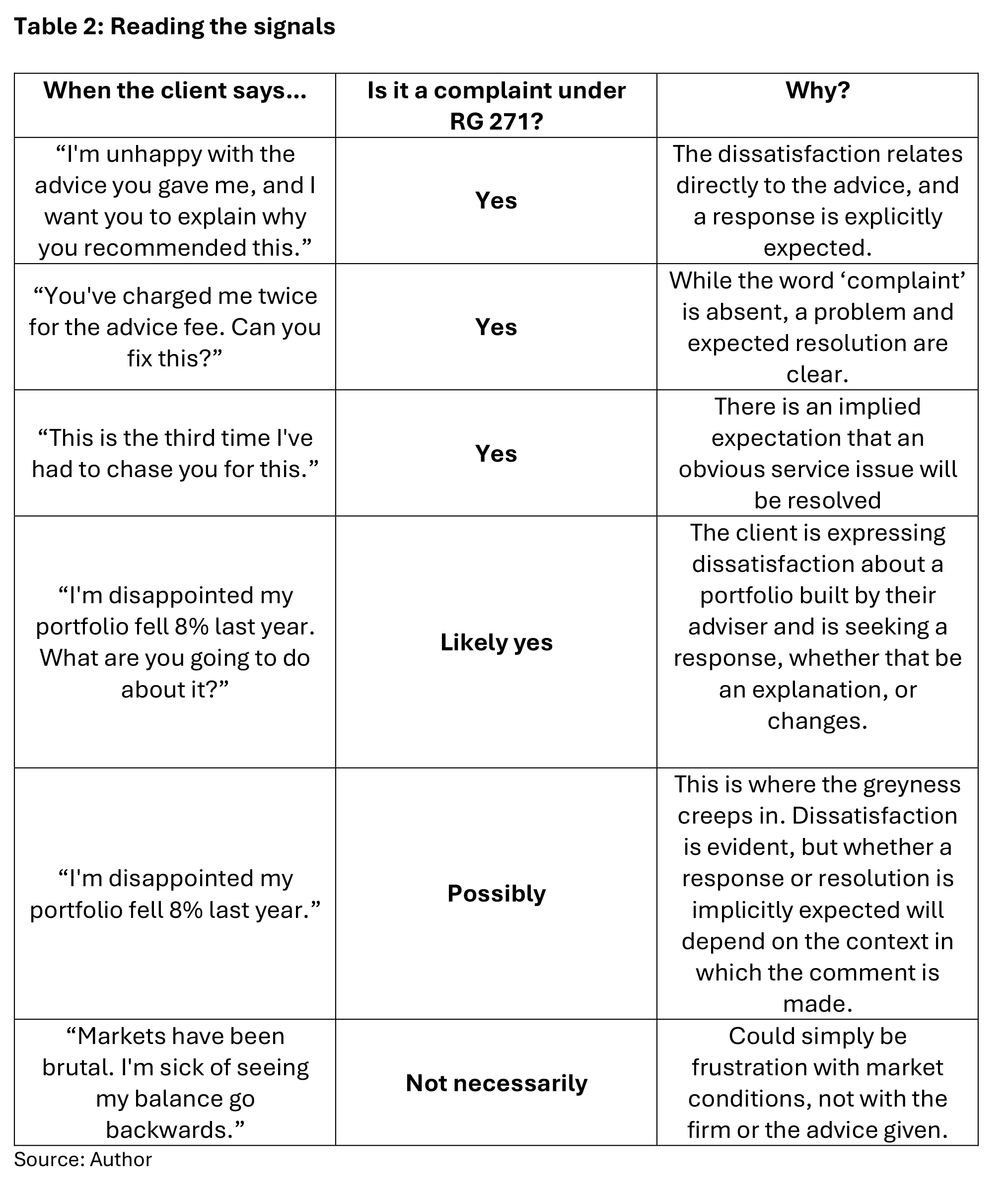

The variance in understanding about what constitutes a complaint became evident through surveillance conducted by ASIC in 2025[7]. In reviewing a cohort of licensees suspected of under-reporting complaints – including some that had never submitted IDR data – ASIC found that some licensees believed they only needed to report complaints involving serious issues or claims for compensation, or complaints that could not be resolved immediately[8]. A small number of the AFSLs reviewed also showed persistent non-compliance across IDR, financial reporting, and other obligations, leading ASIC to consider regulatory action as a result[9].
ASIC made its response to this under-reporting issue clear, via its February 2026 Financial Advice Update[10]. Put simply, once an expression of dissatisfaction meets the RG 271 definition, neither its severity nor how quickly it is resolved removes the obligation to capture it in the firm’s IDR reporting.
For advisers and licensees, correctly identifying a complaint is only the first step. What happens next can be equally important, particularly where a complaint is resolved quickly.
The complaint you resolve immediately still counts as a complaint
Another area of confusion identified by ASIC concerned complaints that were resolved immediately, or shortly after they were raised[11].
RG 271 makes an important distinction on this point[12]. The speed with which a complaint is resolved may affect what the firm needs to do next but doesn’t determine whether the complaint existed in the first place.
RG 271 specifically requires firms to record all complaints they receive, including those resolved to the complainant’s satisfaction at the time they are raised. If a client rings their adviser to dispute a fee and the adviser identifies and fixes the error during the same phone call, the fact that the client went away happy doesn’t erase the complaint, nor the obligation to record it.
Where quick resolution can make a difference is in the need to provide a formal written IDR response back to the complainant.
Under RG 271, firms generally don’t need to provide a written IDR response where a complaint is resolved to the complainant’s complete satisfaction within five business days, or where the firm has provided an explanation or apology and there is no further action it can reasonably take to address the complaint.
There are, however, exceptions to this five-day rule.
A written response is still required if the complainant asks for one, and regardless of how quickly they’re resolved, complaints involving hardship, a declined insurance claim, or the value of an insurance claim must also always receive a written IDR response.
A quick resolution does not mean it wasn’t a complaint – it may simply mean a formal written IDR response isn’t required. For advisers, this means the instinct to deal with client dissatisfaction quickly is a good one. That instinct only becomes problematic if a fast and successful resolution means it never makes it into the records.
Since 2024[13], all financial firms covered by the IDR reporting regime have been required to report complaints data to ASIC every six months, meaning complaints are no longer just an internal matter. And from earlier this year, the launch of the publicly visible IDR dashboard makes the correct recording and reporting of complaints even more critical.
From complaints to regulatory intelligence
Those mandatory six-monthly submissions – even when the complaint count is ‘nil’ – give ASIC much more than a simple complaint count. The data provides market-level insights across a number of dimensions, including the products and services complained about, the issues raised, resolutions, complaint channels, resolution times and the financial value of any remediation.
This level of detail makes complaints data a potentially powerful source of regulatory intelligence, with patterns and trends revealed at an aggregate level helping ASIC identify emerging issues and areas of potential consumer harm.
The IDR dashboard makes your complaints data public
ASIC’s IDR dashboard has fundamentally changed the visibility of complaints data in Australian financial services.
For the first time, consumers, advisers, licensees, journalists and competitors can search for individual financial firms and examine the complaints they have reported to ASIC. Firms can be searched by name or licence details and compared against each other across measures including complaint volumes, issues, outcomes, resolution times and monetary remedies.
(Note that, as a compromise in response to industry submissions[14], ASIC excludes some data – including demographic information, postcode data, and whether a complaint relates to an authorised representative– from public view.)
ASIC Commissioner Alan Kirkland described the dashboard as providing a ‘bird’s-eye view’ of how the financial sector handles complaints[15], making it easier to identify trends and flag emerging issues before they become more serious problems.
But ASIC’s enthusiasm around transparency was not shared universally, with significant concerns expressed about the potential for data to be misinterpreted.
During ASIC’s consultation on the proposed dashboard, the FAAA raised this very concern[16], noting that different firms could potentially take different approaches to identifying and recording the same expression of dissatisfaction, making simple comparisons of complaint volumes problematic.
The FAAA also questioned whether publishing data in this way could effectively become a ‘name and shame’ exercise[17], particularly if consumers or the media interpreted higher complaint numbers as evidence of poorer performance without considering the size or nature of the businesses being compared.
ASIC has acknowledged the potential for this issue[18], and in their guidance accompanying the dashboard have explicitly warned a high number of complaints doesn’t necessarily indicate poor performance. Complaint numbers can reflect market share and product mix, while a firm with a strong complaints management culture and well-trained staff may actually identify and report more complaints than a comparable firm.
After consulting industry, ASIC has built more contextual information into the dashboard19 and moved the emphasis away from raw complaint counts alone, placing greater weight on measures such as resolution times.
What this means for advisers and licensees
At a high level, the take-out for advisers and other client-facing staff is simple – they need to be able to recognise the signs of a complaint even if they don’t hear that word. Familiarity with the RG 271 three-part test for a complaint is essential.
For licensees, the shift is less about individual complaints and more about what the pattern is showing. Is a particular product or adviser generating disproportionately more complaints? Is resolution time getting longer? These are questions only the licensee’s own IDR data can answer. Externally, the licensee also needs to think about how its aggregate numbers look against peers, knowing that the dashboard now allows ASIC, competitors and journalists to make that comparison themselves.
Five questions every adviser and licensee should be able to answer
- Are we confident our complaints data is accurate?
A low complaint count is only a good result if client dissatisfaction, including at the individual adviser level, is being consistently recognised and recorded. - What does our complaints data tell us, adviser by adviser and product by product?
Look beyond total numbers. Which advisers, products, services and issues generate complaints, how quickly are they resolved, and are those measures changing? - How do we compare with similar businesses?
The IDR dashboard provides a new opportunity to benchmark performance, but comparisons need to take account of differences in size, business mix and complaint-recording practices. - What are we doing about the patterns we find?
Identifying recurring complaints about the same adviser, process, service or product is only useful if those patterns trigger investigation and, where necessary, changes to the way the business operates. - What would someone else conclude from our data?
Clients, competitors, journalists and ASIC can now see much of the same firm-level information. Licensees should understand what their publicly available complaints data says about their firm before somebody else draws their own conclusions.
Conclusion
2026 has indeed been a ‘big’ year for financial services complaints, but the record AFCA figures are only part of the story.
While the rules around complaints reporting haven’t changed, the visibility of that data has, courtesy of the public IDR dashboard. What was once largely an internal record of individual client issues can now provide ASIC, competitors, journalists and consumers with a much broader picture of how a business manages client dissatisfaction.
The dashboard is just one example of an elevated regulatory focus on complaints handling and the extent to which complaints can signal potential consumer harm arising from financial products, processes and advice.
For advisers and licensees, that makes the fundamentals covered in this article – recognising a complaint, recording it properly and understanding the patterns in the data – foundational to effective complaints management and regulatory compliance.
Take the FAAA accredited quiz to earn 0.5 CPD hour:
CPD Quiz
The following CPD quiz is accredited by the FAAA at 0.5 hour.
Legislated CPD Area: Regulatory Compliance & Consumer Protection (0.5 hrs)
ASIC Knowledge Requirements: Regulatory Environment (0.5 hrs)
please log in to start this quiz

———–
References:
[1] https://www.moneymanagement.com.au/investment-advice-afca-complaints-up-56-in-fy26
[2] Ibid.
[3] https://www.asic.gov.au/about-asic/news-centre/find-a-media-release/2026-releases/26-051mr-asic-launches-financial-complaints-data-dashboard/
[4] https://www.moneymag.com.au/afca-financial-complaints-record-high
[5] https://download.asic.gov.au/media/3olo5aq5/rg271-published-2-september-2021.pdf
[6] Ibid.
[7] https://www.asic.gov.au/about-asic/news-centre/news-items/financial-advice-update-february-2026/
[8] Ibid.
[9] Ibid.
[10] Ibid.
[11] Ibid.
[12] https://download.asic.gov.au/media/3olo5aq5/rg271-published-2-september-2021.pdf
[13] https://www.asic.gov.au/regulatory-resources/financial-services/dispute-resolution/internal-dispute-resolution-data-reporting/
[14] https://www.asic.gov.au/about-asic/news-centre/news-items/asic-outlines-approach-to-breach-and-complaints-data-publications/
[15] https://www.insurancebusinessmag.com/au/news/breaking-news/asic-unveils-internal-dispute-resolution-dashboard-across-financial-firms-568950.aspx
[16] https://download.asic.gov.au/media/h0zpcw0v/financial-advice-association-australia-faaa-_redacted.pdf
[17] https://financialnewswire.com.au/financial-planning/purpose-and-cost-of-asic-name-and-shame-regime-challenged/
[18] https://www.asic.gov.au/regulatory-resources/financial-services/dispute-resolution/internal-dispute-resolution-data-dashboard/
[19] https://www.asic.gov.au/about-asic/news-centre/news-items/asic-outlines-approach-to-breach-and-complaints-data-publications/
CPD Quiz
The following CPD quiz is accredited by the FAAA at 0.5 hour.
Legislated CPD Area: Regulatory Compliance & Consumer Protection (0.5 hrs)
ASIC Knowledge Requirements: Regulatory Environment (0.5 hrs)
please log in to start this quiz
