

The structure of local currency emerging market debt creates opportunities for active managers to add value through selection, flexibility and disciplined risk management.
Key takeaways
- A large, diverse and fast-growing opportunity set: local currency EMD spans economies at very different points in the cycle, offering income, growth and genuine diversification.
- Structure, not just yield, rewards active management: wide dispersion, independent return drivers and index mechanics create levers a passive approach cannot pull.
- Avoiding the wrong risks matters as much as picking the right bonds: separable rate and currency risk make disciplined risk control central to long-term returns.
Local currency emerging market debt (EMD) has matured into one of the most diverse opportunity sets in global fixed income. Issuance has grown, liquidity has deepened, yield curves have developed, and the ownership base has broadened across domestic and international investors. For many emerging economies, a functioning local bond market and credible monetary policy are now signals of economic development rather than aspirations.
For many investors, the question is no longer whether local currency EMD merits an allocation, but how best to capture it. A passive or smart beta approach offers a low-cost entry point, but it also embeds a series of decisions that many investors may not fully appreciate. In our view, the structural characteristics of this asset class, namely its breadth, heterogeneity and multiple sources of return, create conditions in which specialist active management is particularly well placed to add value.
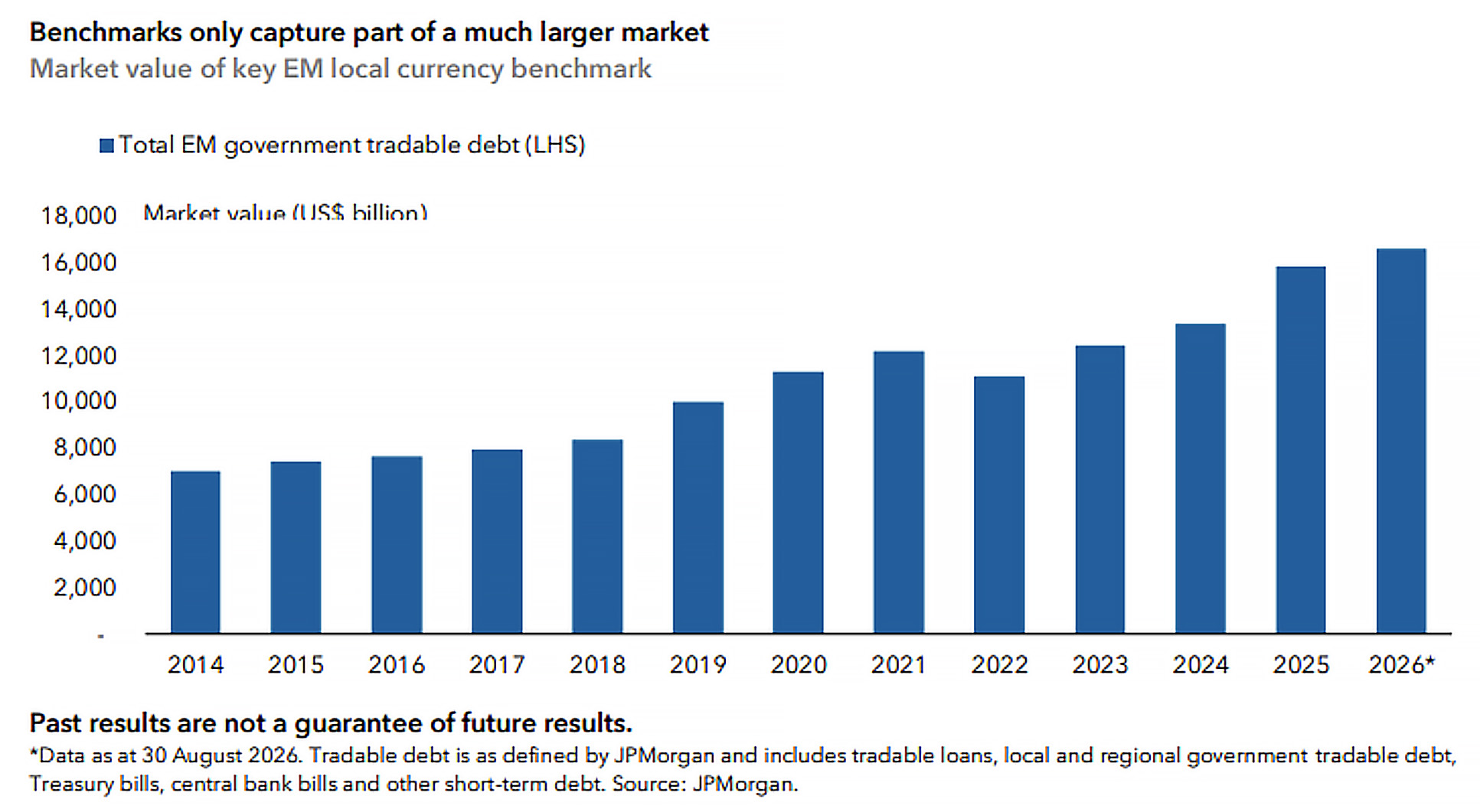
The scale of the market underlines how much is at stake. The widely followed JPMorgan GBI-EM Global Diversified Index represents around US$2.8 trillion, compared with approximately US$16.6 trillion of tradable local currency government debt. In other words, the benchmark captures less than 17% of the broader market. A substantial opportunity set therefore sits outside the standard benchmark from the outset. This paper sets out four structural features of the market that, taken together, make the case for an active approach.

1. Dispersion: local currency EMD is not one market
The single most important feature of this asset class is that it is not homogeneous. Beneath the label of emerging market debt sits a collection of economies at very different stages of the cycle, facing very different pressures.
Inflation trajectories differ, and growth paths, fiscal positions, external balances and political circumstances vary widely from one country to the next. A bond investor positioned in one market is often facing an entirely different opportunity from one positioned elsewhere. This dispersion is not a footnote; it is the foundation of the active case. The wider the differences between countries, the greater the potential for a manager who researches those countries deeply to distinguish between them and allocate accordingly.
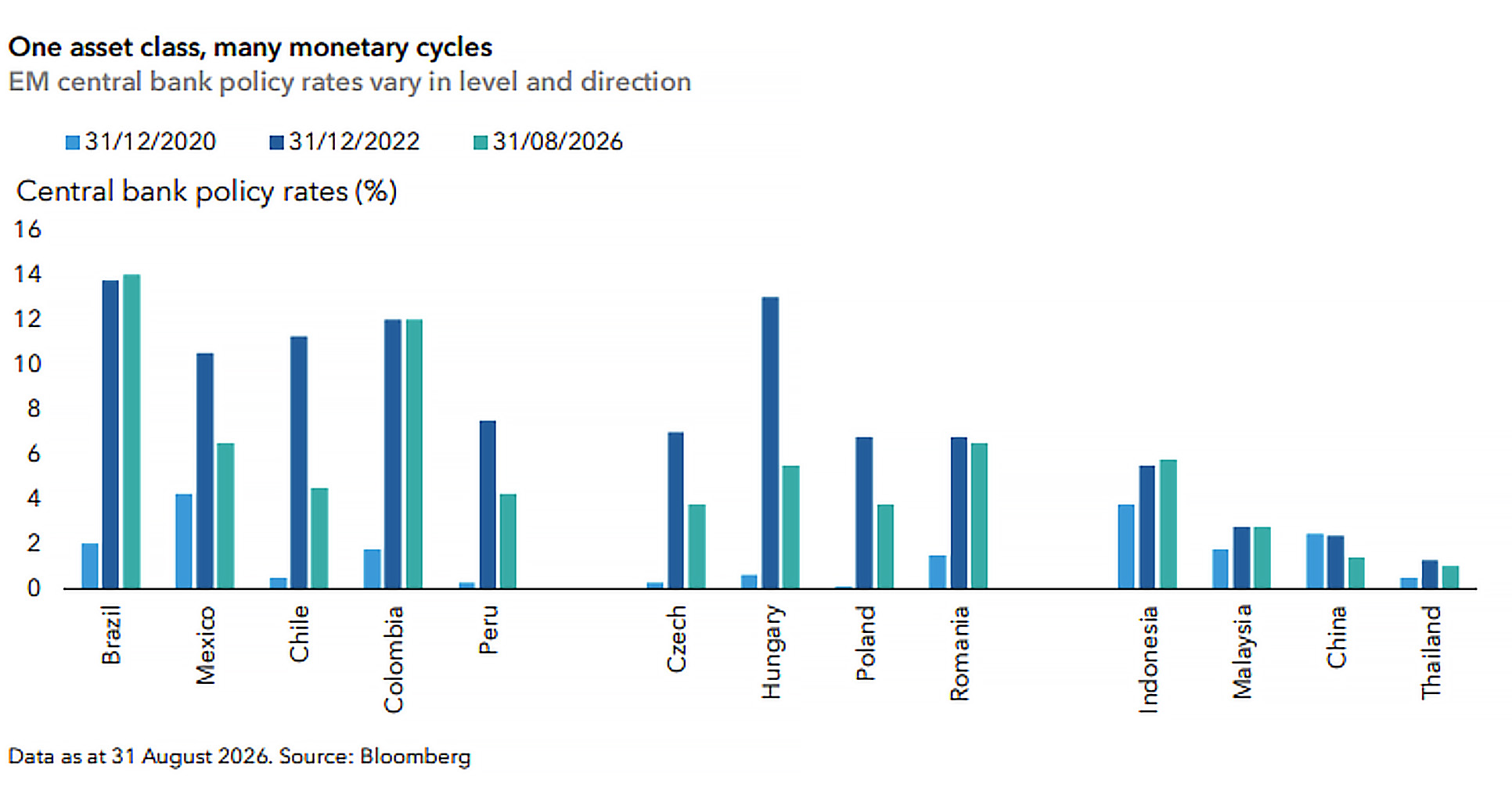
Nowhere is that divergence more visible than in monetary policy, where emerging market central banks are frequently moving in opposite directions at the very same time. In the most recent cycle, the synchronised easing of prior years gave way to sharp divergence: some EM central banks continued to cut cautiously as inflation receded, many moved to the sidelines as a renewed energy-price shock clouded the outlook, and a few tilted back towards tightening, leaving policy rates moving in different directions across the asset class. A single aggregate benchmark return conceals exactly this kind of variation. For a passive investor, that dispersion is simply absorbed; for an active investor, it is the raw material of alpha.

2. Benchmarks reflect eligibility, not opportunity
A benchmark is a useful tool, providing a reference point for risk, enabling comparison across managers and supporting manager selection. We are benchmark-aware for exactly these reasons. But a benchmark is also a simplification and the choices embedded in that simplification carry real consequences. Index providers must prioritise liquidity, transparency and operational simplicity. The result is a benchmark that reflects what is eligible for inclusion, not the full set of what is investable.
The starting point for most local currency EMD benchmarks is the level of sovereign debt outstanding, so exposure tilts towards the most indebted issuers. The widely used JPMorgan GBI-EM Global Diversified Index mitigates this through a 10% country cap, but that cap is itself an active decision. So too are the index’s other construction rules, which exclude a large part of the investable universe:
- Countries with capital controls or restricted market access
- Instruments outside defined maturity thresholds (at least 2.5 years to enter the index, and at least six months to remain in it)
- Issues below a minimum size (US$1 billion for onshore local bonds, US$500 million for offshore)
- Inflation-linked, callable, puttable or convertible structures
- Corporate and quasi-sovereign issuance
These eligibility rules materially narrow the opportunity set represented by the benchmark. Corporate and quasi-sovereign issuance, smaller or shorter-dated securities, and certain markets with access restrictions are excluded by construction, meaning the benchmark reflects only a subset of the broader local currency debt universe.
The consequences are not neutral. The methodology reshapes regional and country exposures in ways an investor may not intend. The diversification and capping rules, for example, pull the index’s regional mix away from the underlying market: Asia accounts for close to 80% of the broader local currency universe but under half of the Global Diversified index, while Latin America’s share rises correspondingly. Given Asia’s lower yield of around 2.5% versus close to 10.1% in Latin America, that methodological choice effectively raises both the yield and the risk of the benchmark. In other words, a passive allocation is not as passive as it appears.
Index construction also shapes market behaviour in ways passive strategies must follow and active managers can use. Four mechanical effects recur regardless of which country happens to be topical in any given year:
- Weights reflect issuance, not fundamentals. Large, benchmark-eligible issuance mechanically increases index weight even when valuations are stretched, while smaller or shorter-dated issuance from sound borrowers can be excluded entirely.
- Mechanical exclusions reduce flexibility. Rules-based exclusions keep whole segments out of the index by construction. This does not mean an active manager seeks distressed exposure; rather, it can engage earlier, avoid forced selling, and assess stressed situations on their merits where recovery values or reform paths are credible.
- Forced turnover creates predictable flows. Bonds drop out as they approach maturity and new issues enter automatically once eligible, so passive portfolios must trade around these events irrespective of valuation.
- Diversification caps mask underlying risks. Redistribution rules shift weight between issuers without regard to liquidity or credit quality. An active manager can calibrate these exposures deliberately rather than mechanically.
The conclusion for investors is subtle but important. Choosing a benchmark, and choosing to track it, is itself an active decision about future beta. An active manager, by contrast, can treat the benchmark as a reference rather than a constraint, and can access the broader opportunity set beyond it, including the off-benchmark securities where inefficiencies are often greatest.
3. Returns come from multiple, independent sources
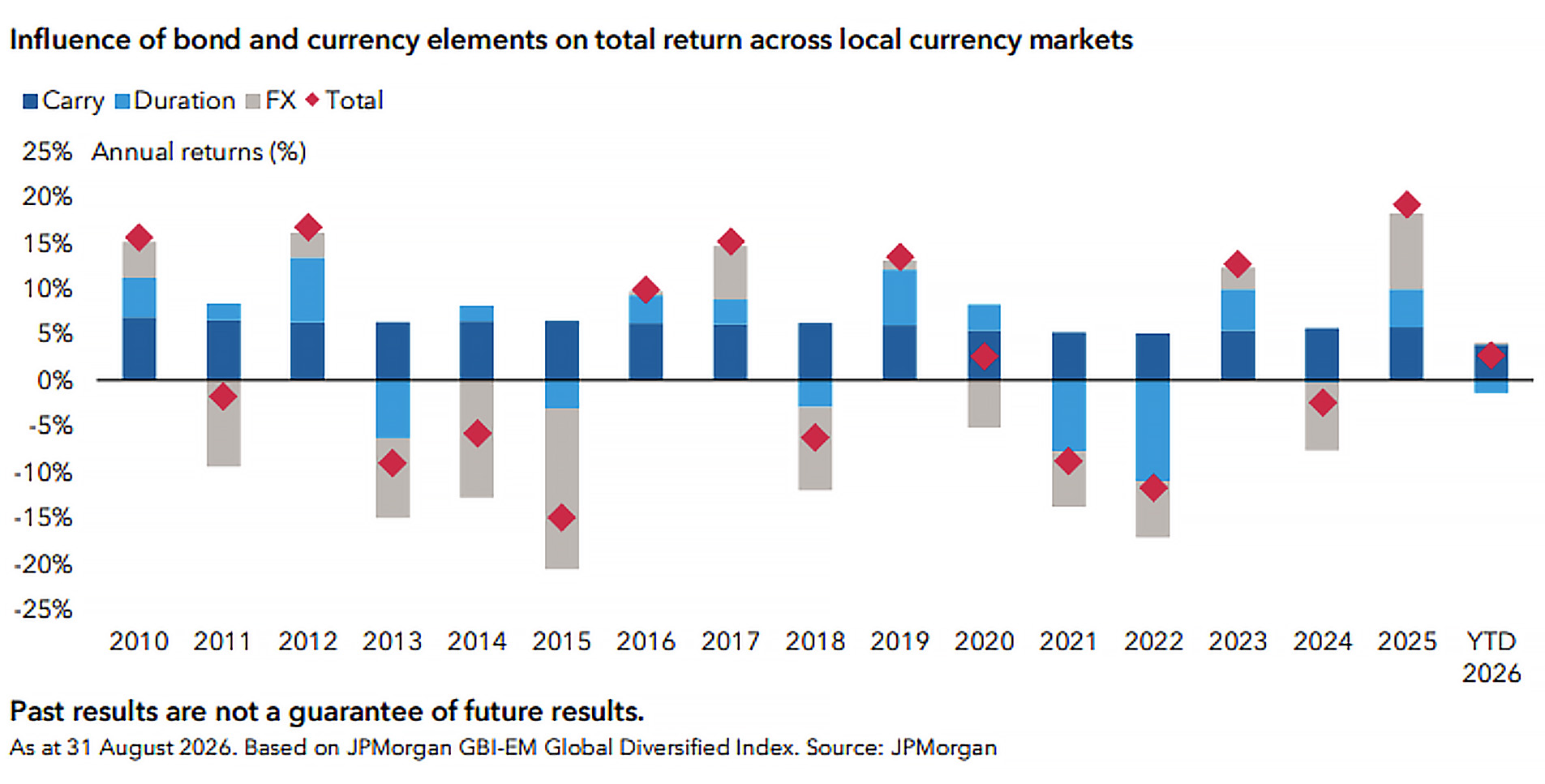
Local currency EMD is unusual within fixed income in offering several distinct drivers of return. Total return reflects duration, yield curve positioning, carry, currency and, at times, liquidity, and these do not always move together. In recent years, the bond and currency components of the market have at times diverged meaningfully.
This matters because it multiplies the ways in which an active manager can express a view. A manager can take duration risk in one market while hedging its currency, position along the curve in another, and hold an off-benchmark position in a third. Each of these is a distinct lever, and liquidity conditions themselves can be a further one, offering entry and exit points that passive strategies, bound to trade around index events, cannot choose. The concentration of returns underlines the point: in 2025, South Africa, Mexico and Indonesia together contributed over 45% of the index’s return, a reminder that headline returns often rest on a handful of markets. An active manager can choose whether to lean into or away from that concentration; a passive investor simply inherits it.
These drivers are not merely numerous, they are genuinely independent, which is what makes them valuable within a broader portfolio. Because local currency returns are driven primarily by domestic interest rates, inflation dynamics and country-specific policy rather than global credit cycles, the asset class has historically shown only moderate correlation with US high yield, in the region of 0.5 to 0.6.
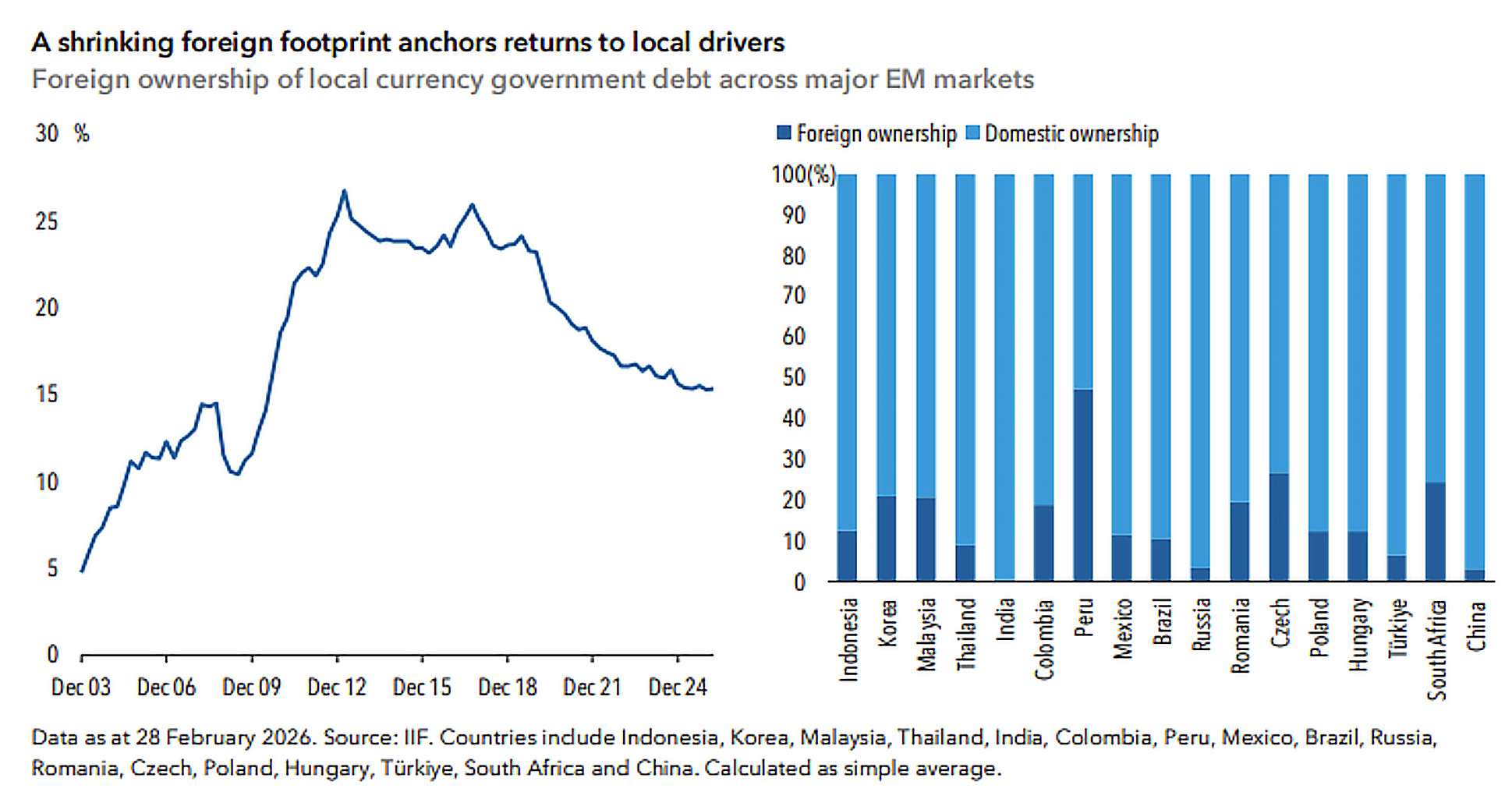
That domestic anchor is visible in the ownership base itself: across the major local currency markets, the share held by foreign investors has trended lower over the past decade, leaving returns driven more by local policy and local flows than by global risk sentiment. This is part of what makes the diversification genuine rather than incidental.

Currency deserves particular attention. It can be a significant contributor to, or detractor from, total return, and over long periods, emerging market currencies have tended to depreciate against developed market peers. Yet valuations move in cycles, and periods of currency weakness can create the conditions for future appreciation. Capturing that potential requires active selection rather than passive exposure to the basket as a whole.

4. Structural inefficiencies and deliberate risk management
The rules that govern index membership are themselves a source of opportunity. Benchmark composition changes on a fixed schedule; fundamentals do not. That mismatch forces passive capital to move mechanically, creating dislocations between price and fair value that an active manager can anticipate.
This pattern is more durable than any single event. Whenever a market is added to or removed from a major index, or the rules governing index weights change, the staged rebalancing reshapes capital flows and pricing over a defined window, well ahead of any change in fundamentals. A recent illustration: JP Morgan’s 2025 review lowered the GBI-EM country cap from 10% to 9% over a five-month phase-in during 2026, and set Paraguay, Saudi Arabia and the Philippines on a path towards inclusion, changes that move benchmark weights on a fixed schedule rather than in response to value. Anticipating such technical events can offer a positioning advantage that passive strategies, by design, cannot pursue.
What matters is the mechanism, not any particular episode. Forced, calendar driven flows are predictable in direction if not always in magnitude, and a manager positioned ahead of them is being paid for foresight that the benchmark cannot exercise on its own behalf.
Anticipating opportunities, however, is only half of the active manager’s task. The other half is deciding which risks to accept in the first place. A common misconception is that the return potential of local currency EMD is simply a function of taking more risk. In our experience the opposite discipline is what distinguishes strong long-term outcomes: the task is not to maximise risk but to decide which risks are worth taking, which should be hedged, and which should be avoided entirely.
Because duration and currency risk can be separated and managed independently, an active manager has genuine control over the risk profile of a portfolio through changing volatility regimes. Interest rate and exchange rate volatility can be high at times, and the ability to dial exposures up or down, rather than remaining fully exposed to whatever the benchmark dictates, is a meaningful advantage. It also allows a manager to selectively hedge currency where depreciation risk dominates or carry is unattractive, and to add exposure where valuations, external balances and policy credibility support appreciation. Managing volatility carefully across both rate and currency risk is, in our view, as important to long-term results as security selection itself.
What it takes, and how we approach it
The opportunities described above are not available simply because a manager is active. They depend on capabilities that are demanding to build and harder still to integrate: specialised research that can tell one economy from another, the operational reach to hold positions the benchmark excludes, the combined rates and currency expertise to work each return driver independently, and a risk function with the standing to shape exposures rather than merely report them.
Our own approach is organised around those requirements. Emerging market debt is covered by dedicated sovereign and corporate analysts, macroeconomists and a currency strategist rather than generalists, so dispersion between countries is researched at the level at which it actually occurs. A specialist team assesses market mechanics and counterparty access across more than 75 markets, which is frequently what determines whether an off-benchmark opportunity is genuinely investable rather than merely attractive on paper. And a dedicated risk team engages with portfolio managers on a regular cadence, working from frameworks tailored to each portfolio rather than applied uniformly.
The structural features of local currency EMD, its dispersion, the simplifications embedded in its benchmarks, its multiple sources of return, and the inefficiencies and risks created by its own mechanics, are precisely the conditions in which we believe specialist active management can add the greatest value.
Take the FAAA accredited quiz to earn 0.25 CPD hour:
CPD Quiz
The following CPD quiz is accredited by the FAAA at 0.5 hour.
Legislated CPD Area: Technical Competence (0.5 hrs)
ASIC Knowledge Requirements: Fixed Interest (0.25 hrs) and Managed Investments (0.25 hrs)
please log in to start this quiz
———–
Statements attributed to an individual represent the opinions of that individual as of the date published and may not necessarily reflect the view of Capital Group or its affiliates. This communication is intended for the internal and confidential use of the recipient and not for onward transmission to any other third party. This communication is of a general nature, and not intended to provide investment, tax or other advice, or to be a solicitation to buy or sell any securities. All information is as at the date indicated and attributed to Capital Group unless otherwise stated. While Capital Group uses reasonable efforts to obtain information from third-party sources that it believes to be accurate, this cannot be guaranteed. In Australia, this communication is issued by Capital Group Investment Management Limited (ACN 164 174 501 AFSL No. 443 118), a member of Capital Group, located at Suite 4201, Level 42 Gateway, 1 Macquarie Place, Sydney, NSW 2000 Australia. All Capital Group trademarks are owned by The Capital Group Companies, Inc. or an affiliated company. All other company names mentioned are the property of their respective companies. © 2026 Capital Group. All rights reserved.
CPD Quiz
The following CPD quiz is accredited by the FAAA at 0.5 hour.
Legislated CPD Area: Technical Competence (0.5 hrs)
ASIC Knowledge Requirements: Fixed Interest (0.25 hrs) and Managed Investments (0.25 hrs)
please log in to start this quiz
———–