

Shane Oliver
Key points
- Share markets are down sharply on the back of worries that AI enthusiasm went too far, central bank rate hikes and recession fears in Australia.
- Beyond a near term bounce, further short-term weakness is likely but in the absence of a US recession this is more likely a correction than the start of a bear market for now.
- A recession in Australia is not our base case, but the risk is high and rising.
- This will weigh on short-term super fund returns but follows four years of strong returns. Periodic share market falls are normal, and the key is to stick to an appropriate long-term strategy.
Introduction
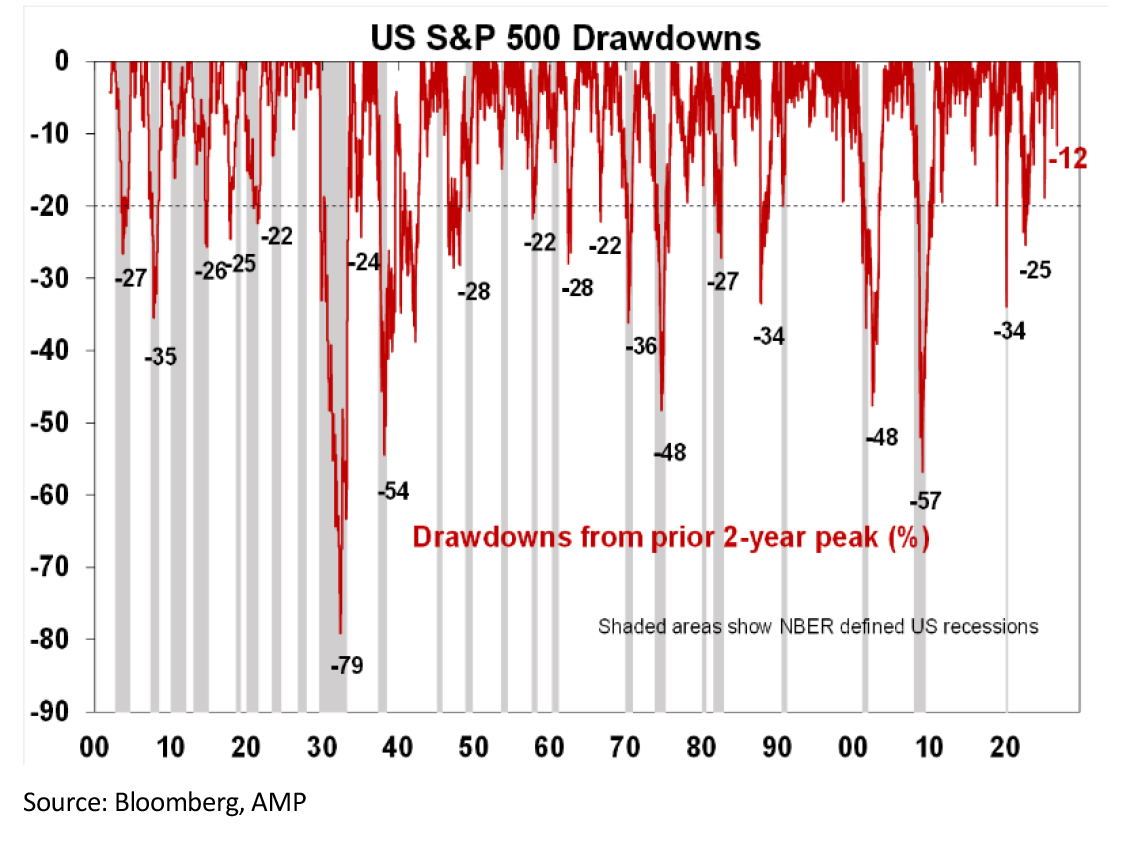
Much of the time share markets are relatively calm and so don’t generate a lot of attention. But every so often they tumble and generate headlines like “billions wiped off share market”. Sometimes it ends quickly and the market heads back up again and is forgotten about. But periodically they keep falling for a while. Sometimes the falls are foreseeable (usually after a run of strong gains), but rarely are they forecastable (which requires a call as to timing and magnitude) despite many claiming otherwise. And now it’s happening again. From their record highs US shares have fallen 11.6%, global shares have fallen 10.6% and Australian shares have fallen 7.5%.
As most of us have at least some of our wealth in shares via our superannuation and often directly such falls can be depressing but seen in the context of share market history, they are normal. So far, while the fall in the direction setting US share market has been rapid, the total drop is mild when compared to falls seen over the last 120 years. The next chart shows US share market falls from their prior two year high.

What’s driving the plunge in shares – the worry list
The key drivers of the fall in shares are a combination of factors:
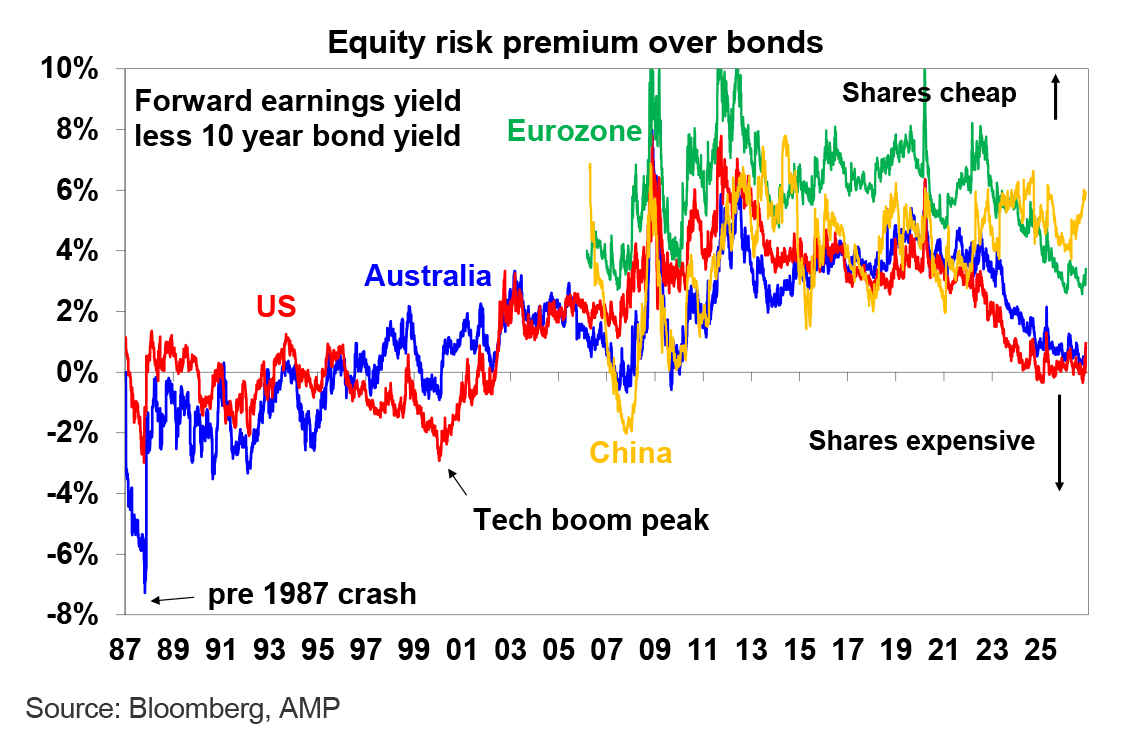
- First, several years of strong returns and rising bond yields had left share market valuations relatively stretched. In particular, US and Australian shares were offering relatively little risk premium over bonds as measured by the gap between the forward earnings yield and 10-year bond yields. This has been the case for the last two years, so was no guide to timing, but it left shares vulnerable.

- Second, AI bubble fears intensified. Stretched valuations have been offset over the last few years by very strong growth in US company profits on the back of the AI boom. But fears have been building that this is unsustainable with worries that the massive AI data centre buildout – which on some measures at 3-4% of US GDP is bigger than the railroad boom of 1870-90 and the telco build out of the late 1990s-early 2000s – will prove to be unnecessary as the capabilities of AI models located on laptops and smart phones catches up to those requiring data centres leaving the “hyper scalers” like Meta and Alphabet with a lot of white elephants. This is a bit like laptops and smart phones replace mainframe computers and how the huge telco build out of the 1990s tech boom proved to be unnecessary. And there are worries that when it ends it will lead to a big slump in US growth, crashing chip demand with a huge flow on to countries like Taiwan, South Korea and Japan. These fears have been accentuated by the turmoil flowing from the affairs of former Nvidia CEO Jensen Huang and worries it will trigger a regulatory crackdown. (Bubbles can end with strange things like the start of WW1!). The concern is not so much that AI will not lead to a big productivity boost but that, as with the internet centric tech boom a generation ago, AI enthusiasm has run ahead of itself. At the same time the huge capital raisings by Space X ($US86bn) and Anthropic ($US107bn) compared to all US IPOs in 2025 (of $US44bn) may have sucked capital away that might have been used for “dip buying”.
- Third, and related to this the US share market had become heavily reliant on a handful of stocks with the Magnificent Seven (Apple, Microsoft, Amazon, Alphabet, Meta, Nvidia and Tesla) accounting for nearly two thirds of US share market gains in 2023, 55% in 2024, 46% in 2025 and 34% this year taking them to roughly 35% of the S&P 500’s market capitalisation.
- Fourth, high and sticky inflation has added to expectations of more central bank rate hikes. This is particularly the case in the US with influential Fed Governor Waller talking of raising the Fed Funds rate by up to 1% (not all at once) to “shock people to get them to remember that the [Fed] wants inflation to be much lower.” The Fed has a history of hiking till something breaks.
- Fifth, and in the background are ongoing concerns about the Iran War which could flare again driving another spike in oil prices, other geopolitical tensions, high public debt levels, the rising trend in bond yields and concerns that the big Democratic win in the midterms signals more regulation and tax hikes beyond 2028.
- Finally, and in Australia there is concern about the impact of high rates after five RBA rate hikes this year and a rising risk of recession.
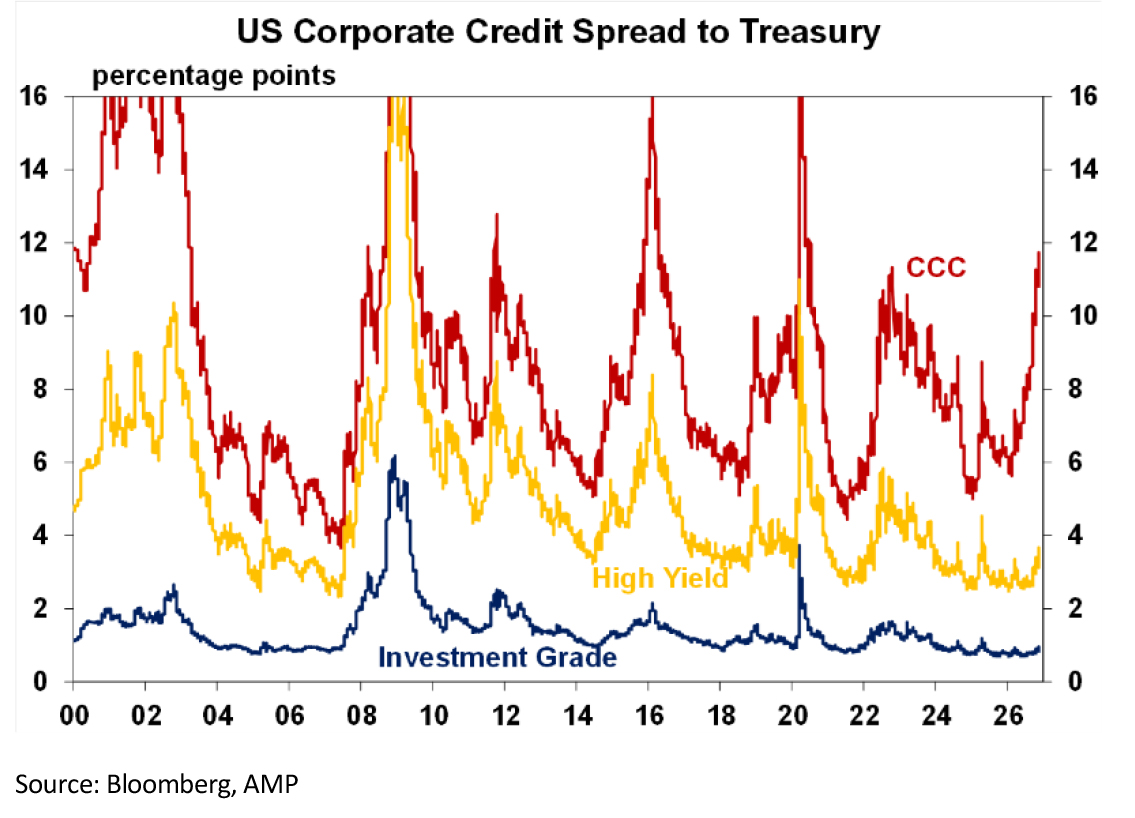
As is often the case with share market falls there has been a flight to the perceived safety of bonds and the US dollar and away from other growth assets like high yield corporate debt (with yield spreads to US bonds blowing out – see the next chart), metal prices (copper is down 20%), gold and Bitcoin (which has fallen to its June lows) with increased expectations for Fed hikes not helping.

Correction, gummy bear or grizzly bear?
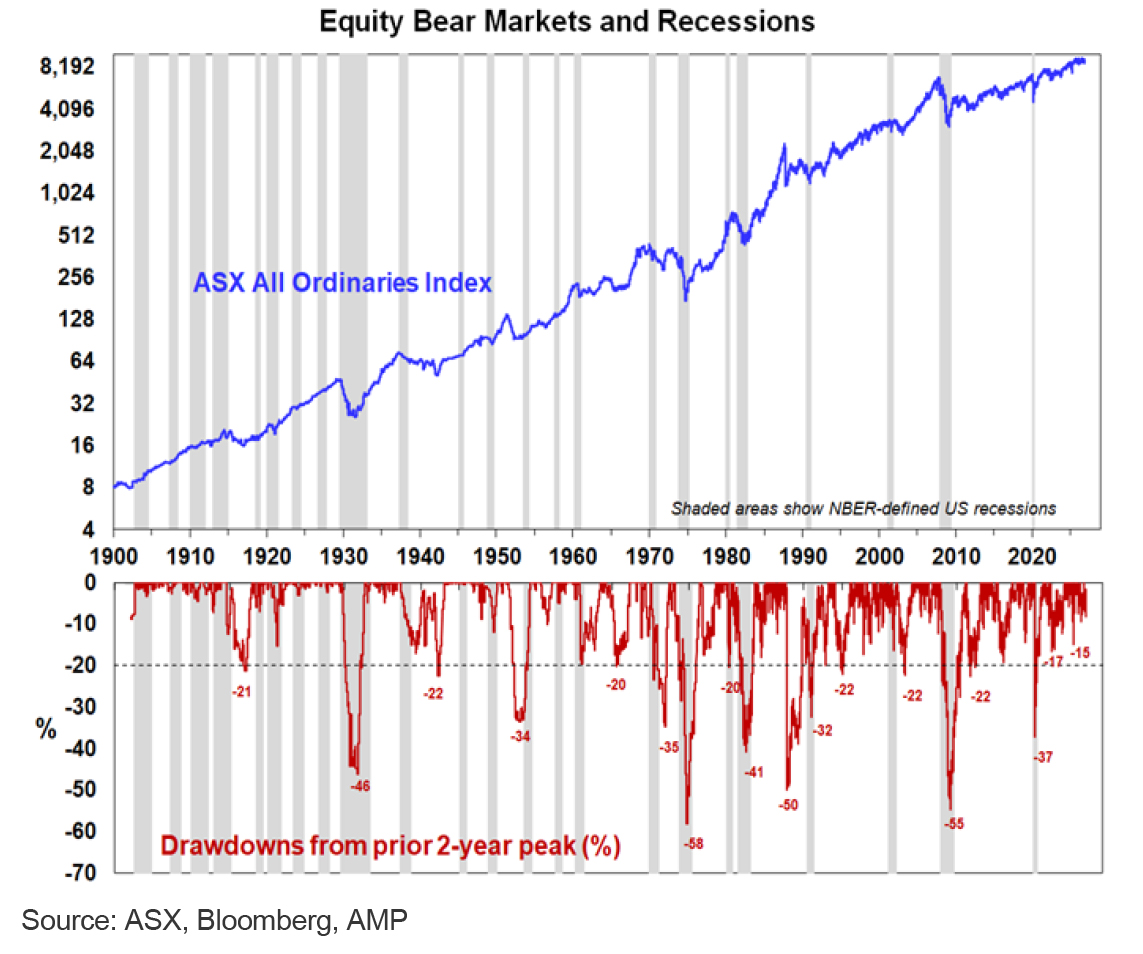
Historically, the main driver of whether we see a correction (a fall of say 5% to 15%) or a mild bear market with say a 20% or so decline that turns around relatively quickly like we saw in 2015-2016 in Australia – which may be called a “gummy bear market” – as opposed to a major “grizzly” bear market (like in the GFC when shares fell by around 55%) is whether we see a US recession. The first chart in this note & the next show that deep bear markets in US and Australian shares tend to be associated with a US recession which are shown by the shaded lines.

At this stage the risk of a US recession is low
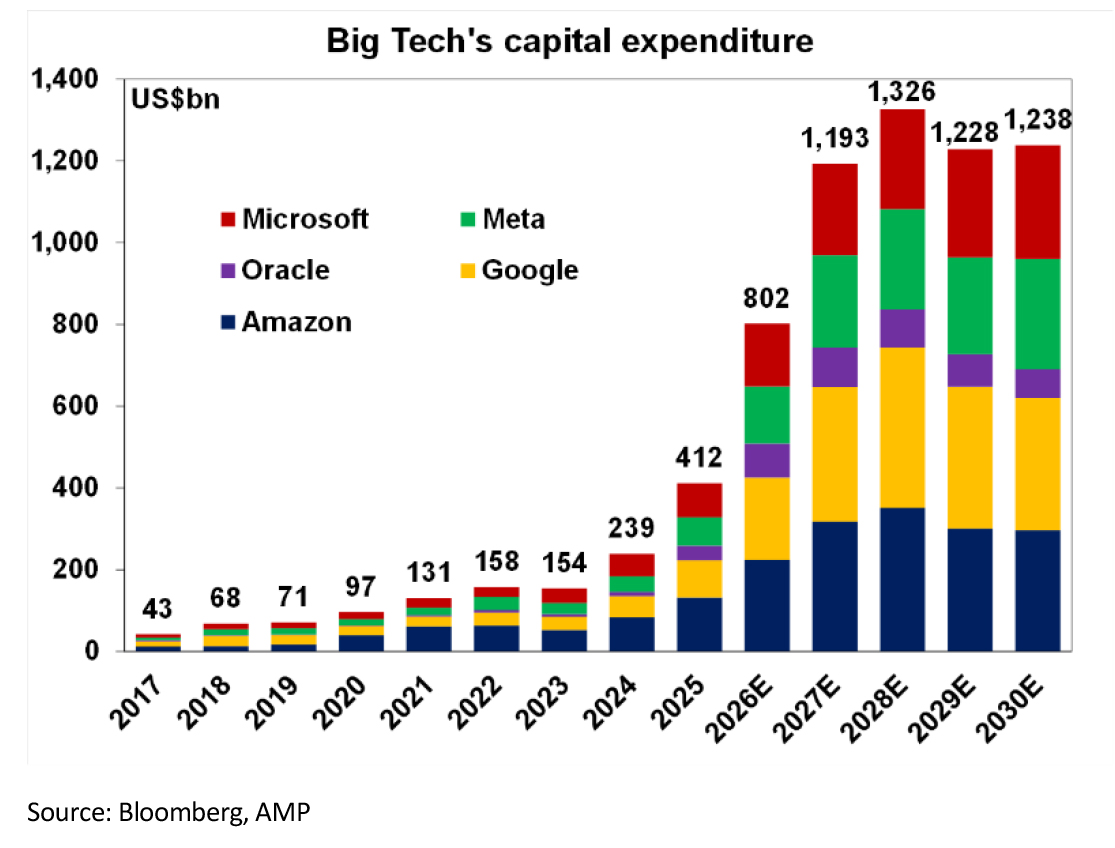
The risk of a US recession at this point is low: the Atlanta Fed GDPNow tracker of GDP growth this quarter is showing a solid 3.2% annualised pace; business conditions PMIs are strong; annual growth in US leading economic indicators is positive; the US yield curve is positive (whereas an inverted yield curve normally precedes a recession); and while worries are high regarding excessive investment in data centres for now capex plans by the big tech “hyper-scalers” remains high. See the next chart. Meanwhile profit growth in the US came in strong in the September quarter at 33%yoy with booming tech and energy profits but much of the upside surprise was in non-tech non-energy companies. This is not to say that the Fed won’t go too far or that fading AI share prices won’t weigh but this could be an issue more for later next year or 2028. But for now, the US economy looks ok as does global growth.

But the risk of recession in Australia is high and rising
For Australian shares, US recessions are key but local recessions also matter and were associated with bear markets in the mid-70s, early 80s and early 90s. And unfortunately, on this front the risk has increased with very depressed levels of consumer and business confidence, falling business conditions indicators including PMIs, falling home prices which will lead to a negative “wealth effect”, falling new home sales, rising anecdotes of mortgage stress, trading updates from Australian companies suggesting sales are falling in real terms, increasing corporate failures and layoffs and an accelerating rise in unemployment to now 4.9%. The latter is still low but it’s the direction of travel which matters for economic growth.
A rapid decline in economic indicators that lead (eg, confidence), are coincident with (like real household spending) and lag (like unemployment) the economic cycle warn that the risk of recession is high and rising. As can be seen in the next chart the slump is the worst since the pandemic but is not quite yet as bad as seen around the GFC.
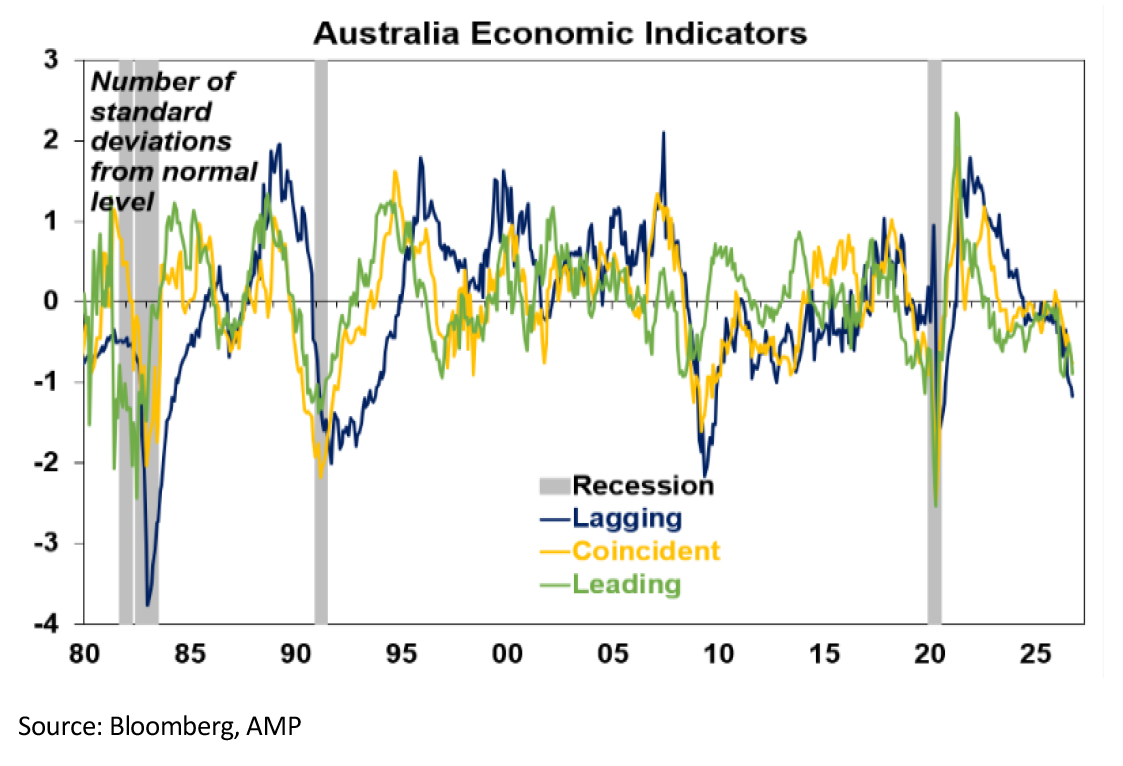

At this stage a recession in Australia is not our base case given a strong outlook for business investment due to the AI data centre building boom and okay global growth supporting our exports in contrast to the run up to the early 1980s and 1990s recessions. And a now falling $A will provide a bit of a shock absorber for Australia by boosting exports. However, we would put the risk of recession at a high and still rising 40%.
The rising trend in unemployment and other indicators of a rising risk of recession are consistent with rate hikes working to slow demand which will ultimately slow inflation. AI may be impacting too but it’s a side show to these underlying drivers. As such, it confirms our view that the RBA has already done enough and while there is still some chance it could hike again the odds are low with it likely to remain on hold at the December meeting as it assesses the recent flow of data and then remain on hold into next year. But barring a quick lurch into recession or a major financial crisis that severely threatens the growth outlook, the RBA will be wary of rushing into a rate cut until it sees clear evidence of a broad-based fall in inflation. It doesn’t want a repeat of its 2025 experience. So rate cuts are likely next year but not until the second half.
For Australian shares the higher risk of a recession is a negative, but it may be offset by the low exposure to AI related trades in the Australian share market should the AI slump turn into a major bear market. Recall that in the tech wreck bear market of the early 2000s Australian shares only fell 22% versus a 48% decline for US shares because our market had a lower tech exposure. It didn’t go up so much so it didn’t come down so much.
Shares could still have more short-term downside
After big falls shares are now oversold technically and so may see a near term bounce. But the size of the worry list noted above means they could still have more downside before bottoming. Our assessment coming into this year was that shares will likely have another 15% or so correction along the way – it’s unfortunate that it’s come near the end of the year leaving less time to recover by year end.
However, we don’t see a bear market for now
However, in the absence of a US recession on the horizon we see this as more likely a correction than a new bear market. And in addition:
- Continuing growth in the US and further to go in the data centre build out will likely support US profit growth for a while yet.
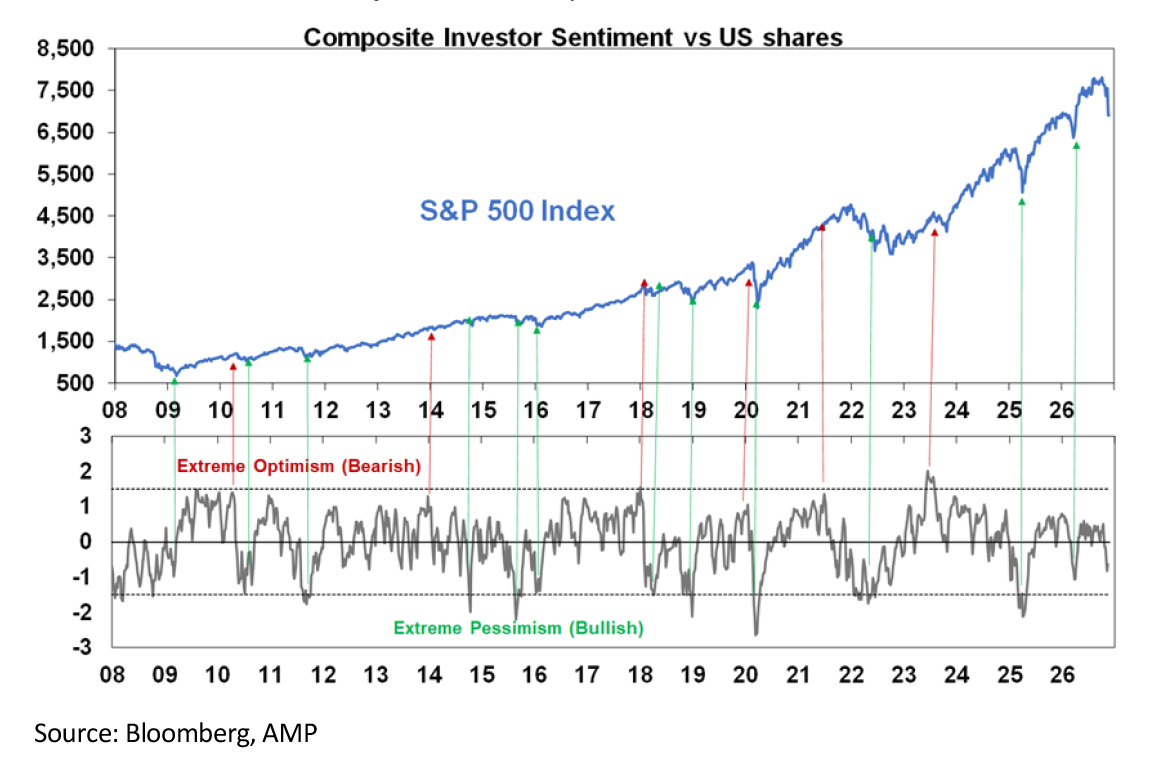
- Investor sentiment in the US is poor and around levels often associated with a bounce in shares, albeit it could still fall further in the short term. But looked at another way we did not really see the sort of investor euphoria prior to the recent falls that is normally associated with major market tops.

- US shares have rallied in the 12 months following all midterm elections since 1950.
- Central banks are unlikely to hike aggressively from here, where its more about fine tuning in contrast to the 2022-23 rate hiking cycle. This includes in the US.
- And in Australia, the RBA has likely finished hiking with rate cuts likely later next year.
- The seasonal pattern for US and Australian shares normally starts to turn positive from around here into year end.
The risk of a bear market may grow next year as we get closer to the peak in data centre investment.
Key things for investors to bear in mind
Sharp share market falls are stressful for investors as no one likes to see their investments fall in value. But try as one may, it’s never easy to accurately predict economies and shares. In each major slump in shares the drivers are slightly different. However, as Mark Twain is said to have said “history doesn’t repeat but it rhymes”, and so it is with share market falls. So, the key is to focus on basic investment principles at a time like this. These things are worth keeping in mind:
- Share market pullbacks are healthy, in that they help limit excessive risk taking, and they are normal. The volatility of share markets is the price we pay for the higher returns they provide over the long term.
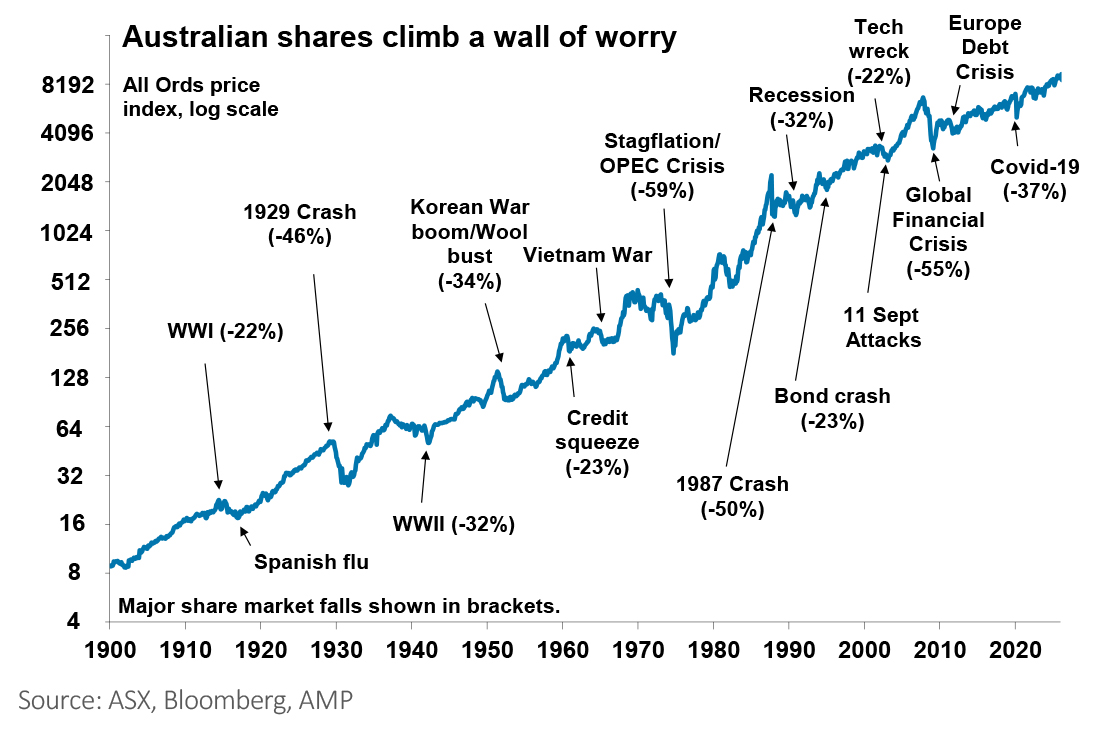

- It’s very hard to time market moves so the key is to stick to an appropriate long-term investment strategy.
- Selling shares after a fall just locks in a loss and many don’t get back in again until shares have recovered above their previous highs.
- Share market pullbacks provide opportunities for investors to buy them more cheaply.
- Shares invariably bottom with maximum bearishness.
- Australian shares still offer an attractive income (or cash) flow, particularly once franking credits are allowed for.
- To avoid getting thrown off a long-term strategy – it’s best to turn down the noise around all the negative news flow.
By Dr Shane Oliver, Head of Investment Strategy and Chief Economist, AMP