

Headline developments of the past week
- The Reserve Bank of Australia surprised many by leaving interest rates on hold, but it made it quite clear that it retains a tightening bias, stating that if the outlook unfolds as it expects then higher interest rates will likely be necessary at some stage to ensure that inflation remains under control. With confidence in the continuation of the global recovery likely to improve in the months ahead and the Australian labour market remaining vey strong, further tightening is likely before year end, most likely in November.
- The continuing slide in the US dollar and strong Australian jobs data propelled the Australian dollar to its highest level in nearly 28 years, taking it just below parity against the $US. The chart below (at left) highlights that up until the early 1980s, the norm for the Australian dollar was above parity against the US dollar. This ended in 1982 when a secular bear market in commodity prices, a bad track record on inflation and years of poor economic performance knocked the $A below parity. But with the terms of trade running around levels last seen in the early 1950s – when one Australian dollar bought $US1.12 – (see chart at right) and Australian interest rates well above US rates and likely to rise even further, a sustained rise above parity is likely.

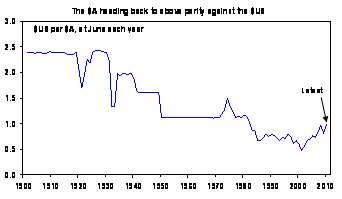
Source: RBA, AMP Capital Investors
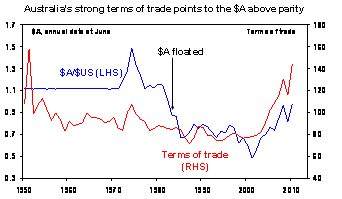
Source: ABS, RBA, AMP Capital Investors
- The surge in the $A will bring winners and losers. Losers are likely to be manufacturers and companies that compete internationally. Mining, energy and agricultural businesses won’t be affected that much as commodity prices have generally risen in line with the strong $A. Winners are Australian consumers, who will see the prices of imported items such as electronic goods, clothes and cars fall in value and offshore holidays get cheaper, and companies with large import bills, such as airlines and retailers. Overall, the strong Australian dollar is likely to be more positive than negative – $A strength has normally gone hand in hand with economic strength, in contrast to the lows of $US0.48 in 2001 and $US0.60 in late 2008. To the extend that the strong $A helps control inflation it will also do some of the RBA’s work for it and so interest rates may not need to rise as much as might otherwise have been the case.
- It’s worth noting that looking at the US dollar alone exaggerates the strength of the $A. A big part of the Australian dollar’s rise reflects a weak US dollar story – it is not nearly as strong against Asian currencies, and so companies with exposures to countries outside the US won’t be as affected. This is evident in the trade weighted index for the Australian dollar this year only rising 5.4% as against the 9.3% rise against the $US.
- While there is talk of an international “currency war”, the fall in the $US versus emerging market currencies is a part of the necessary adjustment towards less reliance on consumption in the US and more reliance on consumption in the emerging world. Fighting against it will only slow this necessary adjustment. While the international currency war will be a hot topic at the weekend IMF/World Bank meetings, we don’t expect any major changes in policy to result.
Major global economic releases and implications
- US economic data was mixed. On the positive side there was unexpected rise in conditions in the non-manufacturing sector ISM, a rise in pending home sales in September, a bigger than expected fall in unemployment claims and another rise in weekly mortgage applications. Against this, payroll employment was worse than expected as a result of worse than expected falls in public employment. Fortunately, private sector employment continued to rise although not quickly enough to bring the unemployment rate down which held at 9.6%. It’s looking increasingly likely that more quantitative easing will be announced by the Fed next month.
- European economic data was a bit better than expected with upwards revision to conditions in the services sector in September, a strong rebound in German factory orders in August and stronger than expected increases in industrial production in the UK and Germany. Euro-zone retail sales were weaker than expected though and UK house prices fell sharply in September. There were no surprises from the European Central Bank and Bank of England which both left interest rates on hold.
- The Bank of Japan announced a further easing in monetary policy taking the cash rate down to a range of 0-0.1%, from 0.1%, but more importantly announcing that it would buy 5 trillion Yen worth of government bonds and private sector securities. The latter clearly signals that Japan is now embarking on another round of quantitative easing, getting in ahead of the Fed presumably to prevent a further rise in the Yen.
Australian economic releases and implications
- Australian economic data provided a somewhat mixed picture with soft readings for imports, retail sales and conditions in the services and construction sectors but another strong rise in employment in September. Of these the labour force report probably dominates: employment and hours worked are both up 3.3% over the last year and this will provide a strong boost to household income growth and hence consumer spending. While momentum in job ads has slowed pointing to some loss of momentum in employment growth going forward it still looks like being solid. And while retail sales growth slowed in August it caps off six months of consecutive gains at an annual rate of 6.5% suggesting that the post stimulus soft patch may be over. All of which points to another interest rate hike remaining likely in the months ahead.
Major market moves
- Shares pushed higher over the last week on some better economic data, a good result from Alcoa kicking off September quarter earnings reports and expectations for more quantitative easing in the US, and news that Japan was already embarking on its own easing. Chinese shares surged after a five day public holiday.
- The anticipation of more Fed buying of US bonds also pushed global bond yields down.
- The $US remained under downwards pressure and this saw the Australian dollar climb higher.
What to watch in the week ahead?
- In the US, data for retail sales is expected to show modest gains in September, inflation data is likely to remain benign and consumer sentiment data will be watched to see if there is any recovery after a week reading for September. The September quarter profits reporting season will also kick off in earnest. Chinese September data for lending and trade will be released.
- In Australia, the NAB business survey for September and consumer confidence data for October will be released. Consumer confidence is likely to have been boosted by good news on the labour market and the RBA’s decision to leave interest rates on hold this month.
Outlook for markets
- While shares are at risk of a near term consolidation or correction, further decent gains are likely into year-end and through 2011. Share markets have been tracing out a rising trend since the lows in early July, which points to a resumption of the cyclical bull market which started in March last year. More fundamentally, shares are very cheap relative to government bonds, they will likely benefit from another round of global monetary reflation and once it becomes clear that the US/global recovery is continuing, albeit slowly, there is likely to be a big reversal of investment flows – out of government bonds and back into shares.
- Notwithstanding the risk of a short term correction, further gains in the value of the $A taking it well above parity against the $US are likely on a six to 12 month horizon as it becomes clear that the global recovery is continuing and commodity prices are remaining strong, the US Federal Reserve embarks on more quantitative easing and Australian interest rates continue to rise well above global rates.
- Double dip and deflation worries are likely to keep bond yields low in the short term, but medium-term returns are likely to be poor, reflecting low yields and excessive public debt levels in many developed countries.
Important note: While every care has been taken in the preparation of this document, AMP Capital Investors Limited (ABN 59 001 777 591) (AFSL 232497) makes no representation or warranty as to the accuracy or completeness of any statement in it including, without limitation, any forecasts. Past performance is not a reliable indicator of future performance. This document has been prepared for the purpose of providing general information, without taking account of any particular investor’s objectives, financial situation or needs. An investor should, before making any investment decisions, consider the appropriateness of the information in this document, and seek professional advice, having regard to the investor’s objectives, financial situation and needs. This document is solely for the use of the party to whom it is provided.