- In the past there have been a host of factors cited by the Reserve Bank to justify lifting interest rates. So what about the most recent lift in rates, what were the factors driving the decision? This time around the answer is clear cut – it was all about inflation fears. Simply, the Reserve Bank doesn’t want to wait until it sees the whites of the eyes of inflation, it wants to act now before it becomes a problem.
- Now clearly that strategy is not without its risks given that the bulk of evidence suggests the economy is soft. Certainly retailers are all saying that consumers are hesitant to spend, loans to build homes have fallen for a record 10 months, and manufacturing, tourism, exporters and import-competing firms are all doing it tough. Add in the fact that home prices are actually quite flat and that inflation is currently very much under control.
- The risk is that the Reserve Bank under-estimates the challenges faced by consumers and businesses and that it flattens the economy with the latest rate hike. Still, setting interest rates is all about weighing up the risks. The Reserve Bank Board always seeks to answer one question – of all the decisions that could be made, what would we regret the least. No doubt the risk of causing sub-standard economic growth was weighed against the risk of falling behind the curve on inflation – and it was the latter which won the day.
- But how real is the risk of higher inflation? The Reserve Bank is worried that the income we are generating from coal, iron ore and other raw material prices will end up boosting spending, and therefore inflation. And clearly commodity prices have been rising. The CRB futures index is up 22 per cent since May. And the spot iron ore price has risen just over 27 per cent since early July.
- But something else has been rising at the same time – the Aussie dollar – and that has been negating the commodity gains and income flows to Australia. The Reserve Bank commodity index in Australian dollar terms is actually at five-month lows and down almost 25 per cent from the highs of two years ago. And spot iron ore prices are up only 10 per cent over the past four months when adjusted for a higher Australian dollar.
- Of course that is why we have a floating exchange rate. If commodity prices soar, potentially boosting incomes, the Australian dollar also should soar and thus crimp the gains. And indeed that is what is happening. The floating exchange rate is working just as it should, dampening certain sections of the economy and crimping inflationary pressures, while at the same time higher commodity prices are pumping up other sectors of the economy.
- No one should downplay the role that the high Australian dollar is playing in dampening the economy. The Aussie dollar is at the highest levels in 28 years. This is clearly no ‘garden variety’ event. Already there are a record number of products that are cheaper now than they were a year ago and the savings for consumers are only just starting to flow through.
The week ahead
- In the coming week there is a good, consistent flow of new economic information. But interestingly there will be nothing of note from the Reserve Bank – a rare week where the central bank doesn’t hog the spotlight. Meanwhile a very quiet week is in prospect in the US.
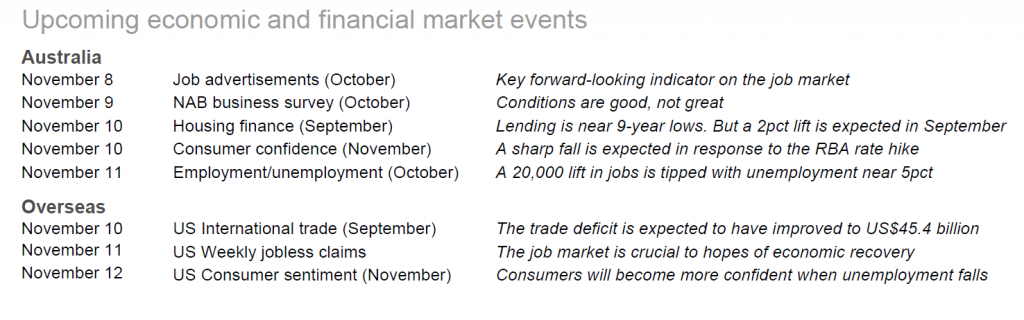
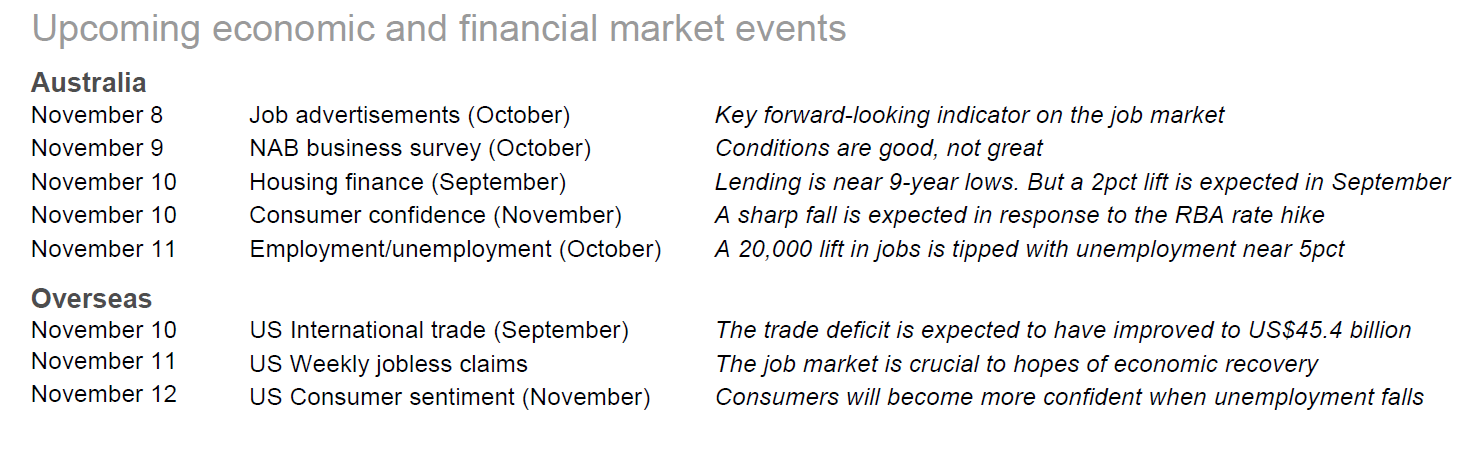
- In Australia, the week kicks off with data on job advertisements on Monday together with the latest tourism data. The job market has been a pillar of strength in recent months but there was a hiccup in September when job ads rose by just 0.7 per cent – the smallest rise in five months. A drop in job ads in October would raise doubts about the Reserve Bank’s anti-inflation strategy. And the data on international arrivals & departures will likely highlight just how tough conditions are in the tourism sector.
- On Tuesday NAB releases its latest business survey. The key indicators of confidence and conditions have been tracking sideways over the past few months, highlighting the mixed fortunes across Corporate Australia. But the survey loses some relevance given that it pre-dates the latest rate hike.
- On Wednesday data on housing finance is released alongside the survey of consumer confidence. While housing finance may have lifted by 2 per cent, the main interest is in lending to build new homes. Construction loans have fallen for a record 10 consecutive months. The outlook for home building is already sombre and the mood will darken further unless new lending starts to lift.
- Consumer confidence should have predictably fallen in November in response to the latest rate hike. The only saving grace is a higher dollar which tends to improve the mood of consumers in capital cities.
- On Thursday the latest job market data is released. Overall we expect that 20,000 new jobs were created – a figure that largely covers new entrants. The unemployment rate will most likely be around 5.0-5.1 per cent, with much depending on how many extra people are joining the search for jobs.
- In the US, the cupboard is largely bare. On Tuesday figures on wholesale inventories are expected, followed by trade and the monthly government budget data on Wednesday. On Thursday the weekly unemployment claims data is released with consumer sentiment slated for Friday.
- Financial markets have lost interest in the trade data, but economists expect a near US$1 billion improvement in the deficit in September to US$45.4 billion. The Federal Budget is tipped to have been in deficit by US$161 billion in October. And consumer sentiment may have lifted from 67.7 to 69.0 in November.
- There are a number of speeches by Federal Reserve officials to watch over the week as well with three slated for Monday and one speech slated for delivery on Thursday.
Sharemarket
- This year began with plenty of optimism. The hope was that the GFC had finally ended, that major economies would continue to repair and sharemarkets would continue to drift higher. Unfortunately this didn’t quite go to plan. Debt problems in Europe upset the apple-cart earlier in the year while the continual sluggishness of the US economy kept investors guessing about the potential for a double-dip recession.
- So after a solid increase of 30.8 per cent in 2009, 2010 has turned out as somewhat of a disappointment for investors. In the year to date, the ASX 200 is down by 1.5 per cent. Still, a good performance over the next eight weeks could still ensure that the market finishes with respectable gains. For a second year small companies have out-performed with the Small Ordinaries up by 4 per cent as opposed to losses of around 4 per cent for the ASX50 and ASX100 indexes.
- So far only seven of the 21 sub-sectors are higher for the year. The star performer has been Autos & components (up 54 per cent) but it is dominated by one stock – Fleetwood Corp. Next best has been Consumer services, Utilities, Food, beverage and tobacco and Food and staples retailing. At the other end of the scale, biggest declines have been in Telecom (down 22 per cent) and Insurance (down 18 per cent).
Interest rates, currencies & commodities
- The Reserve Bank is worried about inflation. More specifically the RBA is worried that the soaring amount of money that we are earning from commodities will lead to higher spending in the economy and thus higher prices. As a result the Reserve Bank has launched a pre-emptive strike against inflation by lifting the cash rate by 25 basis points.
- So how have commodity prices been recently? Well prices have indeed been rising, at least in US dollar terms. In fact the CRB commodity futures index currently stands at 2-year highs, up 22 per cent over the past five months. And while the Reserve Bank measure of US dollar commodity prices has also been rising, it is up by only 10 per cent over the same period. And in Australian dollar terms the RBA measure of commodity prices has actually gone backwards by 2 per cent.
- So where are interest rates likely to go from here? Most economists believe that cash rates will be around 5.50- 5.75 per cent in a year’s time. But interestingly financial markets are more circumspect with the overnight indexed swap rate expected to be at 5.00 per cent in a year from now.
Produced by Commonwealth Research based on information available at the time of publishing. We believe that the information in this report is correct and any opinions, conclusions or recommendations are reasonably held or made as at the time of its compilation, but no warranty is made as to accuracy, reliability or completeness. To the extent permitted by law, neither Commonwealth Bank of Australia ABN 48 123 123 124 nor any of its subsidiaries accept liability to any person for loss or damage arising from the use of this report.
The report has been prepared without taking account of the objectives, financial situation or needs of any particular individual. For this reason, any individual should, before acting on the information in this report, consider the appropriateness of the information, having regard to the individual’s objectives, financial situation and needs and, if necessary, seek appropriate professional advice. In the case of certain securities Commonwealth Bank of Australia is or may be the only market maker.
This report is approved and distributed in Australia by Commonwealth Securities Limited ABN 60 067 254 399 a wholly owned but not guaranteed subsidiary of Commonwealth Bank of Australia. This report is approved and distributed in the UK by Commonwealth Bank of Australia incorporated in Australia with limited liability. Registered in England No. BR250 and regulated in the UK by the Financial Services Authority (FSA). This report does not purport to be a complete statement or summary. For the purpose of the FSA rules, this report and related services are not intended for private customers and are not available to them. Commonwealth Bank of Australia and its subsidiaries have effected or may effect transactions for their own account in any investments or related investments referred to in this report.