Petrol price
- According to the Australian Institute of Petroleum the national average retail pump price rose 0.5 cents a litre last week to 124.3 cents a litre – a three month high.
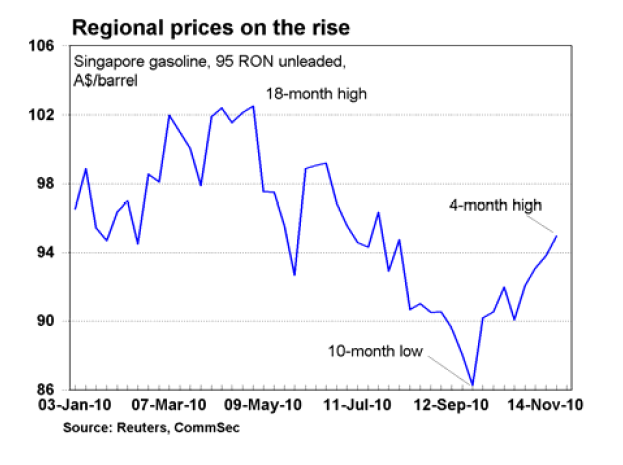
- The recent Aussie dollar weakness has seen the Singapore unleaded price near four month highs, while the wholesale (terminal gate) price has hit three month highs. Over the next fortnight CommSec expects pump prices to breach a $1.25 litre and rise by 2-3 cents a litre.
- Mobile phone shipments (in effect, sales) sales have surged due to seasonality factors. However a more smooth measure of activity would be a comparison of mobile phone shipments with the same period last year, which shows sales are down 6.5 per cent on a year earlier.
What does it all mean?
- Petrol prices have risen for the second straight week, and are now holding at a three-month high. And there is unlikely to be much good news for motorists in the near term, especially given that the regional oil prices have also reached multi-month highs.
- The recent weakness of the Australian dollar has far outpaced the falls in the Singapore unleaded price. And as a result the Singapore unleaded fuel is trading at near four month highs in Australian dollar terms. Already the higher regional petrol price is starting to filter through domestically, with the wholesale (terminal gate) price rising to three month highs in the past week.
- CommSec expects petrol prices to move higher with the national average price breaching a $1.25 a litre in the next fortnight.
- The data on mobile phone sales is one of the timeliest readings on consumer spending. And given that mobile phones are still a ‘must have’ item, if sales are moving, then it provides a pointer to consumer spending trends.
- Mobile phone sales are largely influenced by seasonal factors, and to get a better reading on trends, CommSec has used a smoothed annual measure. In the three months to October, phone sales have fallen by just over 6 per cent compared with the same period a year ago – a result that highlights that despite confidence levels remaining high, consumers are still displaying conservative attitudes when it comes to spending.
- However when closer attention is paid to the single monthly result mobile phone sales are up 13 per cent compared with October of last year. And while the rise is largely due to seasonality factors, the pickup on the same period last year is encouraging. The sustained improvement in labour market conditions, pick up in equity markets, and rising wealth levels should support consumer activity in the midterm.
- What is required in coming months is a period of interest rate stability to allow consumers and businesses to the higher borrowing costs and in time lift spending patterns.

What do the figures show?
Petrol prices:
- According to the Australian Institute of Petroleum, the national average Australian price of unleaded petrol rose by 0.5 cents per litre to 124.3 cents a litre in the week to November 21. The metropolitan price rose by 0.2 c/l to 123.9 c/l, while the regional average price rose by 1.1 c/l to 125.0 c/l.
- Petrol prices across states in the past week were: Sydney (down 0.8 cents to 123.2 c/l), Melbourne (up 0.1 cents to 124.0 c/l), Brisbane (up 1.0 cents to 126.5 c/l), Adelaide (up 1.1 cents to 123.2 c/l), Perth (up 2.6 cents to 122.9 c/l), Darwin (down 0.2 cents to 127.2 c/l), Canberra (down 2.6 cents to 122.2 c/l) and Hobart (down 0.8 cents to 128.0 c/l).
- The national average wholesale (terminal gate) hit an 11-month low of 111.6 cents a litre on October 1. However the terminal gate price has since risen to a three month high of 117.3 cents today. The key Singapore unleaded petrol price rose by US40c (0.4 per cent) to US$93.60 last week. And in Australian dollar terms Singapore gasoline rose by $1.15 (1.2 per cent) over the week to $94.96 a barrel – a near four month high.
Mobile phone shipments:
- Mobile phone shipments: The Australian Mobile Telecommunications Association has reported that 1,077,307 mobile phones were shipped to stores in October (in effect, mobile phone sales), a sharp rise on October sales.
- A more smooth measure of activity would be a comparison of mobile phone shipments with the same period last year. In the three months to October, phone sales have fallen by almost 6.5 per cent on the same period a year earlier.
- After peaking with annual sales of just over 10 million units in the year to May 2008, mobile phone sales have retreated to an annual rate of just under 8.5 million units in October 2010. The annual rate has been averaging close to nine million mobile phone sales since June 2009.
What is the importance of the economic data?
- Weekly figures on petrol prices are compiled by ORIMA Research on behalf of the Australian Institute of Petroleum. National average retail prices are calculated as the weighted average of each State/Territory’s metropolitan and non-metropolitan retail petrol prices, with the weights based on the number of registered petrol vehicles in each of these regions.
- The Australian Mobile Telecommunications Association releases data on mobile phone shipments each month. The figures collected for AMTA by Informark record the number of shipments, rather than sales. While figures on handset shipments don’t fully translate to sales, they are nevertheless a useful proxy. The data on mobile phone shipments is a guide to consumer spending.
What are the implications for interest rates and investors?
- The higher regional oil prices are filtering through to domestic wholesale prices, pump prices are likely to lift in the near term. Motorists are likely to see petrol prices rise by 2-3 cents a litre over the next fortnight
- The recent interest rate hike is likely to keep domestic activity subdued in the near term. Lending finance is stagnating and a period of interest rate stability will be needed to entice consumers and businesses to increase borrowing levels and in turn boost activity.
