Most people tend to regard the national accounts as just an update on economic growth. But the publication is far more comprehensive than that, covering indicators such as inflation, productivity, savings and wage costs. So from a big picture perspective what can we conclude?
Well if we were to sum the economy up in one word it would be ‘patchy’. The economy is growing, but certainly not uniformly. For instance 11 of the 19 industry sectors actually went backwards in the September quarter. And if you stripped out the rural sector, the non-farm economy also went slightly backwards.
Still, we shouldn’t panic. The economy is still expanding, and given the firm result in the June quarter we should have expected some softening in the September quarter. However the soft result is clearly a wake-up call.
All we have been hearing about over the past year is our booming terms of trade (rising export prices and falling import prices). The concern has been that this income boost would filter across the economy boosting wages and prices. Certainly that is a risk, but it is not the full story. As the Reserve Bank has previously suggested, if the income boost is saved, not spent, it is less of a concern. And that is happening. Businesses are cautious about spending and borrowing and cautious Aussie consumers have been saving more.
If you measure the household savings ratio in trend terms, the result for the September quarter is the highest in 23 years. Now if there were signs of this conservatism coming to an end that would be a concern for policymakers. But there is no evidence of slippage. Threats of higher interest rates, rising living costs, media hype about housing affordability, a soggy sharemarket and global concerns are all causing people to squirrel away more of their income.
And while it is important to focus on the effect of the mining boom across the broader economy, it is also important to focus on the broader effects of factors like higher interest rates and the stronger Aussie dollar. These factors also have multiplier effects across the economy and at present they appear to be nullifying the impact of the mining boom.
Certainly one piece of good news in the latest national accounts was the low reading for inflation – the household consumption deflator was only up by 0.3 per cent in the quarter and 2.0 per cent for the year (well below the decade average of 2.5 per cent). Then there were labour costs. In real terms, real unit labour costs were down by 2.2 per cent on a year ago – no wonder employers have been looking to take on staff.
But all the extra people added to the workforce over the last year have been at the cost of weaker productivity. Productivity has lifted just 0.5 per cent over the year. There are more people with jobs but at present it isn’t translating to more output across the economy.
The week ahead
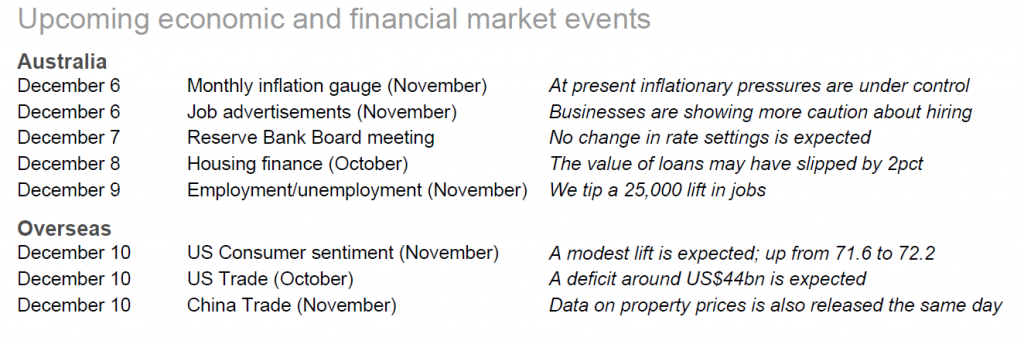
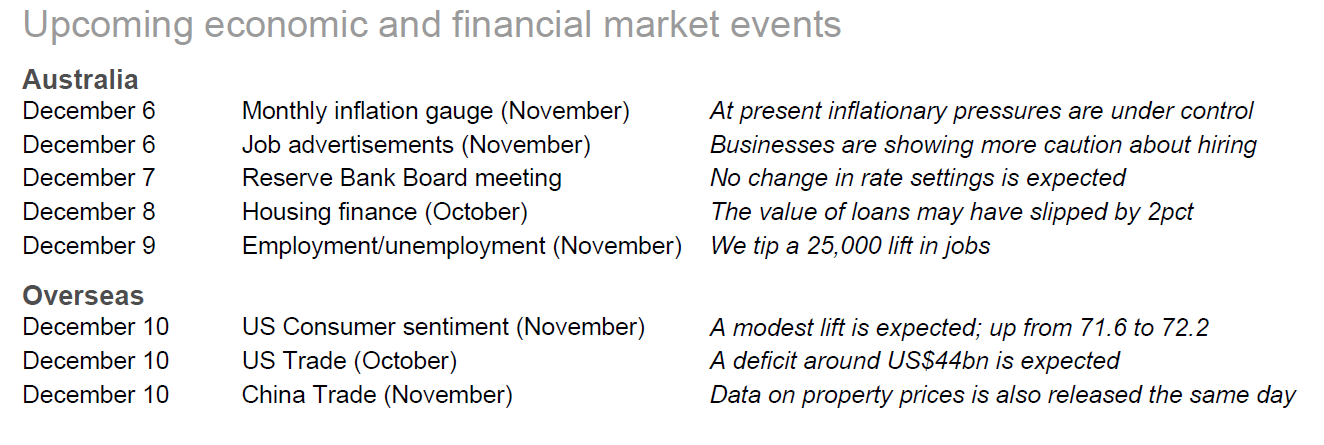
Ordinarily the Reserve Bank Board meeting would be the dominating influence in the coming week. But with rates up in November, inflation under control and the economy losing momentum in the past quarter, clearly now is not the time to be lifting rates further. The Reserve Bank Board meets Tuesday and the final meeting for 2011 should be relatively uneventful.
Still, even with the Reserve Bank firmly camped on the interest rate sidelines there is still a swathe of economic figures to be dissected over the week. On Monday, TD Securities and the Melbourne Institute release the monthly inflation gauge for November while the Performance of Construction index is released and various surveys of job advertisements will be released. Also on Monday the latest data on tourism arrivals and departures is published.
In an underlying sense inflation is well contained, with significant discounting by retailers keeping price pressures in check. And while job ads probably rose in November, recent data suggests that businesses were becoming a little more circumspect about putting on staff.
On Tuesday, estimates of industry productivity are issued – one for the data aficionados.
On Wednesday, housing finance figures for October are released while Reserve Bank Assistant Governor Lowe also delivers a speech. We suspect that new home loans fell again in October – highlighting the softness of the sector – with the value of loans down 2 per cent.
And on Thursday the November employment report is issued. In October the jobless rate surprisingly rose from 5.1 per cent to 5.4 per cent as more people went in search of work. We suspect that the labour force participation rate may have eased modestly from 65.9 per cent to 65.8 per cent in the month. And with employment estimated to have lifted by 25,000, this would cause the jobless rate to return to 5.1 per cent.
In contrast to Australia, economic data will be thin on the ground in the US in the coming week. Consumer credit figures are released on Tuesday with data on wholesale inventories issued on Thursday together with the weekly figures on claims for unemployment insurance. On Friday monthly trade figures are released alongside the monthly budget data and the survey of consumer sentiment.
The trade deficit is expected to be largely unchanged at US$44 billion while consumer sentiment may have improved from 71.6 to 72.2 in December.
Apart from the US data, investors will also be focussed on new Chinese economic indicators to be released on Friday. Trade figures for November are slated for release together with figures on property prices. Also data on money supply and fixed direct investment are slated for release over the period December 10-15.
Sharemarket
We have made no adjustment to our sharemarket forecasts for four months and we remain comfortable with the current view. CommSec expects the All Ordinaries and S&P/ASX 200 indexes to end the year at 4,800, before rising over 2011 to end the year around 5,400 points. It’s worth noting however that when we last adjusted our forecasts, that the All Ordinaries and ASX 200 were much closer together. But currently the All Ordinaries is around 90 points above the ASX 200. The widest gap on record was 129 points on June 3 2008. The All Ordinaries tends to out-perform in a flat to falling market, so the gap with the ASX200 may ease over 2011 should the market lift as we expect.
Interest rates, currencies & commodities
The Reserve Bank is constantly watching so-called “market pricing” to determine what traders and investors are pricing in for the cash rate in coming months. There is no definition about what this “market pricing” is, but the main guides are the overnight indexed swap (OIS) rate and 90 day bank bill futures.
The current 1-year OIS quote is 4.93 per cent, meaning that financial market traders and investors believe that there may be one rate hike over the next twelve months, but they aren’t yet totally convinced. In terms of the bank bill market, the implied yield on December 2011 bills is 5.30 per cent. Given that the current physical 90 day bill rate stands at 5.00 per cent, this again highlights current thinking that there may be just one rate hike over the next year.
Certainly economists have tended to have a more bearish view of where rates will be in 2011 – in other words, they expect a few more rate hikes. The current consensus view is that the cash rate will be around 5.50 per cent in late 2011. Still, this consensus estimate hasn’t been adjusted since the Reserve Bank Governor delivered testimony last Friday as well as the soggy figures on economic growth and retail trade. No doubt the consensus view is more likely to gel now with so called “market pricing.”
The spot iron ore price has posted a stunning rebound over the past 4½ months. In mid July the price hit lows of US$117.50 a tonne. It was a case of two steps forward, one step back, through to mid September with a similar trend through to the current day. Currently the iron ore price stands at a 6½ month high of US$167.80 a tonne and is again within sight of the record high of US$186.50 a tonne posted in late April. Recent data shows that the Chinese economy continues to expand strongly, suggesting further upside in commodity prices.
Produced by Commonwealth Research based on information available at the time of publishing. We believe that the information in this report is correct and any opinions, conclusions or recommendations are reasonably held or made as at the time of its compilation, but no warranty is made as to accuracy, reliability or completeness. To the extent permitted by law, neither Commonwealth Bank of Australia ABN 48 123 123 124 nor any of its subsidiaries accept liability to any person for loss or damage arising from the use of this report.
The report has been prepared without taking account of the objectives, financial situation or needs of any particular individual. For this reason, any individual should, before acting on the information in this report, consider the appropriateness of the information, having regard to the individual’s objectives, financial situation and needs and, if necessary, seek appropriate professional advice. In the case of certain securities Commonwealth Bank of Australia is or may be the only market maker.
This report is approved and distributed in Australia by Commonwealth Securities Limited ABN 60 067 254 399 a wholly owned but not guaranteed subsidiary of Commonwealth Bank of Australia. This report is approved and distributed in the UK by Commonwealth Bank of Australia incorporated in Australia with limited liability. Registered in England No. BR250 and regulated in the UK by the Financial Services Authority (FSA). This report does not purport to be a complete statement or summary. For the purpose of the FSA rules, this report and related services are not intended for private customers and are not available to them.
Commonwealth Bank of Australia and its subsidiaries have effected or may effect transactions for their own account in any investments or related investments referred to in this report.