Labour market statistics
New figures raise questions about how tight the job market really is.
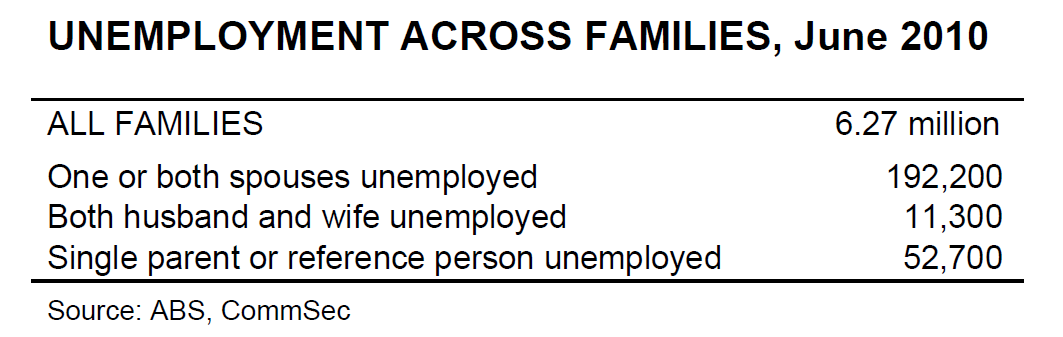
- As at June 2010 there were almost a quarter of a million families (244,900) where one or both spouses were unemployed (3.9 per cent of all families).
- There were over 134,400 families with children under the age of 15 where either the husband or wife were out of work. And there were 64,000 families where neither parent (or lone parent in one-parent families) had a job.
- Around one in six workers in the hospitality sector want to work more hours. Overall, just over 7 per cent of all employed workers want to work more hours.
- Just over one in five of all workers have been with their current employer for less than 12 months.
What does it all mean?
- New data challenges the perception that the job market is super tight, in essence backing up the views of the Reserve Bank. While more people are in jobs than ever before, many aren’t working the number of hours that they would like. And there are still a large number of families where either the husband, wife or sole parent are out of work. One reason that Aussies are not spending like they used to is because many still can’t get jobs or aren’t able to work the number of hours that would enable them to meet everyday living costs.
- While many extol the strong conditions in the job market it is salutatory to note that there are 64,000 families where there is no major breadwinner – that is, neither the husband, wife nor sole parent has a job. Clearly one of the priorities of the Federal Government over the next year should be for all families to have at least one of the parents in the job market.
- Around one in six workers employed by retailers, hotels, cafes and restaurants want to work more hours. The large numbers of workers in admin and support jobs as well as those employed in the arts and recreation sector are also crying out for more work. Contrast this with the mining sector where workers are very satisfied with the hours they are working with few complaints by those working in utilities like electricity, gas and water businesses.
- Around one in five people have been with their current employer for less than a year. When combined with the number of people that are still out of work or want to work more hours it is understandable that consumers are cautious with their spending.
What do the figures show?
Labour market statistics
- As at June 2010 there were 6.27 million “families” in Australia. Of the 5.22 million “couple families” there were 192,200 families where one or the spouses were unemployed. Further there were 11,300 couple families where neither spouse had a job.
- Of the 938,300 single parent families, 50,000 had the parent unemployed. And of the 110,900 “other families”, 2,700 had the family reference person out of work.
- As at November 2010, 7.4 per cent of all workers were underemployed. That is, these employed workers want, and are available for, more hours or work, whether they be in full-time or part-time employment. The underemployment rate stood at 17.2 per cent in Accomodation & food services; 14.1 per cent in Retail trade; and 12.5 per cent in Administrative & support services.
- At the other end of the scale, the unemployment rate stood at 0.4 per cent in Mining; 1.7 per cent in Electricity, Gas, Water and Waste Services; and 2.7 per cent in Financial and Insurance Services.
- Workers in the retail sector are more likely to leave their jobs voluntarily in the search for new positions. In November 2010, 29,200 unemployed workers indicated that they left their last job in the retail sector voluntarily. In contrast only 20,500 of unemployed retail workers say that they were asked to leave their last positions.
- Further 23,100 unemployed workers indicated that they left their last job in the Accommodation & food services retail sector voluntarily while 16,200 say they “lost” their last job.
- By contrast only 400 workers in former workers in Electricity, Gas, Water and Waste Services say they left their last job in the sector voluntarily. And only 1,500 unemployed workers say that they left their last job in the Information media and telecommunications sector voluntarily.
- Most people in jobs expect to be working in 12 months time. Of all workers, 90.8 per cent believe they will still be working but 82.5 per cent of those thatr have been with the same employer for less than a year still expects to be working in a year’s time.
- Interestingly, 20.2 per cent of all workers have been with their current employer for less than a year.
What is the importance of the economic data?
- Australian Labour Market Statistics is a publication released quarterly by the Bureau of Statistics and provides data that enables more detailed analysis of trends in the job market such as labour utilisation.
What are the implications for interest rates and investors? - The latest jobs data throws new light on why people aren’t spending. In essence there are a host of families that are still affected by unemployment, where people have been in jobs for a short time or where people want to work more hours but can’t get the extra work.
- The Federal Government will need to focus on the job market “have-nots” over the coming year. While most believe the job market is in good shape, many families would question that belief.
- Job market confidence will need to improve much more before consumers are more willing to spend freely. Retailers need to be mindful of the true position of the job market.
- The Reserve Bank will be in no rush to lift rates in coming months. The Bank has already questioned just how tight the job market is, but many economists have failed to fully analyse job market data.
