NAB Business Survey; Migration & Tourism
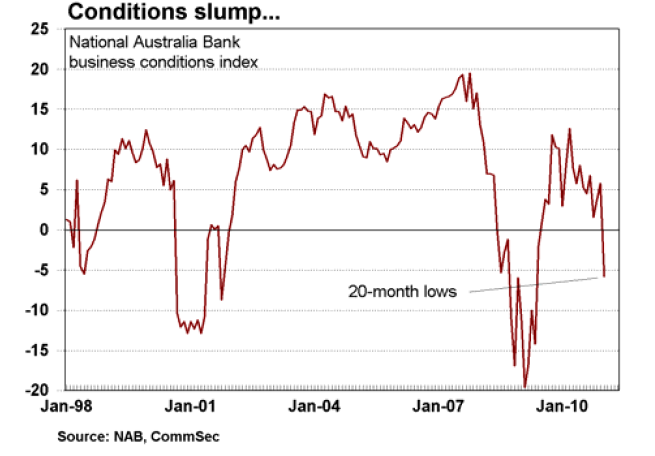
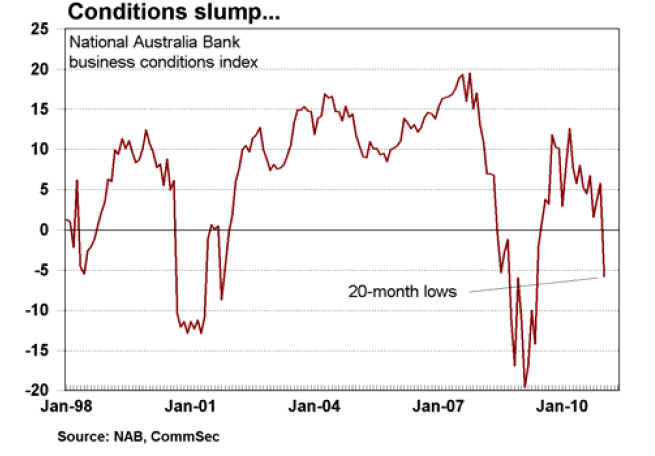
- The NAB business confidence index rose from -2.7 to +4.0 in January. The business conditions index slumped from +5.8 in December to -5.8 in January. Excluding Queensland the confidence reading rose by 2 points to +3.0, while conditions fell by 10 points to -1.0.
- Forward looking sub-indices remained decidedly weak despite modest improvements. Profits fell sharply, employment recorded a modest fall and the pace of contraction in new orders increased.
- Migration slumps to 34-year low. Net migation (permanent and long-term arrivals less departures) slumped to just 1,650 people in December – the lowest monthly result since June 1976.
What does it all mean?
- The latest NAB business survey reinforces the view that corporate Australia is remaining on the sidelines. The weakness in consumer spending, a slowdown in housing construction, and the multiple interest rate hikes of last year have all taken their toll on business confidence and conditions. Added to this, the devastating floods have robbed businesses of much needed optimism at a time of sluggish activity. In fact business conditions have now fallen to the weakest levels in just shy of two years.
- It’s important to highlight that the survey was conducted from 22 January – 2 February, effectively just under a fortnight after the December survey. And the resulting slide between the two results clearly highlights just how much of a devastating impact the floods have had on business conditions.
- More concerning is the added weakness in forward looking indicators. Business owners continue to trim future orders, while profitability has slumped to the weakest levels in 22 months. Given that retailers are aggressively discounting, borrowing costs are rising, and the higher Aussie dollar is curbing manufacturing exports, it is likely that activity will remain subdued in the near term. The negative momentum is clearly worrying, meaning that the Reserve Bank could face an extended stay on the interest rate sidelines.
- It is not all bad news, especially given that rates are likely to remain on hold over the next couple of months. And once businesses and consumers focus on the rebuilding phase following the floods and cyclone, growth and activity should rebound quite dramatically – as the Reserve Bank pointed out in the Monetary Policy Statement released last week.
- Simply, it doesn’t make sense. The job market is super-tight and employers are crying out for skilled workers. But net migration in December was the lowest in over 34 years. Clearly migration intake targets will needed to be lifted markedly over 2011 if we want to complete all necessary projects – both the rebuilding and repair work in Queensland and Victoria as well as the raft of mining and energy projects. To meet the demand for workers, the government will clearly need to look overseas or risk forcing wages and prices up.

What do the figures show?
National Australia Bank Business Survey:
- The National Australia Bank business confidence index rose from -2.7 to +4.0 in January.
- The business conditions index fell from +5.8 to -5.8 in January.
- Excluding Queensland the confidence reading rose by 2 points to +3.0, while conditions fell by 10 points to -1.0.
- The index of trading conditions deteriorated, down from +8.7 to –7.0; profitability recorded a sharp fall from +2.6 to -10.0; employment fell from +5.1 to +0; and forward orders remained weak sliding from -2.6 to -4.8.
- The monthly reading of labour costs rose modestly from 0.8 per cent to 0.9 per cent in January. NAB noted that annual growth of labour costs stands at 3.8 per cent.
- Inflationary pressures are well contained. Retail prices were flat in January after rising at a 0.2 per cent quarterly rate in December. Purchase costs jumped by a 0.8 per cent quarterly rate, however the annual rate of increase edged lower from 2.0 per cent to 1.9 per cent.
- Capacity utilisation eased from 82.3 per cent to 80.5 per cent in January – below the decade average of 81.6 per cent and the weakest reading since September 2009.
Overseas arrivals/departures
- Net permanent and long-term arrivals to Australia fell to 205,900 people in calendar 2010, down 32.2 per cent or 97,730 people on a year ago. Departures from Australia rose by 38,520 while arrivals plunged by 59,210.
- The net number of permanent settlers entering Australia (arrivals less departures) stood at just 1,650 in December – the lowest monthly result in over 34 years.
- Tourist departures rose by 0.2 per cent in December to 603,800 after rising by 0.8 per cent in November. It was the third rise in departures in four months. Departures are up 10.4 per cent on a year ago.
- Tourist arrivals rose by 0.3 per cent in seasonally adjusted terms in December to 505,800 after lifting by 1.1 per cent in November. It was the fourth rise in arrivals in five months. Arrivals are up 4.2 per cent on a year ago.
- In seasonally adjusted the tourism deficit – the gap between departures and arrivals – stood at 98,000 in December, unchanged on November and below the record (34-year history) deficit of 125,900 in June.
- In trend terms, tourism arrivals have risen for the past eight months. Tourism departures fell 0.2 per cent in trend terms in December.
What is the importance of the economic data?
- The monthly National Australia Bank business survey is valuable in providing a timely reading on the health of Corporate Australia. Key indicators of business conditions such as orders, employment, profitability and capacity use are covered together with a gauge on confidence levels.
- The Australian Bureau of Statistics releases data on overseas arrivals and departures is produced monthly and is an indicator of the health of the tourism sector.
What are the implications for interest rates and investors?
- Looking forward, business confidence and conditions should improve to a modest degree as long as the Reserve Bank remains on the interest rate sidelines.
- The continued easing in migrant numbers must be addressed by Government or it will risk a lift in inflationary pressures. But the increase in short-term tourism arrivals is certainly encouraging when you
consider the heady levels of the Aussie dollar
Produced by Commonwealth Research based on information available at the time of publishing. We believe that the information in this report is correct and any opinions, conclusions or recommendations are reasonably held or made as at the time of its compilation, but no warranty is made as to accuracy, reliability or completeness. To the extent permitted by law, neither Commonwealth Bank of Australia ABN 48 123 123 124 nor any of its subsidiaries accept liability to any person for loss or damage arising from the use of this report.
The report has been prepared without taking account of the objectives, financial situation or needs of any particular individual. For this reason, any individual should, before acting on the information in this report, consider the appropriateness of the information, having regard to the individual’s objectives, financial situation and needs and, if necessary, seek appropriate professional advice. In the case of certain securities Commonwealth Bank of Australia is or may be the only market maker.
This report is approved and distributed in Australia by Commonwealth Securities Limited ABN 60 067 254 399 a wholly owned but not guaranteed subsidiary of Commonwealth Bank of Australia. This report is approved and distributed in the UK by Commonwealth Bank of Australia incorporated in Australia with limited liability. Registered in England No. BR250 and regulated in the UK by the Financial Services Authority (FSA). This report does not purport to be a complete statement or summary. For the purpose of the FSA rules, this report and related services are not intended for private customers and are not available to them.
Commonwealth Bank of Australia and its subsidiaries have effected or may effect transactions for their own account in any investments or related investments referred to in this report.