Labour force
- Employment rose by 24,000 people in January, slightly above forecasts centred on gains of around 15,000 (range from -11,000 to +35,000 jobs). The December result was revised lower to show growth of 1,800 people (previously +2,300). Full-time employment fell by 8,000 in January (December jobs were up by 200) and part-time jobs rose by 32,000 (December jobs rose by 1,600).
- The unemployment rate was unchanged at 5.0 per cent. The participation rate rose from 65.8 per cent to 65.9 per cent. The working age population rose by 19,000.
- Average hours worked fell by 0.8 per cent in December but rose by 2.6 per cent over the year.
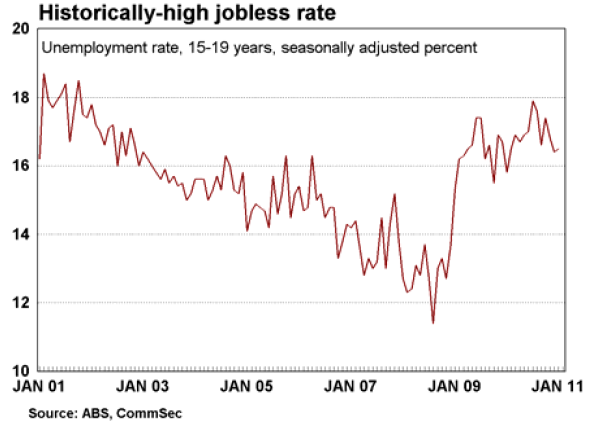
- While the overall jobless rate is hovering near 5.0 per cent, the youth jobless rate is stuck above 16 per cent and showing no signs of improvement. In fact employment for the 15-19yrs age group fell by 100 over the past year.
- Employment rose most in Victoria (up 17,800) followed by Western Australia (up 3,200), Tasmania (up 600), ACT (up 500), NSW (up 100). Employment fell 5,100 in Queensland followed by South Australia (down 400) and Northern Territory (down 300).
What does it all mean?
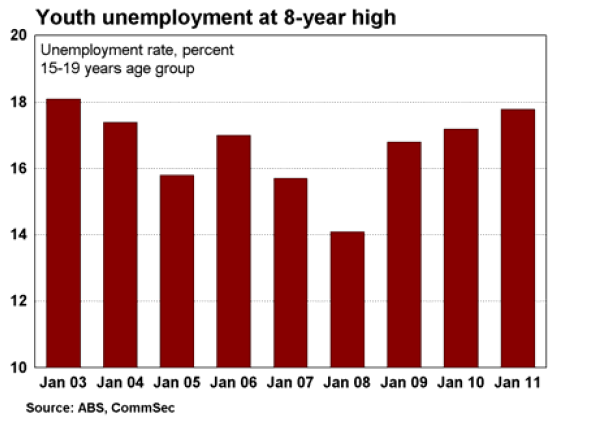
- While the overall performance of the job market has been solid over the past year, the question is whether we are failing our young people. The jobless rate for the 15-19 year age group stood at 17.8 per cent in original terms in January – the highest January reading in eight years. Even for the wider grouping of 15-24 years, the jobless rate was 12.8 per cent in January – the highest January reading in seven years.
- While the seasonally adjusted measure of the youth jobless rate has eased from a high of 17.9 per cent, it appears stuck above 16 per cent and showing no sign of falling in line with the economy-wide unemployment measure
- The Government needs to ensure that our younger workers aren’t being left behind, otherwise that will set up problems in the future. Around one in seven young people are unemployed. If they young unemployed are unsuited for higher education, then every attempt needs to be made to provide them with workplace or vocational training to ensure they can meaningfully contribute to economy over time.

- It’s clear that the job market is as variable as the weather. And of course the weather also had a significant influence on the January jobs figures as well. But reading between the lines it is clear that the soft readings on economic activity are now being reflected in the job market figures. Businesses seem to prefer part-time workers to full-time staff while also cutting back the number of hours of their existing employees. Overall the job market is in reasonable shape, but it is now going sideways. Certainly today’s result accords with the views of the Reserve Bank that the job market isn’t overly tight at present.
- The top line employment result suggests employment remains robust. But delve a little deeper and the latest employment figures loses some of its lustre. Full time employment tracked backwards, after a sedate reading in the prior month. And full-time hours worked slumped by 0.7 per cent. The results are consistent with CommSec’s view that the economy is softer than many believe.
- The economy has softened in the last couple of months. Manufacturing, construction and the services sector are all contracting, while businesses are trimming new orders and profitability is being affected – given the lack of activity. No doubt the softer economy is ensuring that businesses remain cautious and the gains in part time employment adds further weight to that picture. Overall it is unlikely that the Reserve Bank will be pursuing further interest rate rises anytime soon. CommSec expects the next rate hike to be towards midyear.
- The Reserve Bank is also anticipating a softening of conditions in the labour market going forward – in line with the weak growth forecasts for the first half of 2011. In fact the Reserve Bank expects the unemployment rate to only slide by 0.5 per cent over the coming two years. No doubt in the longer term an improvement in productivity is what is needed to ensure that these forecasts are met.
- Even the slide in the growth rate of the working age population is concerning. The working age population grew by 1.93 per cent over the past year – the smallest gain in 45 months. No doubt the fall in migration is a key factor. However more importantly the lower growth rate means that the employment hurdle rate will fall – i.e. fewer jobs have to be created on a monthly basis to ensure the unemployment rate continues to fall.
- It is important to highlight that the data is backward looking, capturing how the economy was tracking around 4-5 months ago. The more forward looking indicators like the job ads series suggest that while employment growth will remain a feature it is likely to be a less robust in the near term.
- There are always plenty of quirks in the data and one of the more notable was the sharp jump in Tasmanian unemployment from 5.1 per cent to 6.4 per cent despite employment rising by 600 workers. Hard to blame the Queensland floods for that.
- The ABS noted: “Due to flooding in Queensland, operational difficulties were experienced in conducting the Labour Force Survey in January 2011. Due to the sample loss noted above, there will be increased volatility in the Queensland estimates, particularly in the original and seasonally adjusted estimates. Given increased volatility, the ABS continues to encourage users to focus on trend estimates in monitoring the underlying level of series.”
What do the figures show?
Labour force
- Employment rose for the eleventh straight month in January, lifting by 24,000 workers. Full-time employment fell by 8,000 after rising by 200 in December. Part-time employment rose by 32,000 after rising by 1,600 in December.
- The annual employment growth rate eased from 3.3 per cent to 3.2 per cent.
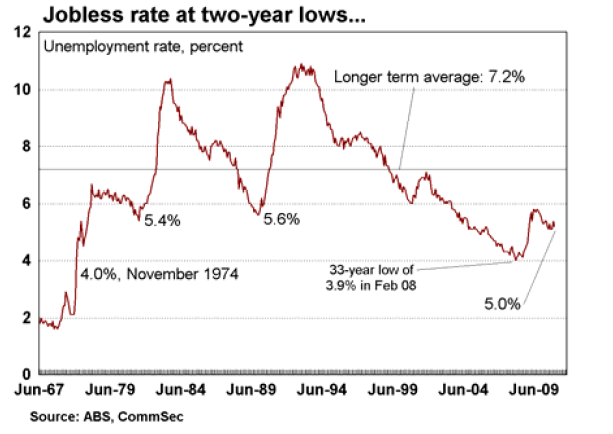
- The unemployment rate remained steady at 5.0 per cent. The participation rate rose from 65.8 per cent to 65.9 per cent.
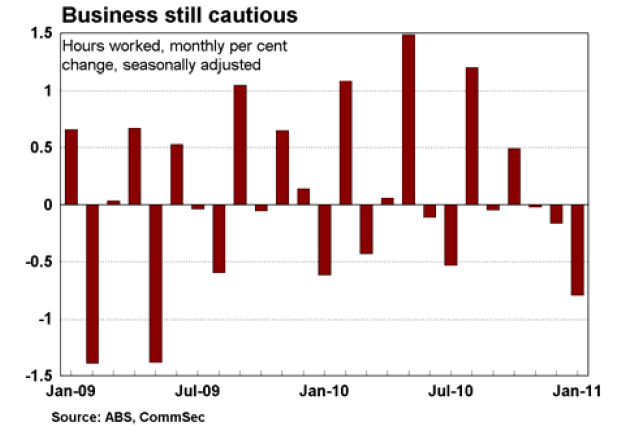
- Average hours worked fell by 0.8 per cent in January but rose by 2.6 per cent over the year.
- Victoria (up 17,800) led the job gains in January, followed by Western Australia (up 3,200), Tasmania (up 600), ACT (up 500), NSW (up 100). Employment fell 5,100 in Queensland followed by South Australia (down 400) and Northern Territory (down 300).
- Across the states and territories unemployment rates in January were: NSW 4.9 per cent (4.6 per cent in December); Victoria 5.1 per cent (4.9 per cent); Queensland 5.6 per cent (6.0 per cent); South Australia 5.3 per cent (5.6 per cent); Western Australia 4.6 per cent (4.4 per cent); Tasmania 6.4 per cent (5.1 per cent); Northern Territory 2.3 per cent (2.4 per cent); ACT 3.4 per cent (3.3 per cent).
- The working age population rose by 19,000 in January after lifting by 19,700 in December. The working age population grew by 1.93 per cent over the past year – the smallest gain in 45 months.
What is the importance of the economic data?
- The Labour Force estimates are derived from a monthly survey conducted by the Bureau of Statistics. The population survey is based on a multi-stage area sample of private dwellings (currently about 22,800 houses, flats, etc.) and a sample of non-private dwellings (hotels, motels, etc.). The survey covers about 0.24 per cent of the population of Australia and includes all people over 15 years of age, except defence personnel.
- If more people are employed, then there is greater spending power in the economy. But at the same time companies may adjust the work hours of employees. If employees work less hours, and therefore get paid less, then spending power in the economy is reduced.
What are the implications for interest rates and investors?
- CommSec expects the jobless rate to ease to around 4.5 per cent over the coming year. But if the Federal Government was to provide a much needed boost to labour supply by lifting the migrant intake and easing work visa restrictions, the job market may not need to tighten as much as expected.
- The Federal Government now needs to give consideration to increasing labour supply (migration) to prevent inflationary pressures from emerging. Looking forward, productivity and migration need to lift to prevent inflationary pressures from developing
- We don’t expect the Reserve Bank to touch official interest rates until at least May 2011.
- It is understandable that employment growth is likely to moderate over the next couple of months. The rapid fire rate hikes and sluggish consumer activity is starting to show cracks in the labour market data. Overall the lack of consumer spending, a consolidating housing market, coupled with sectors like manufacturing, services and construction going backwards will keep businesses on the sidelines.
- We expect the job market to remain relatively healthy particularly in the second half of the year. However the job market may trend sideways for the next couple of months. Our equity media analysts maintain their hold rating on SEEK Limited.

Produced by Commonwealth Research based on information available at the time of publishing. We believe that the information in this report is correct and any opinions, conclusions or recommendations are reasonably held or made as at the time of its compilation, but no warranty is made as to accuracy, reliability or completeness. To the extent permitted by law, neither Commonwealth Bank of Australia ABN 48 123 123 124 nor any of its subsidiaries accept liability to any person for loss or damage arising from the use of this report.
The report has been prepared without taking account of the objectives, financial situation or needs of any particular individual. For this reason, any individual should, before acting on the information in this report, consider the appropriateness of the information, having regard to the individual’s objectives, financial situation and needs and, if necessary, seek appropriate professional advice. In the case of certain securities Commonwealth Bank of Australia is or may be the only market maker.
This report is approved and distributed in Australia by Commonwealth Securities Limited ABN 60 067 254 399 a wholly owned but not guaranteed subsidiary of Commonwealth Bank of Australia. This report is approved and distributed in the UK by Commonwealth Bank of Australia incorporated in Australia with limited liability. Registered in England No. BR250 and regulated in the UK by the Financial Services Authority (FSA). This report does not purport to be a complete statement or summary. For the purpose of the FSA rules, this report and related services are not intended for private customers and are not available to them.
Commonwealth Bank of Australia and its subsidiaries have effected or may effect transactions for their own account in any investments or related investments referred to in this report.