Economic Perspectives
- The GDP (economic growth) figures were released last week. And the question we are getting asked most is what is the story with inventories – that is, unsold goods. Inventories provided the biggest contribution to economic growth in the December quarter. But strangely the inventories to sales ratio fell.
- Inventories are goods sitting on shelves, work in progress or stockpiles of raw materials like coal and wheat. If they are rising, it may point to softer production or imports ahead. In this note we provide a view on the apparent inventories puzzle. And it all appears due to prices – especially lower import prices.
Inventories – the true story
- Most people probably wonder what all the fuss is about – inventories (stocks) hardly seem a big story. But if we import or produce goods and they don’t get sold, then some adjustment may need to occur. If we import too much, it may actually be positive – we can cut future imports. However if we produce too much, that is a different story. That may lead our businesses to trim production because we have enough goods sitting on shelves.
- In the December quarter, inventories seemingly accounted for all economic growth – inventories contributed 0.8 percentage points to growth and overall economic growth was 0.7 per cent. But, strangely, when you compare the level of inventories to overall sales, the ratio actually fell to a record low. That is, it doesn’t seem as though we have too many inventories after all.
- Well it seems that part of the answer is contained in prices. It seems that we brought in more of cheaper imported goods. But if those goods haven’t been sold as yet, that can produce some inconsistencies or quirks in the data. (The Bureau of Statistics notes that “For national accounting purposes, the physical change in inventories during a period should be valued at the prices prevailing at the time that inventory changes actually occur.” The problem is that many businesses use historical cost accounting methods so the ABS has to calculate an Inventory Valuation Adjustment (IVA) to calculate true changes in volumes and values.)
- We use the word ‘seems’ because no one can ever know the full story with inventories. Did companies import a lot more goods and then didn’t sell them as hoped? Or did they import the goods because the deals were good and they wanted to stock up on the expectation of stronger sales ahead. Still, whatever the case, companies need to sell the goods in question eventually.
So what do the figures show?
- The accompanying tables give a detailed picture of what really happened to inventories in the December quarter.
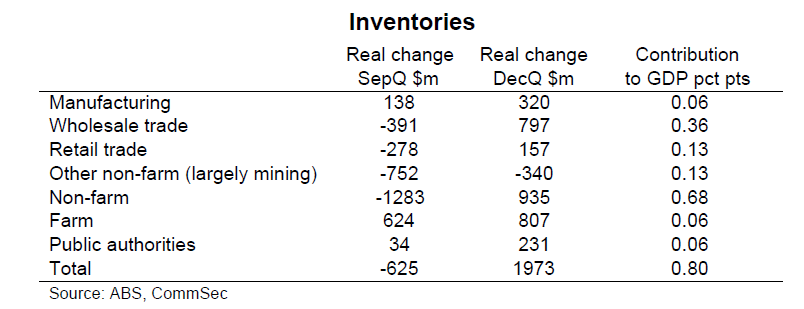
- The sector that provided the biggest contribution to GDP in terms of the change in inventories was wholesale trade (adding 0.36 percentage points). Retail trade and “other non-farm” (mainly mining) provided 0.13pp, with manufacturing, farm and public authorities all adding 0.06pp.
- So the greatest change came from wholesale trade. These are firms that purchase goods (generally in bulk) for the purpose of on-selling (and generally to retailers). Now wholesalers may import the goods or buy in bulk from domestic manufacturers for on-selling.
- The next interesting point is to compare the real (inflation-adjusted) change in inventories to that in current prices. The biggest difference is wholesale trade. In real terms inventories rose by $797 million; in current price terms, inventories rose by only $381 million. Farm inventories also rose by $807 million in real terms and by $1297 million in current prices.
- Clearly farm prices are rising sharply – accounting for the higher figure in current prices. But the wholesale trade sector appears to have stocked up with cheaper goods, thus the lower build-up of stocks in current price terms compared to real terms.

- In real terms, non-farm inventories rose by $935 million; in current price terms the book value of stocks actually fell by $640 million. Now sales in current prices rose by $505 million – all of which was domestic sales. So the overall inventories to sales ratio (comparing goods in current price terms) actually eased from 0.673 to 0.668.
- If prices of imported goods are falling and cheaper imported goods are flooding in to the country, the lower prices are reflected in the book-value value of inventories. Domestic sales will end up reflecting the cheaper goods in future months.
- A reasonable conclusion is that wholesale trade sector stocked up with cheaper goods that haven’t been sold as yet. Businesses and consumers will hope they will be able to buy these cheaper goods in coming months.
Implications for investors
- The puzzle seems to have been solved – wholesalers bought cheaper imports and these haven’t been sold as yet. As we stress, no one knows the full story, but across all sectors stocks (inventories) provided a boost to economic growth.
- Inventories don’t appear excessive in relation to sales and it doesn’t appear that production needs to be wound back – but perhaps import growth will soften. Still, it’s hard to see inventories boosting GDP in the March quarter.
- Will wholesalers pass on the savings of a stronger dollar and lower technology prices to retailers? And then will retailers pass these savings on to consumers? Certainly businesses and consumers are price conscious and are driving hard for bargains.
- The bottom line is that deflation is still a key issue for the business community, especially retailers. Pressure on margins and profitability will continue. But lower retail prices are positive for consumers and inflation, potentially keeping interest rates lower for longer.

Produced by Commonwealth Research based on information available at the time of publishing. We believe that the information in this report is correct and any opinions, conclusions or recommendations are reasonably held or made as at the time of its compilation, but no warranty is made as to accuracy, reliability or completeness. To the extent permitted by law, neither Commonwealth Bank of Australia ABN 48 123 123 124 nor any of its subsidiaries accept liability to any person for loss or damage arising from the use of this report.
The report has been prepared without taking account of the objectives, financial situation or needs of any particular individual. For this reason, any individual should, before acting on the information in this report, consider the appropriateness of the information, having regard to the individual’s objectives, financial situation and needs and, if necessary, seek appropriate professional advice. In the case of certain securities Commonwealth Bank of Australia is or may be the only market maker.
This report is approved and distributed in Australia by Commonwealth Securities Limited ABN 60 067 254 399 a wholly owned but not guaranteed subsidiary of Commonwealth Bank of Australia. This report is approved and distributed in the UK by Commonwealth Bank of Australia incorporated in Australia with limited liability. Registered in England No. BR250 and regulated in the UK by the Financial Services Authority (FSA). This report does not purport to be a complete statement or summary. For the purpose of the FSA rules, this report and related services are not intended for private customers and are not available to them.
Commonwealth Bank of Australia and its subsidiaries have effected or may effect transactions for their own account in any investments or related investments referred to in this report.