Retail trade; International trade
- Retail spending grew by 1.1 per cent in April after falling by 0.3 per cent in March. The lift in sales was driven by increased spending at sporting good outlets, footwear and department stores.
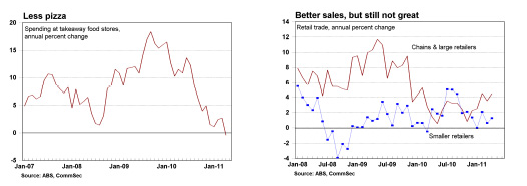
- Spending fell most at newsagents, book stores and take-away food outlets. Spending at takeaway food stores has now fallen for five straight months.
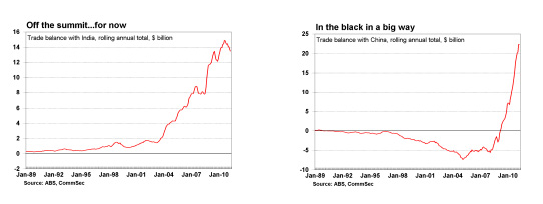
- Australia’s trade surplus narrowed by $94 million to $1597 million in April. Exports rose 0.5 per cent with imports up 1.0 per cent.
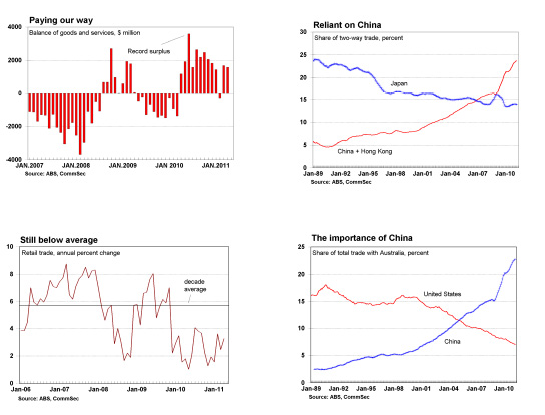
- China accounts for 26 percent of Australia’s exports, 19 per cent of our imports and a record 22.7 per cent of two-way trade. Australia’s reliance on China is now on par with our reliance on Japan in the late 1980s.
- Australia’s trade surplus with China eased slightly to $22.25 billion over the year to April while the surplus with India also eased modestly to $13.5 billion.
What does it all mean?
- At face value Aussie consumers seem to be getting their mojos back. But retailers would be wary of celebrating too early. While sales rose in April, they were down in March and spending has followed this saw-tooth pattern over 2011. Also the timing of Easter also causes difficulty in analysing retail spending data. If you put March and April together, the average monthly gain is 0.4 per cent which is good, but not great.
- It’s also interesting that Victorian consumers are seemingly spending like there’s no tomorrow, but consumers in other states are far more cautious. Spending actually fell in three states/territories but sales were up strongly inVictoria & Queensland.
- Looking at the break-up of sales, it appears that Aussie consumers have gone on a health kick. Sales of sporting goods were strong in April and spending at take-away food stores fell for the fifth straight month. For the first time in four years spending at take-away food outlets is lower than a year ago.
- With the effect of the floods and cyclone dissipating, Australia is again paying its way in the world. We should get used to monthly trade surpluses around $1.5 billion a month, and for that we can thank China and India. Over the past year Australia chalked up trade surpluses of around $36 billion with China and India or around 3 per cent of our GDP.

- There’s various ways to show the two-speed economy, but one way is to look at the composition of our imports. Imports of consumption goods have fallen in four of the past five months and are down almost 6 per cent over the year. In contrast, imports of capital goods like machinery are up 14 per cent over the year.
- Australia is now as reliant on China as it was on Japan in the late 1980s. And it is still early days. While we will ride China’s successes in coming years we are also vulnerable to its stumbles.
What do the figures show?
Retail trade:
- Retail trade rose by 1.1 per cent in April after falling by 0.3 per cent in Match. Non-food retailing rose by 1.2 percent in April after falling by 0.4 per cent in March. Over the past year retail trade lifted by just 3.3 per cent – in line with the rate of inflation.
- Sales by chain stores and other large retailers rose by 0.7 per cent in seasonally terms in April after a 0.2 per cent increase in March. And sales at smaller retailers rose by 1.9 per cent in April after a 1.2 per cent fall in March. In annual terms sales at chain stores were up 4.4 per cent on a year ago but sales at smaller retailers were up just 1.3 per cent.
- During April, sales increased most at “Other recreational good stores” – Sporting goods, video games and toys(up 7.3 per cent), followed by Footwear & jewellery (up 4.5 per cent) and Department stores (up 3.6 per cent).
- Spending fell most at Newsagents and book stores (down 4.8 per cent) and Take-away food outlets (down 1.2per cent).
- Across the states sales lifted most in Victoria (up 2.8 per cent), followed by Queensland (up 1.8 per cent),Western Australia (up 0.6 per cent), Tasmania (up 0.5 per cent) and NSW (up 0.1 per cent). Sales fell in theNorthern Territory (down 0.8 per cent), ACT (down 0.6 per cent) and South Australia (down 0.4 per cent).
International trade:
- Australia’s trade surplus narrowed by $94 million to $1597 million in April.
- Exports of goods and services rose by 0.5 per cent while imports of goods and services rose by 1.0 per cent. Exports are up 8.2 per cent on a year ago while imports are up 7.2 per cent.
- Rural exports rose by 5.5 per cent in April while non-rural exports rose by 1.1 per cent.
- Within non-rural exports, metal ores and minerals rose by 3.8 per cent and coal exports rose by 1.4 per cent but most other categories were weaker. Non-monetary gold exports slumped by $264 million or 19.5 per cent to$1,088 million in April. Within rural exports, cereals rose by 10.9 per cent with wool up 5.9 per cent.
- Within imports, consumer imports fell by 3.1 per cent in April – the biggest fall in 20 months and the fourth fall in five months. Capital goods imports soared by 12.2 per cent while intermediate goods imports fell by 1.4 per cent.
- Consumer goods imports are down 5.6 per cent on a year ago but capital goods are up 14.1 per cent and intermediate goods are up by 17 per cent.
What is the importance of the economic data?
- The monthly International Trade in Goods and Services release from the Bureau of Statistics provides estimates on exports and imports of physical goods (such as coal, beef and computers) and services (such as travel receipts). The balance of goods and services (BOGS) is a narrower description of Australia’s external position than the current account estimates. The import data is a useful gauge of consumer and business spending while exports reflect global demand as well as domestic influences such as drought.

- The Bureau of Statistics’ Retail trade publication contains the most current readings on the performance of consumer spending. The ABS surveys 500 ‘larger businesses’ and 2,750 ‘smaller businesses’. Retail trade covers spending at a broad range of retail outlets but excludes both petrol and motor vehicle sales. A weak retail trade result may point to a slowing economy as well weighing on the share prices of listed retail stocks. But retail trade estimates can’t be assessed in isolation – it is important to look at the influences determining future trends in consumer spending, such as income, employment and confidence levels.
What are the implications for interest rates and investors?
- Consumer spending appears to picking up modestly, but the growth rate remains a long way below normal. It is also uncertain how much discounting is being applied to achieve the better sales outcomes.
- Department stores have just begun their end of financial year sales. A lot is riding on the outcomes. If cooler,wetter weather continues, demand for seasonal items should get a nice lift. But it still requires significant discounting to get the goods out of the stores.
- Today’s data doesn’t change our view. Retail spending is well below “normal”, home prices are falling and manufacturing, construction and tourism are weak. We believe that the Reserve Bank should stay on the sidelines until it has a clearer read of the economy.

Produced by Commonwealth Research based on information available at the time of publishing. We believe that the information in this report is correct andany opinions, conclusions or recommendations are reasonably held or made as at the time of its compilation, but no warranty is made as to accuracy, reliability orcompleteness. To the extent permitted by law, neither Commonwealth Bank of Australia ABN 48 123 123 124 nor any of its subsidiaries accept liability to any person forloss or damage arising from the use of this report.The report has been prepared without taking account of the objectives, financial situation or needs of any particular individual. For this reason, any individual should,before acting on the information in this report, consider the appropriateness of the information, having regard to the individual’s objectives, financial situation and needsand, if necessary, seek appropriate professional advice. In the case of certain securities Commonwealth Bank of Australia is or may be the only market maker.This report is approved and distributed in Australia by Commonwealth Securities Limited ABN 60 067 254 399 a wholly owned but not guaranteed subsidiary ofCommonwealth Bank of Australia. This report is approved and distributed in the UK by Commonwealth Bank of Australia incorporated in Australia with limited liability.Registered in England No. BR250 and regulated in the UK by the Financial Services Authority (FSA). This report does not purport to be a complete statement orsummary. For the purpose of the FSA rules, this report and related services are not intended for private customers and are not available to them.Commonwealth Bank of Australia and its subsidiaries have effected or may effect transactions for their own account in any investments or related investments referred toin this report.