Outside of the troubled countries in Europe, government bond yields in developed countries have fallen to generational and in some cases record lows. Reflecting the capital gains that are generated when bond yields fall, returns from bonds have been very strong.
Over the last year global bonds returned 11.1% and Australian bonds returned 11.4%. Over the last two years they have returned 10% per annum and 8.7% pa respectively. With such strong returns it is worth asking whether they are in a bubble. Our answer is no, but they could certainly be considered poor value and there are much better return opportunities elsewhere.
Generational lows
Despite seeing their sovereign rating downgraded from AAA last year, US 10 year bond yields have fallen to their lowest level on record (based on data dating back to the 1850s).

Australian bond yields are at their lowest level since 1951.

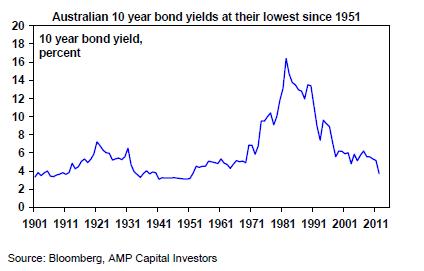
Bond yields in the UK, Japan and Germany are also running around generational lows, if not record lows.

What has driven bond yields so low?
The sharp decline in bond yields from the early 1980s can be largely explained by the shift from a high inflation to a low inflation world. The more recent fall to extreme lows reflects a combination of factors, flowing from the Global Financial Crisis and its aftermath.
- First, sub-par economic growth and benign inflation have further lowered equilibrium levels for bond yields.
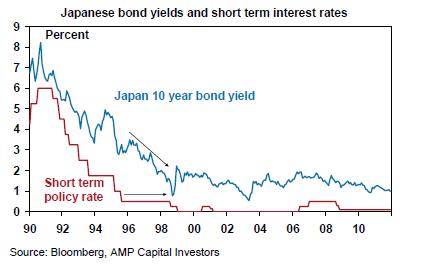
- Second, and related to this, market expectations for short term interest rates have been continuously revised down over the last few years. Several central banks have been cutting interest rates again since late last year (eg, the ECB, the RBA and central banks in emerging countries) while the US Federal Reserve, the Bank of England and the Bank of Japan have left interest rates near zero. Furthermore the Fed has indicated that rates are likely to stay near zero at least out to late 2014, after previously indicating out to mid 2013. The historical experience tells us that the longer short term rates stay low, the more likely it is that long term bond yields will converge on them as expectations of future short term rates are revised down. This is exactly what has happened in Japan over the last two decades, particularly during the 1996-98 period. The US, UK and Germany appear to be going through something similar

- Third, the US Federal Reserve and the Bank of England have been actively buying government bonds as part of their quantitative easing programs, which are designed to keep private sector borrowing rates as low as possible and encourage banks to lend. This, and the expectation of more to come following recent comments from the US Federal Reserve, has had the effect of keeping bond yields lower than might otherwise have been the case.
- Fourth, the US Federal Reserve introduced “Operation Twist” which involved selling short term bonds and buying long term bonds in September last year in order to further keep down long term bond yields and hence private sector borrowing costs.
- Finally, safe haven demand for bonds from investors has been boosted in response to the worries last year about another global economic downturn, partly resulting from the intensification of the debt crisis in peripheral European countries. In this regard it’s worth noting that sovereign bonds in perceived core countries have been the best safe haven through recent bouts of share market turmoil. As such they have been in strong demand as a diversifier.
What about Australian bond yields?
Australian long term bond yields are a function of the level of bond yields globally and particularly in the US, expectations regarding short term interest rates as set by the RBA and perceptions regarding the riskiness of Australian government bonds. All of these have been pointing lower recently.
- Global and US bond yields have been falling for the reasons noted above.
- The Reserve Bank started to cut interest rates late last year and is expected to cut further.
- Australia is one of a diminishing group of 11 countries to still have a safe AAA sovereign credit rating. This has resulted in safe haven demand for Australian bonds, subsequently benefiting the Australian dollar.
Not a bubble, but not good value
Given the sound fundamental reasons for bond yields being so low it’s hard to agree they are in a bubble. Similarly, it’s unlikely we will see a big change in many of the fundamental factors that have pushed bond yields down any time soon. The global economic recovery is likely to remain anaemic and fragile for a while yet, global inflation is likely to fall further on the back of high levels of spare capacity, short term interest rates are expected to either remain low or fall further depending on the country, and further quantitative easing is likely in the US, UK and probably Europe. In Australia, the RBA has further easing ahead of it and safe haven demand for Australian bonds may have further to go as more countries are at risk of losing their AAA rating. Given this, it’s hard to get particularly bearish on bonds.
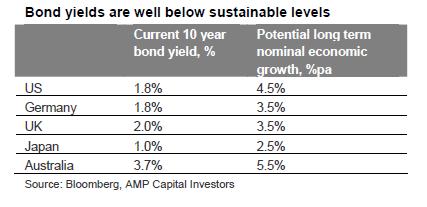
Against this though, bond yields at generational or record lows are poor value. (In the same way shares would be, for example, if dividend yields and earnings yields were at record lows.) Over the long term there is a rough relationship between bond yields and long term nominal economic growth (inflation plus real economic growth). The following table looks at current ten year bond yields relative to our assessment of their long term value based on each countries’ potential long term nominal GDP growth. On this basis, bond yields are well below long term sustainable levels.

Furthermore when bond yields are low, strong returns can only be had if yields fall further. This is what happened last year in Australia, for example, where the 10 year bond yield fell from 5.6% at the start of the year to 3.7% at the end, resulting in roughly 8% of capital growth for investors who held such bonds. Now with Australian bond yields much lower and sub 2% elsewhere, it’s now very hard to see this being repeated, unless there is a complete meltdown in Europe resulting in a return to global recession.
If bond yields track sideways, returns will be no more than current yields, eg, 1.8% in the case of US 10 year bonds and 3.7% in the case of Australian 10 year bonds. Alternatively, if bond yields back up by say just 1%, which will still leave them well below long term fair value measures, investors will suffer roughly a 4% capital loss taking returns negative.
What does this all mean for investors?
Global central banks want to keep bond yields low until a sustainable recovery is clearly underway. This might take some time so it would be premature to bet on a bear market in bonds. Similarly, sovereign bonds are a good diversifier in times of worries about the growth outlook so a core exposure should still be retained given that event risk still remains high regarding the European debt crisis.
However, against this, now is not the time to be boosting core country sovereign bond exposures. They have already rallied hard and the scope for further falls in yields, which would be necessary to provide decent capital growth and hence returns, is limited. By contrast, better medium term return opportunities exist elsewhere for investors:
- Investment grade corporate bonds in Australia are yielding around 6.5% on average.
- Australian listed real estate trusts are yielding around 6.2%.
- Australian shares are yielding 6.3% once franking credits are added in.
With the global growth outlook improving and tail risks associated with a blow up in Europe receding somewhat, the prospects for these assets has improved compared to sovereign bonds in core countries which now have very low yields and hence more constrained return prospects.
Within fixed interest, Australian bonds with their higher yields probably make them better value than global bonds.
So overall, while there is still a strong case to include sovereign bonds in a multi asset portfolio as a diversifier, it makes sense to lighten exposures in favour of assets providing better yields and return prospects.