Renewed fear of a disorderly Greek default and exit from the euro has been a major driver of a flight to safety and falls in share markets recently with global shares falling 10.6% from this year’s highs, Asian shares falling 10.9% and Australian shares falling 8.8%. This raises numerous questions this note seeks to address.
How likely is a Greek exit from the euro?
Greece’s debt debacle has been going for two & a half years now and each crisis seemingly brings it closer to leaving the euro. However, an imminent Greek exit is not a foregone conclusion and depends on the June 17 election.
Scenario I – A victory by the main anti bailout party, Syriza, would likely take it down the exit path. If Syriza doesn’t moderate its stance, the EU and IMF will likely turn off funding in which case Greece will likely start defaulting in early July. To survive it will want to start printing its own currency – hence exiting the euro. Alternatively, Syriza may back down (unlikely) or the EU and IMF may substantially soften the terms of the Greek bailout (unlikely, but possible) in which case Greece may stay in for now.
Scenario II – A victory by pro-bailout parties New Democracy and Pasok would see the bailout agreement implemented (maybe with some tinkering) and Greece stay in for now. However, deep recession and austerity fatigue could all mean that, in the absence of a further assistance, Greece will struggle to reach its deficit targets and might still decide to leave by year end. But for now crisis would be averted.
78% of Greeks still want to stay in the euro, suggesting Scenario II is more likely. Nevertheless, recent polls are very close, which is consistent with market odds which are around 50/50 that Greece will exit soon. The bottom line though is that an imminent Greek exit is not certain.
What would be the path to exit?
The path to exit would be simple in theory. The Greek Government decides to leave, ideally in secret. It makes an announcement that it is exiting and immediately closing all banks to prevent a run on them. A new currency (“New Drachma”) would be printed and circulated. All prices, contracts and bank deposits would be redenominated in the New Drachma. Of course it wouldn’t be simple. Greek citizens would likely get wind of an exit as a result of the political process, eg if Syriza looks like forming Government or relations breakdown with the EU/IMF, and withdraw their euro denominated bank deposits for fear the New Drachma will collapse, thereby triggering a banking crisis.
What would be the cost of exit to Greece?
The short term cost to Greece of exiting would be huge. The absence of support from the EU and IMF will mean much more austerity than is currently the case as it will have to immediately balance its budget. The New Drachma would likely fall 50% or more (Argentina and Russia saw their currencies fall by 75% after their defaults), setting off a brief bout of hyperinflation. A collapse in the banking system would be likely as citizens withdraw their euro denominated funds en masse in anticipation of devaluation. The combination of all this would likely result in an initial GDP slump of around 15%, pushing unemployment beyond 30%.
Greece would also have to default on a big chunk of its debt – even after the recent debt write downs projected Greek public debt of 120% of GDP by 2020 is too high to be sustainable. If the New Drachma falls 50% this ratio will double and be impossible to service. So a default on the bulk of its debt would be likely. Countries that go through such defaults – eg, Argentina in 2001 – usually find themselves locked out of global capital markets for many years.
After 10 years Greece will probably be better off following an exit as currency depreciation works its magic on exports, but in the interim the economic and social pain will be huge.
What’s the impact on the rest of Europe?
As a result of recent haircuts and write downs private sector exposure to Greece has already been substantially cut to around €100bn (split roughly equally across sovereign debt and the Greek private sector). An 80% loss on these investments reflecting currency depreciation and increased default should be manageable.
However, the European public sector will lose much more as it has a roughly €300bn exposure to Greece via the ECB and EU loans. Assuming an 80% loss here would translate to roughly €240bn. Of course it would be the full €300bn if Greece defaults in full. Incidentally this loss would compare to a loss of around €60bn-100bn if it was decided to simply write down Greek debt to a more sustainable level while staying within the euro. So it would be much cheaper for Europe if Greece stayed within the Euro-zone.
However, the real threat to the rest of the Euro-zone would come via contagion to other countries. If Greece heads for the exit, fears will grow that Portugal, Ireland, Spain and maybe Italy will do the same. There are two key threats here: upwards pressure on bond yields in these countries boosting their borrowing costs as investors seek to reduce their positions and runs on banks as citizens start to fear a euro exit and currency collapse.
Ireland and Portugal are supposed to start borrowing in the market again from 2013 which will be impossible if investors fear they may follow Greece in exiting the euro. And the latest Greek crisis has already seen bond yields in Spain and Italy surge back to levels at which the spread to German bond yields triggered bailouts for Ireland and Portugal.
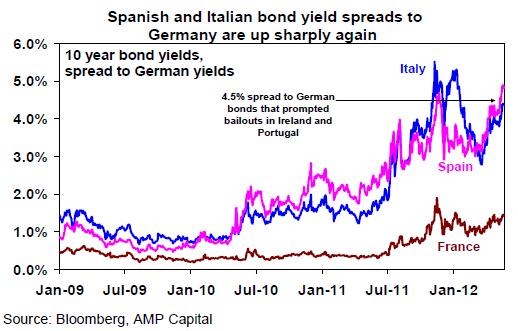

A run on banks in such countries would be even far more problematic. Irish and Portuguese banks are most at risk given they would be seen as closest to exiting, but Spain is also highly vulnerable as its banks need recapitalising.
So while the direct public & private cost to Europe associated with losses on Greek holdings may be around €300bn it would be much more if there is a flow on to other countries.
These sort of costs along with a further sharp blow to confidence and disruptions to banking systems if allowed would risk turning a mild recession this year in Europe (with GDP of -1%) into a deep recession (say a 5% contraction).
What would this mean for global growth?
Deep recession in Europe will affect the rest of the world via trade, the global financial system (including trade finance, 80% of which comes from European banks) and confidence. The Euro-zone takes roughly 25% of US exports and 20% of Chinese exports. Rough estimates suggest that a 5% contraction in the Europe would knock 0.6% off US growth, 2% off OECD growth (probably knocking it into recession), 0.5% off Chinese growth and 1.25% off world growth.
What should and will policy makers do?
Quite clearly the cost of a disorderly Greek exit for Europe and the global economy is potentially very large. It would make more sense to keep Greece in the euro (hence G8 support for that on the weekend) or if it is to leave, intervene heavily to limit the damage. To date the policy response in Europe has suffered from a dangerous mix of fears about moral hazard, an Austrian economics obsession with austerity which has made things worse, inflation paranoia, political divisions and complacency. There are several things policy makers in Europe need to do:
- First, slow the pace of fiscal austerity to reduce downwards pressure on economic growth. Related to this, cut Greece a bit more slack as it’s cheaper to keep it in the euro.
- Second, the ECB to ease monetary policy aggressively – cutting the official interest rate to 0.5% and undertaking aggressive quantitative easing (ie buying bonds across Europe). Note the US, UK and Japan have worse public debt problems but quantitative easing has headed off any funding problems and has done so without much inflation.
- Third, allow the European bailout funds (soon to be the European Stability Mechanism or ESM) to directly recapitalise banks in Spain and elsewhere (much as TARP was used to recapitalise US banks in 2008) rather than have the individual governments borrow the money which will only add to concerns about their public debt.
- Fourth, turn the ESM into a bank so it can borrow from the ECB and have unlimited firepower, beyond €500bn.
- Finally, provide an immediate guarantee of bank deposits backed by the ECB or ESM. This would stop any run on the banks (just as similar guarantees did in the GFC including in Australia). It would need to be backed by a Euro-zone institution like the ECB as individual governments in Spain, etc, are not perceived as strong enough. It would also provide an incentive for Greece to stay in the euro.
Germany has been reluctant to implement these policy options but if it comes down to saving the euro the odds are it will relent. As always it may take more bad news. But if Europe does put some of the above in place it could be the case that a Greek exit (if it occurs) is followed by a rebound in confidence as the much feared disaster is averted.
Why is Australia impacted?
Less than 10% of Australia’s exports go to Euro-zone. But developments there impact Australia indirectly via our trading partners (such as China which sees 20% of its exports go to Europe), confidence and global financial markets as banks and other companies obtain funding in such markets. To the extent the share market falls in response to these concerns it also has a negative impact on household wealth and spending. A rough estimate is that a 5% fall in Euro-zone GDP, were it to occur, would knock 0.4% off Australian economic growth. Fortunately Australia is in a better position to withstand any onslaught as there is lots of scope to cut the cash rate, there is scope for fiscal stimulus if needed, a lower $A will provide a boost to competitiveness, corporate gearing is low, household saving is high and mining investment projects have a long way to go before completion.
Why does $A fall on global growth scares?
In recent years short term swings in the $A have been correlated with the share market – the $A fell 39% during the GFC, 13% during the double dip worries of 2010 and 14% during last years double dip worries. So the latest plunge is nothing new. There are three reasons why the $A is sensitive to global investor confidence. First, as 70% of Australia’s exports are commodity related anything that is seen as threatening global growth, threatens commodity prices and hence the $A. Second, in times of uncertainty investors unwind positions in high yielding currencies like the $A. Third, in times of uncertainty the $US gains as most global lending and trade is conducted in it & this sees the $A fall. The $A will likely rebound again once share markets bottom.
What are the positives?
The next few months are likely to remain rough until Greece’s situation is resolved and/or we see how policy makers respond. But there are several positives compared to last year when markets fell 20% from April/May highs to October lows or during the GFC when shares fell by 55%. US housing and manufacturing are stronger, Japan is growing, we haven’t seen the surge in oil prices that occurred prior to both the GFC & last year, shares are cheaper, sovereign bonds are more expensive making them less attractive, monetary conditions are easier and policy is actually easing in China, emerging countries and Australia.
Concluding comments
In terms of markets, our view is that shares are significantly oversold and due for a bounce but that the next few months may remain rough. However, attractive valuations and further policy easing are likely to see shares higher by year end.